
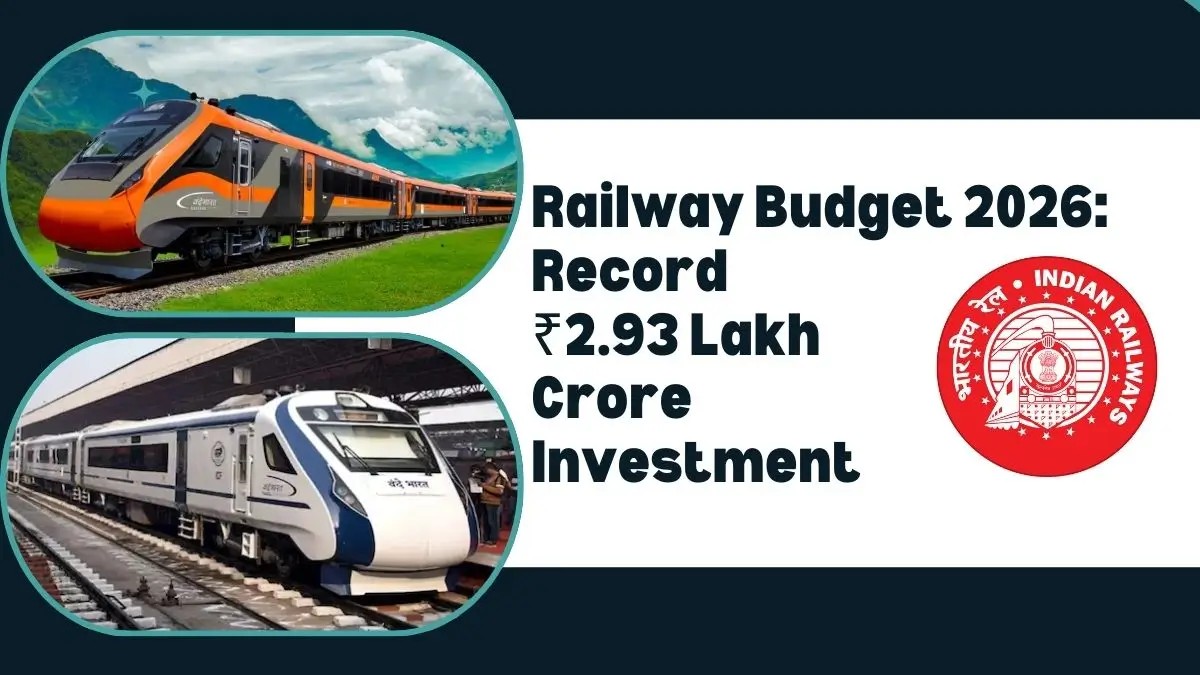
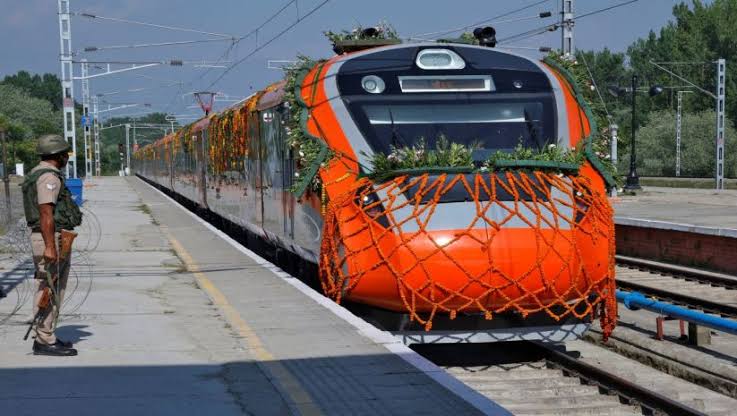

A major highlight of the budget is the announcement of seven new high-speed rail corridors spanning nearly 4,000 kilometres across the country. These corridors are being developed as long-term “growth connectors” to reduce travel time and promote green mobility.
The proposed routes include Mumbai–Pune, Pune–Hyderabad, Hyderabad–Bengaluru, Hyderabad–Chennai, Chennai–Bengaluru, Delhi–Varanasi, and Varanasi–Siliguri. According to Railway Minister Ashwini Vaishnaw, these corridors together are expected to attract investments worth nearly ₹16 lakh crore.
South India to Gain from High-Speed Diamond Network
In southern India, the Chennai–Bengaluru–Hyderabad network will form a high-speed triangle, often referred to as the South High-Speed Diamond. This network will connect major IT and industrial hubs across Karnataka, Telangana, Andhra Pradesh, Tamil Nadu, Kerala, and Puducherry.
Travel time between Chennai and Bengaluru is expected to reduce to about 1 hour and 13 minutes, while Bengaluru–Hyderabad will take nearly 2 hours. Chennai–Hyderabad journeys are projected to be completed in under 3 hours, significantly boosting regional mobility and economic integration.
East–West Dedicated Freight Corridor Boost
The budget also proposes a new 2,052-kilometre-long Dedicated Freight Corridor (DFC) connecting Dankuni in West Bengal with Surat in Gujarat. The corridor will pass through Odisha, Chhattisgarh, Madhya Pradesh, and Maharashtra, strengthening east–west trade flows.
This corridor will integrate with the existing Western DFC and ease pressure on saturated freight routes. Officials noted that the existing Eastern and Western DFCs are already operating near full capacity, handling nearly 400 freight trains daily.
₹1.20 Lakh Crore for Safety
Safety remains the top priority for Indian Railways, with nearly ₹1.20 lakh crore earmarked exclusively for safety-related works. The investment will be used for track renewal, rolling stock maintenance, signalling upgrades, and expansion of the Kavach automatic train protection system.
The government highlighted that sustained safety investments have already reduced railway accidents by nearly 95 percent over the years. Further deployment of CCTV cameras, station redevelopment, and improved passenger amenities are also planned.
‘Make in India’ Rail Technology Goes Global
Highlighting India’s growing technological capability, the Railway Minister said propulsion systems designed and developed domestically are now being exported to countries such as the United States, Germany, France, Switzerland, and Spain.
Manufacturing of Vande Bharat sleeper and chair car trains, Amrit Bharat trains, Namo Bharat trains, and wagons is progressing at an unprecedented pace, reinforcing India’s position as a global rail manufacturing hub.
Sustainability and Nation-Building
Emphasising sustainability, the government reiterated that rail transport is nearly 95 percent less polluting than road transport. With electrification now covering over 99.5 percent of the broad-gauge network, railways is aligned with India’s climate commitments.
The record allocation reaffirms Indian Railways’ role as a pillar of Viksit Bharat, promising faster connectivity, efficient logistics, and inclusive growth.