
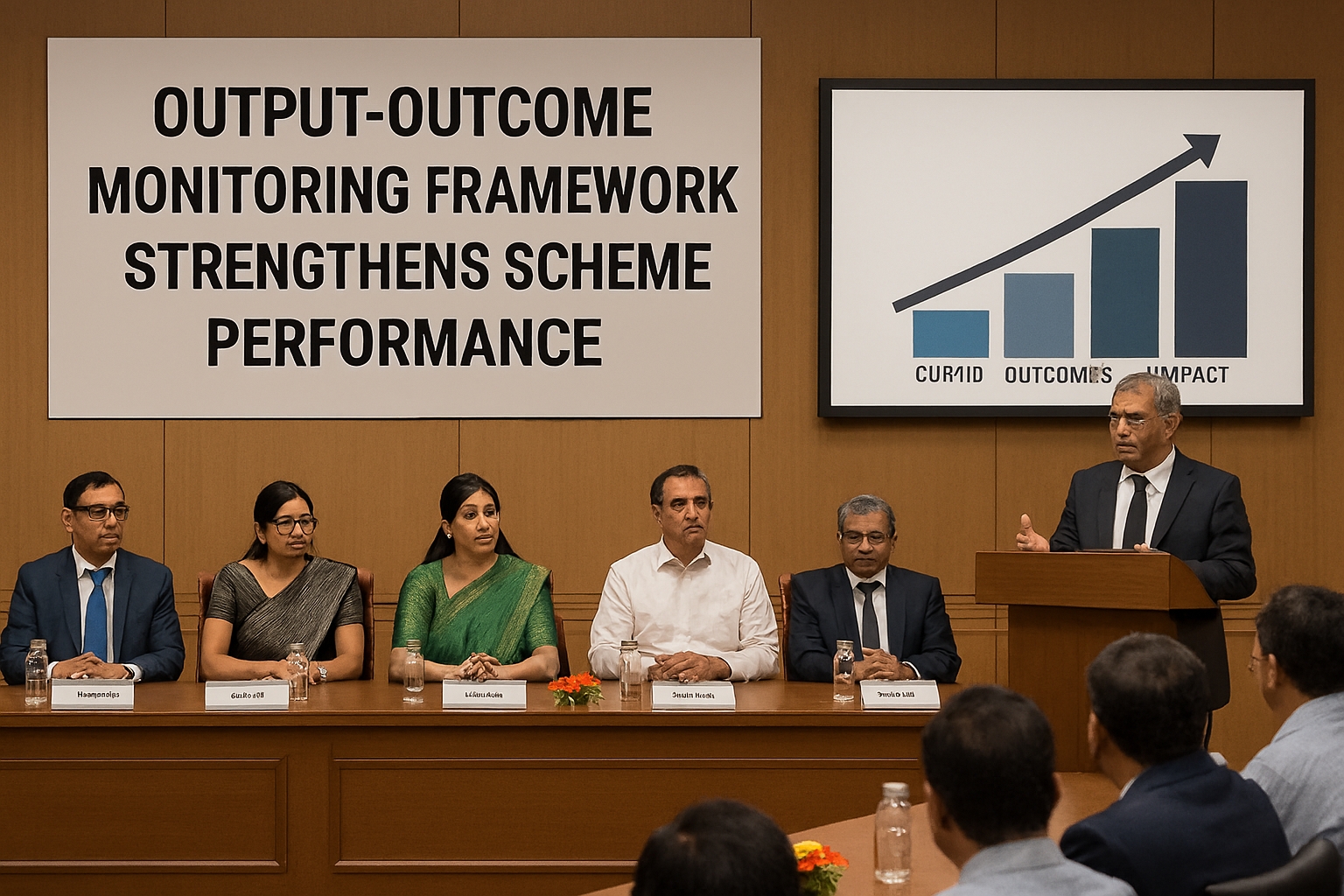

The Development Monitoring and Evaluation Office (DMEO) under NITI Aayog plays a central coordinating role in the preparation of the Output-Outcome Monitoring Framework. DMEO works closely with individual ministries and departments to compile annual OOMF documents for their respective schemes.
These documents are laid before Parliament every year alongside the Union Budget in the form of an Outcome Budget. For schemes with an annual outlay of ₹500 crore or more, inclusion in the Outcome Budget is mandatory, ensuring parliamentary oversight of high-value public expenditure.
Monitoring of Smaller Schemes
For schemes with budgetary allocations below ₹500 crore, the responsibility of placing the Output-Outcome Monitoring Framework before Parliament rests with the concerned ministry or department. These OOMF documents are presented along with the Detailed Demands for Grants during the budgetary process.
This ensures that even relatively smaller schemes are subject to outcome-based scrutiny, reinforcing the government’s commitment to result-oriented public spending across sectors.
Tracking Outputs and Outcomes
Under the OOMF system, ministries and departments track the physical and financial progress of both Central Sector (CS) schemes and Centrally Sponsored Schemes (CSS). The framework focuses on predefined Key Performance Indicators (KPIs) that measure outputs such as infrastructure created or services delivered, as well as outcomes reflecting broader socio-economic impact.
Regular monitoring of these indicators allows implementing agencies to identify gaps, delays or inefficiencies early and make corrective interventions to improve scheme performance.
Improving Policy Design and Delivery
One of the most significant benefits of OOMF-based monitoring is its role in strengthening policy design and delivery mechanisms. Ministries are guided by findings and recommendations from evaluation studies conducted on various schemes.
These insights help refine implementation strategies, redesign components that underperform and ensure that public resources generate maximum impact. The framework thus supports evidence-based policymaking rather than input-driven expenditure.
Enhancing Accountability and Governance
By linking financial outlays to measurable outcomes, the Output-Outcome Monitoring Framework enhances accountability at all levels of government. It empowers policymakers, legislators and citizens to assess whether public funds are translating into tangible benefits on the ground.
The framework also strengthens cooperative federalism, as centrally sponsored schemes require close coordination between the Centre and states, with shared responsibility for achieving agreed outcomes.
Parliamentary Oversight and Transparency
Presentation of OOMF documents in Parliament ensures transparency and informed debate on public spending priorities. Lawmakers can examine not only how much money is allocated to a scheme, but also what outcomes are expected and whether targets are being met.
This shift from expenditure-centric to outcome-centric budgeting marks a significant reform in India’s public financial management system.
Government’s Commitment to Results-Based Governance
The government reiterated that OOMF-based monitoring enables ministries to take timely decisions and improve implementation strategies. It reinforces the broader governance vision of focusing on outcomes, impact and value for money rather than merely tracking financial utilisation.
As India continues to expand public investment in infrastructure, social welfare and human capital, the Output-Outcome Monitoring Framework is expected to play an increasingly vital role in ensuring that development goals are met efficiently and transparently.