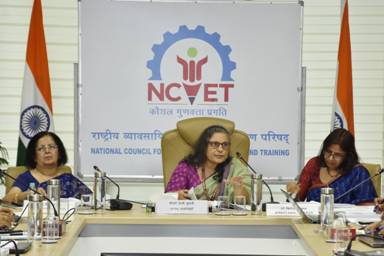
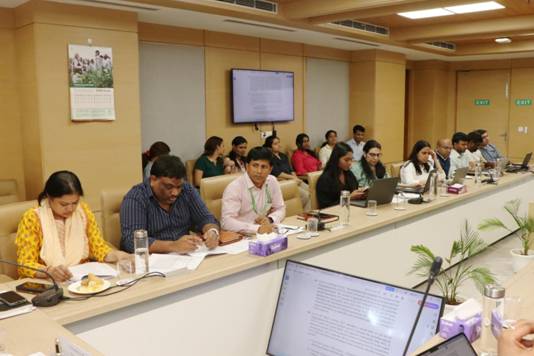
The 47th meeting of the National Skills Qualifications Committee (NSQC) was held on February 25, 2026, under the chairpersonship of Smt. Debashree Mukherjee, Secretary, Ministry of Skill Development and Entrepreneurship (MSDE) and Chairperson of the National Council for Vocational Education and Training (NCVET). The meeting reviewed 58 qualifications, National Occupational Standards (NOS), and micro-credentials aimed at enhancing India’s skill development ecosystem.
 Wide Participation from Ministries and Industry
The meeting saw participation from Prof. (Dr.) Ashok Kumar Gaba, Executive Member of NCVET, Dr. Suhas Deshmukh, Director and Secretary to the Council, and members from key central ministries including the Ministry of Rural Development and the Ministry of Labour and Employment.
Sector experts and representatives from recognized Awarding Bodies also attended, ensuring that decisions reflected both policy priorities and industry expectations.
58 Qualifications Reviewed
A total of 13 Awarding Bodies presented their proposals before the Committee. The NSQC examined 58 qualifications, including revised standards and micro-credentials, submitted by prominent sectoral bodies and institutions.
These included entities such as NASSCOM, Automotive Skills Development Council, Skill Council for Green Jobs, Infrastructure Equipment Skill Council, Confederation of Indian Industry (CII), Directorate General of Training (DGT), and others across sectors like mining, food processing, logistics, and information technology.
The review covered proposals for new qualifications as well as revisions and extensions of existing ones to ensure alignment with evolving market needs.
Focus on AI, Multi-Skilling and Sustainability
Addressing the meeting, Smt. Debashree Mukherjee emphasized the crucial role of NSQC in shaping a globally benchmarked workforce. She highlighted that the Committee’s deliberations reflect the Government’s commitment to strengthening both short-term and long-term skilling initiatives.
One of the major outcomes of the session was the reinforcement of Artificial Intelligence, multi-skilling, and sustainability within the vocational training ecosystem. The Committee underscored the need to equip trainees with competencies required for a technology-driven and environmentally conscious economy.
The revised Employability Skills module now integrates components related to greening practices and Artificial Intelligence. These additions are designed to benefit trainees under the Craftsmen Training Scheme (CTS) and other skill development programs.
Strengthening the National Skills Architecture
The National Skills Qualifications Committee operates under the broader framework of NCVET, which regulates and standardizes vocational education and training across India. By reviewing qualifications and ensuring adherence to quality benchmarks, the Committee plays a pivotal role in strengthening India’s skills architecture.
Officials noted that structured consultation with industry bodies ensures that training programs remain demand-driven. This alignment enhances employability and supports India’s ambition to become a global skills hub.
Further information on qualifications and regulatory frameworks can be accessed through the official portals of the Ministry of Skill Development and Entrepreneurship (https://www.msde.gov.in) and the Press Information Bureau (https://pib.gov.in).
Building a Future-Ready Workforce
The 47th NSQC meeting signals a continued push toward innovation and modernization within India’s skill development framework. By incorporating emerging technologies and sustainability principles, policymakers aim to future-proof vocational training systems.
As industries rapidly evolve, the emphasis on AI literacy, green practices, and cross-sectoral skills is expected to provide trainees with greater adaptability and career mobility. The Committee’s decisions are likely to influence curriculum design and certification standards nationwide.
With structured reviews and industry-backed standards, the NSQC continues to play a central role in ensuring that India’s workforce remains competitive, resilient, and globally relevant.