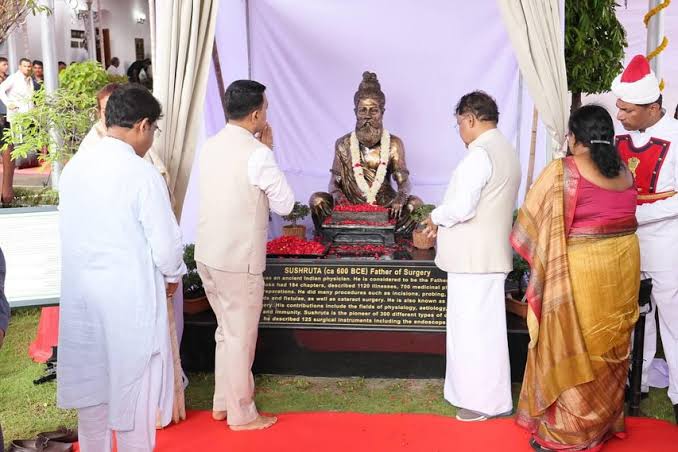
In a heartfelt and reflective address, the Vice-President of India unveiled statues of two legendary figures from India’s rich medical history—Sushruta and Charaka—at Raj Bhavan, Goa. This significant occasion was not just about commemorating two stalwarts of ancient Indian medicine but also about reviving a civilisational pride that has often remained obscured beneath the sands of time.
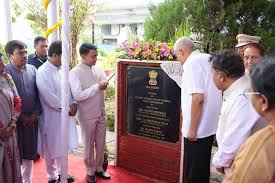
The event, held under the gracious presence of the Hon’ble Governor Shri P.S. Sreedharan Pillai and Chief Minister Dr. Pramod Sawant, brought together dignitaries, lawmakers, bureaucrats, and members of the armed forces. It was an emotional moment, charged with a sense of belonging, pride, and rediscovery.
The Vice-President eloquently connected the past to the present, highlighting how ancient India once stood as a beacon of scientific innovation and ethical healing. “Sushruta was not merely a surgeon; he was the world’s first known surgeon, performing complex procedures like plastic surgery, fracture management, and even caesarean deliveries centuries ago,” he noted with reverence. The intricate surgical tools of the era, as displayed in artistic depictions, amazed those in attendance and served as a testimony to India’s deep scientific roots.
Equally lauded was Charaka, the father of medicine, whose Charak Samhita remains a foundational text in Ayurveda. “These statues are not just commemorative pieces; they are living embodiments of India’s timeless medical wisdom,” the Vice-President remarked, urging the youth to reconnect with this invaluable heritage.
He acknowledged a pivotal transformation in India’s approach to traditional knowledge—pointing to initiatives like the establishment of the Ministry of AYUSH in 2014, and the global recognition granted by the WHO through its Traditional Medicine Centre in Gujarat. He praised India’s modern leadership for revitalising yoga on the global stage and for creating platforms where ancient sciences are not only respected but also rigorously studied and applied.
The Vice-President also reflected with sadness on the loss of ancient institutions like Nalanda, whose burning for weeks destroyed thousands of manuscripts. Yet he expressed optimism that India is now at a turning point, where these treasures are being rediscovered, digitised, and made relevant through research and interdisciplinary approaches.
With a message filled with both emotion and clarity, he reminded the audience that belief in the superiority of the West must be replaced with a renewed confidence in India’s own wisdom. “Let us not think that anything ancient is regressive. The world is learning from us now, and it is time we learnt from ourselves,” he said.
As the statues of Sushruta and Charaka stood gleaming under the Goan sun, they symbolised not just figures of the past, but lighthouses for the future—guiding a nation back to its roots and forward into a future built on the bedrock of its profound knowledge and ethical tradition.
It was a proud and poignant moment, a reminder that India’s past is not a relic, but a living source of strength and inspiration.