Indian Students Begin Transformative Science Journey in Japan
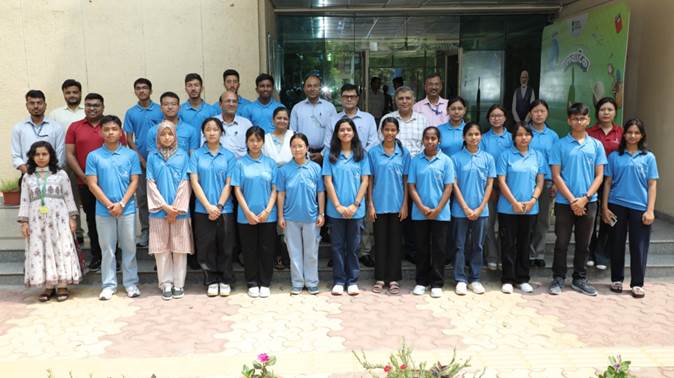
In a proud moment for Indian education and international cooperation, Shri Sanjay Kumar, Secretary, Department of School Education & Literacy (DoSEL), flagged off a group of 20 Indian students selected for the Sakura Science High School Programme 2025. The send-off ceremony was held in New Delhi on June 14, 2025, and witnessed the presence of key dignitaries, including Smt. Archana Sharma Awasthi, Joint Secretary, DoSEL, and Prof. Prakash Chandra Agrawal, Joint Director, NCERT.
These students will participate in a week-long immersive experience in Japan, from June 15 to June 21, alongside peers from Malaysia, Taiwan, and Ukraine.
 Representing India’s Diverse Educational Landscape
The 20 participating students—13 girls and 7 boys—hail from Jawahar Navodaya Vidyalayas and Government Schools located in the Andaman & Nicobar Islands, Ladakh, Mizoram, Nagaland, and Tripura. They are accompanied by two supervisors, making this initiative not just academically enriching but also representative of India’s vast cultural diversity.
Why the Sakura Science Program Matters
The Sakura Science Programme, launched by the Japan Science and Technology Agency (JST) in 2014, is officially titled the Japan-Asia Youth Exchange Program in Science. It aims to foster exchange and mutual understanding among youth in Asia through science, technology, and innovation.
India joined this esteemed program in 2016. Since then, 619 Indian students and 91 supervisors have had the opportunity to explore Japanese advancements in science and experience its rich heritage firsthand. The last Indian delegation visited Japan in November 2024.
A Step Towards NEP 2020 Goals
The initiative perfectly aligns with India’s National Education Policy (NEP) 2020, which emphasizes experiential learning, holistic development, and interdisciplinary exposure. According to NEP 2020:
“Learning should be holistic, integrated, enjoyable, and engaging in itself.”
Sakura Science enables this by taking students out of conventional classrooms and immersing them in global innovation ecosystems, thereby fostering curiosity, creativity, and cultural empathy.
Strengthening Bilateral Ties Through Education
At the flag-off, Shri Sanjay Kumar underscored how such programs are key to nurturing future innovators and building stronger Indo-Japanese relations. He urged the students to deeply value this opportunity and carry forward the insights gained to benefit their communities back home.
The Broader Picture: Education Meets Diplomacy
Educational exchange programs like Sakura are increasingly being recognized as soft power tools. Japan, with its cutting-edge research infrastructure and cultural depth, offers a conducive environment for students to envision global solutions for future challenges.
Moreover, Japan’s emphasis on discipline, innovation, and sustainability complements India’s aspirations under policies like ‘Atmanirbhar Bharat’ and Digital India.
Explore NEP 2020 goals on the Ministry of Education website
Image Suggestions:
Main/Featured Image:
Image: Group photo of flagged-off Indian students in front of the Ministry building
Caption: Indian students flagged off for Sakura Science Programme 2025
Alt text: Indian students selected for Sakura Science Programme with Ministry officials
Description: 20 students from diverse Indian states head to Japan for Sakura Science High School Exchange Programme 2025
Inline Image:
Image: Students participating in a science lab or cultural activity in Japan (from JST’s archive or representative image)
Caption: Indian students exploring Japanese science labs under Sakura Programme
Alt text: Indian students engaged in scientific activities during Sakura Science Programme
Description: Hands-on learning in Japanese science and tech labs as part of the Sakura Science experience
Conclusion: Bridging Borders with Knowledge
As these 20 bright young minds represent India in Japan, they are not just part of a scientific exchange—but of a larger mission. They carry the hope of building bridges between nations through knowledge, curiosity, and collaboration. This initiative is a shining example of how education can transcend borders and create a future-ready global generation.