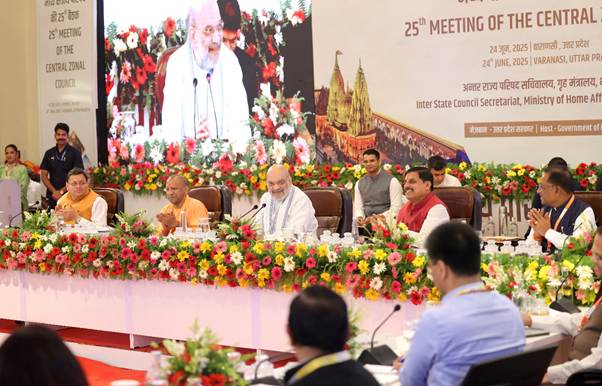
The gathering highlighted Prime Minister Narendra Modi’s transformative development model, while addressing key regional issues through consensus and coordination.
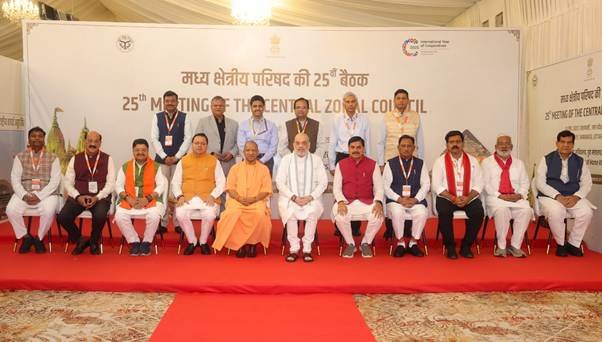 Council Adopts Resolution Honouring PM Modi and Armed Forces
At the start, Shri Amit Shah proposed a resolution lauding PM Modi’s leadership and the valour of the Indian Armed Forces. The resolution received unanimous support from all member states. Shah remarked, “Kashi, the world’s oldest living city, now stands as a symbol of both cultural heritage and modern development—thanks to the PM’s focused efforts as its MP.”
Central Zonal Council Sets Example of Unity
Shah praised the CZC for being the only zonal council without disputes among states, reflecting true cooperative federalism. He stressed that strong inter-state relations strengthen India’s democracy and governance structure.
Since 2014, CZC and its standing committees have convened 61 meetings—resolving around 1,287 issues. This is an 83% success rate compared to the 2004–2014 period, showcasing the increasing efficiency of the council’s mechanisms.
Key Issues Discussed at the Meeting
The council deliberated on 19 priority topics such as:
- Speedy justice via Fast Track Special Courts (FTSCs) for women and child-related crimes
- Improving banking access in rural areas
- Effective implementation of Emergency Response Support System (ERSS-112)
- Eradicating child malnutrition and reducing school dropout rates to zero
- Strengthening cooperatives and Gram Panchayat revenue models
Focus on Gram Panchayats and Cooperatives
Shri Amit Shah urged member states to boost Panchayat revenue by framing state-level rules. Strengthening Panchayati Raj institutions, he said, would make grassroots democracy more efficient and self-sustaining.
He also emphasized the need to revive and empower cooperatives to support rural livelihoods and promote self-reliance.
Zonal Councils Strengthen Federal Dialogue
The Central Zonal Council was established under the States Reorganisation Act, 1956. It includes member states like Uttar Pradesh, Madhya Pradesh, Uttarakhand, and Chhattisgarh.
Shah explained that while the CZC has an advisory role, it now acts as a vibrant platform for conflict-free dialogue, leading to tangible progress in key sectors.
Each Zonal Council comprises a rotating vice-chairperson (a state CM) and permanent committees of Chief Secretaries. Their role is to pre-screen issues before they reach the main Council, ensuring efficiency and better outcomes.
Vision 2047 and PM Modi’s Development Blueprint
Shah reiterated the Centre’s vision for Viksit Bharat @2047. He noted that CZC states must play a key role in this roadmap through better governance, innovation, and cooperation.
“The Prime Minister’s belief in competitive and cooperative federalism is being translated on the ground through councils like these,” Shah said, reinforcing Modi’s message that “strong states build a stronger nation.”
Conclusion
The 25th Central Zonal Council meeting underscored India’s commitment to decentralised, cooperative, and development-driven governance. With increasing inter-state consensus and proactive Centre-state engagement, the CZC continues to emerge as a model for collaborative federalism and sustainable progress.