What History Was Never Allowed to Tell
Before the world remembered Noah, the Vedic world revered Manu Maharaj-Satyavrat, the preserver of civilization through the greatest deluge – The Jal Pralay – in recorded memory.
What we often remember today as a mystical tale of a horned fish and a floating ark began as something much deeper and more real-a sophisticated maritime operation, guided by a totemic clan and driven by dharmic vision. This is not mythology. This is civilizational memory.
Maharaj Satyavrat: The Real Patriarch of Survival
Maharaj Satyavrat, acknowledged in Vedic tradition as the Manu of our current kalpa, was not a fictional character but a real king of high foresight. He is known for preparing for an imminent flood and ensuring the continuity of life, knowledge, and Dharma.
His role is more comprehensively explored in our companion article:
Vaivasvat Manu – The Patriarch of Post-Deluge Civilization.
📚 Recommended Reading:
This and other fascinating historical facts can be read in detail in the book
‘अनसंग हीरोज: इंदु से सिंधु तक’. by Devendra Sikarwar
The Flood Was Real: Shatapatha Brahmana’s Account
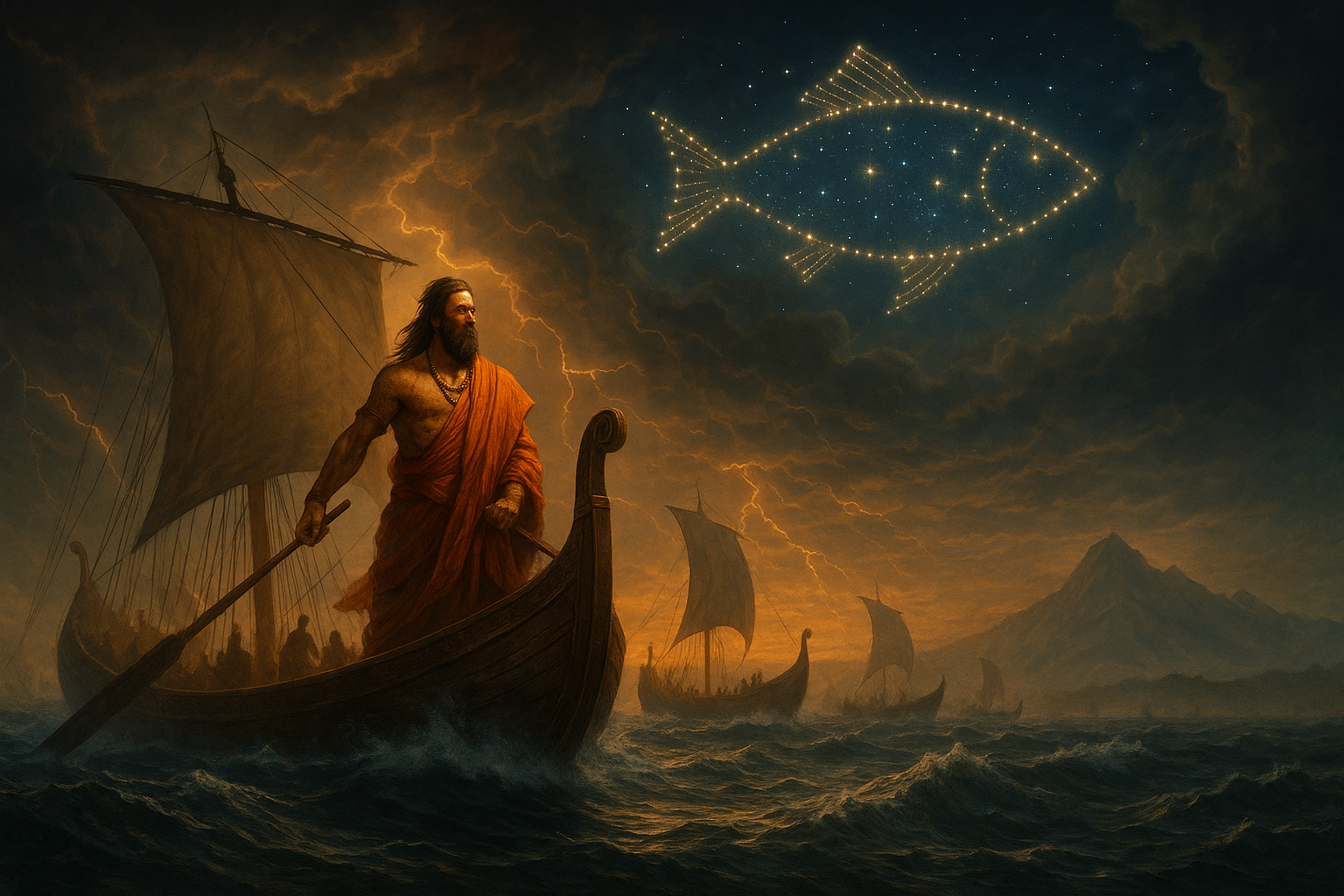
According to Shatapatha Brahmana (1.8.1), Manu was warned by a fish of an impending flood. The fish guided him to construct a boat. This account does not read like fantasy—it reads like a navigational strategy, with practical instructions and timelines.
There is no divine miracle described-no magical transformations or supernatural events-just a leader acting with wisdom, aided by advanced maritime guidance.
The Matsya Clan: Totemic Tribe of Sea Guardians
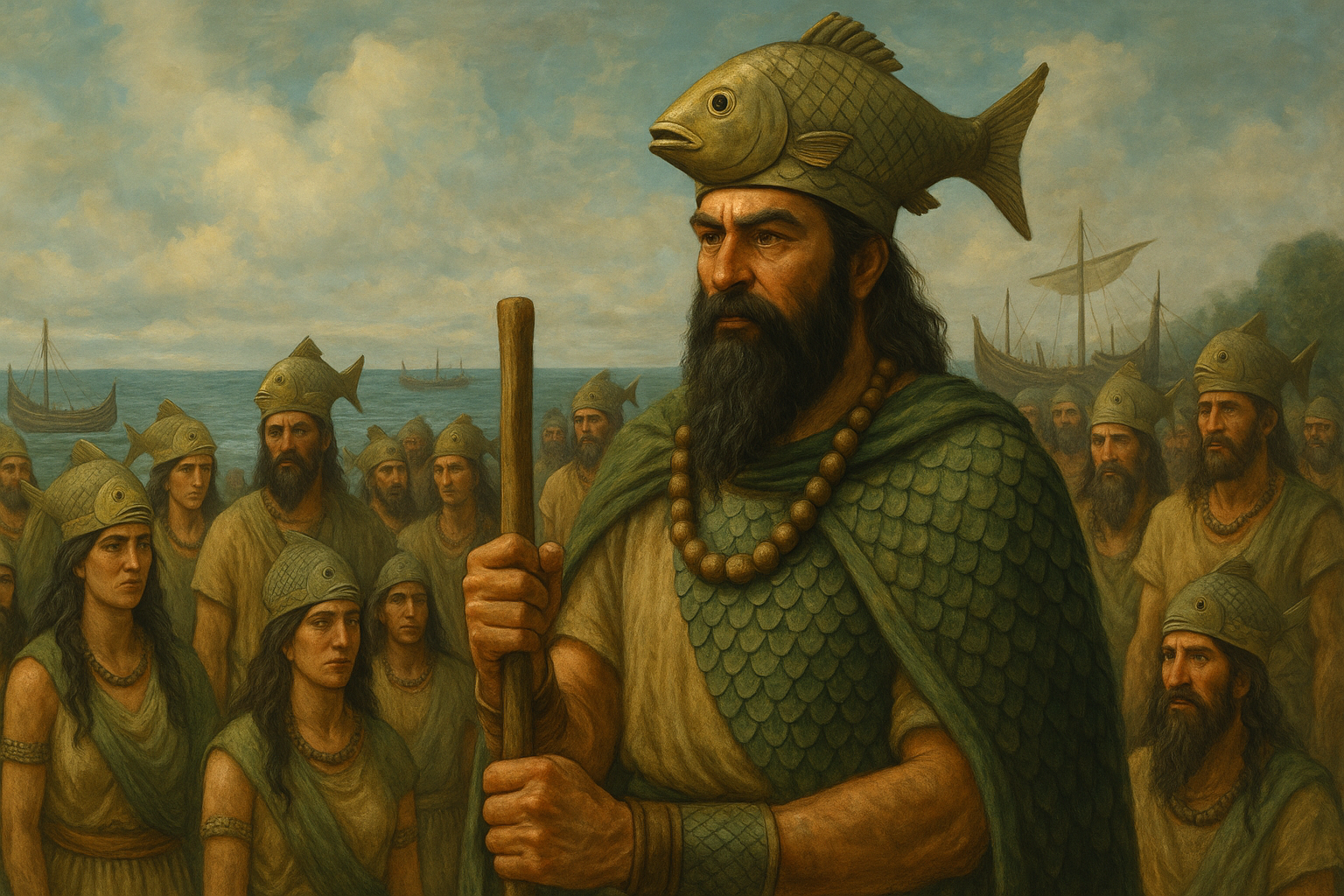
Later mythologized as a literal fish (Matsya Avatar), this figure originally represented a clan: the Matsyas-a totemic maritime tribe revered for their deep seafaring knowledge. These people may have considered the fish their sacred symbol, a marker of their role as navigators of waters and saviors during floods.
They were the unsung heroes behind the successful relocation of Manu’s convoy-a fleet, not a lone ark. Their knowledge of rivers, oceans, celestial navigation, and weather enabled them to guide this convoy from submerged territories to what we now understand as the northern Indian subcontinent, likely along the Saraswati basin.
The Convoy of Civilization
Unlike the Western depiction of a lonely man and a wooden vessel, the Vedic memory paints a picture of a collective mission. Manu wasn’t alone. He was accompanied by sages, rishis, sacred texts, grains, medicinal herbs, animals, and blueprints for society’s reconstruction.
This was not escape. It was preservation. And it was guided with intention. The Matsya tribe became the escort-an entire naval fleet moving through chaos to continuity.
‘Avatar’ as Title of Reverence
In the Vedic tradition, ‘Avatar’ was not merely a divine descent, but a recognition-a reverential title given to those whose contributions were cosmic in impact. To preserve Dharma was no ordinary task. In this spirit, the Matsya leader was honored as the first Avatar of Vishnu-not for miracle, but for mastery.
This was Bharat’s way of saying: “You saved us all.”
Much like today’s Bharat Ratna or Nobel Peace Prize, this title carried the highest honor-meant to inspire generations, not confuse them with fantasy.
Lost in Translation: Enter Noah
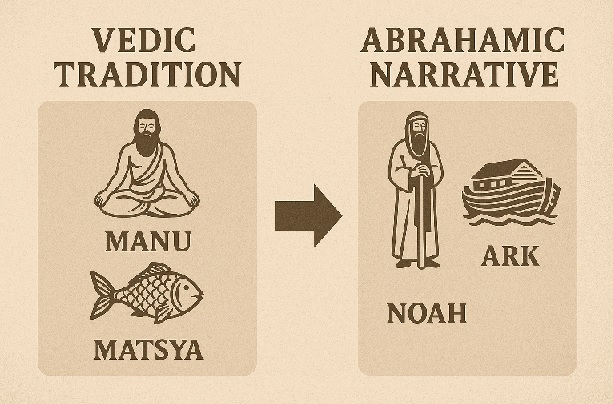
Centuries later, the Abrahamic traditions absorbed fragments of this memory. Noah (or Nooh) became the lone savior. The ark floated, animals came in pairs, and the world was saved. But conspicuously absent was any reference to a guiding tribe, a collective mission, or a dharmic foundation.
In this retelling, Manu’s name disappeared. The Matsya tribe was erased. What remained was a simplification-a metaphor without source, a story without roots.
Why It Matters
This shift wasn’t just about names-it was about perspective. The Vedic worldview emphasized collaboration, preparation, and sacred duty. The Abrahamic version shifted toward obedience, chosen-ness, and judgment.
Both are stories of survival. But only one retains the memory of collective dharmic action.
The Slippery Slope of Mythification
Over time, even in Bharat, the original memory began to blur. The Matsya leader became a talking fish. The fleet became a boat. The science became fantasy. Whether this distortion was accidental or engineered is a question scholars continue to explore.
But one thing is clear: when real heroes are buried under symbols, future generations lose clarity—and with it, their roots.
Reconstructing the Original Narrative
We are not dismissing stories. We are reviving the truths behind them. Ancient memory often used poetic metaphors. But it is now the responsibility of dharmic minds to decode them-and distinguish reverence from confusion.
Cross-referencing Vedic texts, oral traditions, archaeological evidence, and comparative mythology reveals a compelling truth: the story of Manu and Matsya is not fantasy-it is a legacy.
Restoring Honor to the Matsya Legacy
It’s time to give credit where it’s due. To acknowledge that the survival of Dharma was not the work of miracles, but of minds. That the first ‘Avatar’ was perhaps not an incarnation, but a leader who led humanity through the darkest waters.
Let us restore the dignity of our history—not just with belief, but with clarity.
Click here for the Hindi version – हिंदी लेख पढ़ें।
Also Read: Vaivasvat Manu – The Patriarch of Post-Deluge Civilization
Disclaimer: This article has been created on a best-effort basis, drawing from traditional sources, scholarly interpretations, and cultural understanding. Readers are welcome to suggest corrections or enhancements with credible, fact-based references. We honor all sincere contributions toward historical clarity and dharmic truth.