Dual Conduction in Altermagnet CrSb Could Reshape Electronic Design
A new discovery by Indian scientists could redefine how we build future electronic devices. Researchers at the S N Bose National Centre for Basic Sciences (SNBNCBS) in Kolkata have uncovered a rare dual behavior in chromium antimonide (CrSb), a standout altermagnet.
What Makes Altermagnets Unique?
Altermagnets are a newly identified class of magnetic materials. They combine the strengths of ferromagnets and antiferromagnets. Unlike traditional magnets, which display clear magnetic fields, altermagnets lack external magnetism. However, inside, their electrons behave in ways that are ideal for spintronics, a technology that manipulates the spin of electrons instead of their charge for data processing.
Among known altermagnets, CrSb excels. It sustains magnetic order at over twice room temperature. Its spin-splitting capacity exceeds 30 times the standard benchmark. These traits make CrSb one of the most practical candidates for real-world use.
 CrSb’s Dual Conduction Surprise
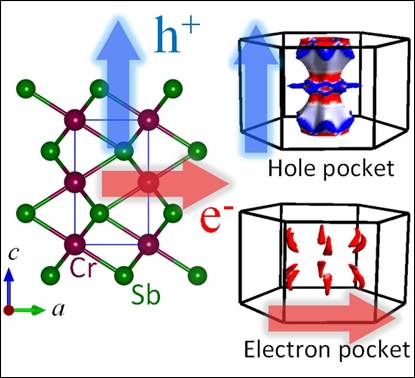
In a remarkable twist, scientists observed that CrSb changes its conduction mode depending on current direction. When current flows within its crystal layers (like reading along a page), it behaves like an n-type conductor, using electrons. When current flows across the layers (like flipping pages), holes carry the charge, making it a p-type conductor.
This rare behavior is called Direction-Dependent Conduction Polarity (DDCP). So far, no other altermagnet has displayed this property.
🔬 “This duality challenges traditional material classification and simplifies future electronics,” said a senior researcher at SNBNCBS.
Why This Matters for Electronics—and the Environment
CrSb has the potential to revolutionize electronic design. Currently, engineers must blend materials or introduce foreign elements to achieve both p-type and n-type behavior. CrSb does it naturally, removing the need for complex structures.
Key benefits include:
- Simpler and smaller device designs
- Reduced manufacturing cost and time
- Improved performance and energy efficiency
CrSb also uses earth-abundant, non-toxic elements. This makes it an eco-friendly choice in the push for sustainable technology.
🧪 “It’s rare to find a single material this multifunctional and still environmentally safe,” said one of the researchers.
Altermagnets & Spintronics: A Natural Fit
Spintronics is emerging as a powerful alternative to traditional electronics. Devices in this field rely on electron spin rather than charge. CrSb’s unique magnetic and electrical behavior fits well with spintronic applications. It can power devices that are smaller, faster, and far more efficient.
The journal Advanced Science recently published this breakthrough, placing Indian research at the global forefront of magnetism and materials science.
A Compact and Greener Tomorrow
This breakthrough by SNBNCBS scientists opens new paths for building sustainable, high-performance electronics. With its dual conduction and unique magnetic properties, CrSb promises to simplify device design while minimizing environmental impact. As further studies advance, this material may anchor the next generation of smart, green technology.