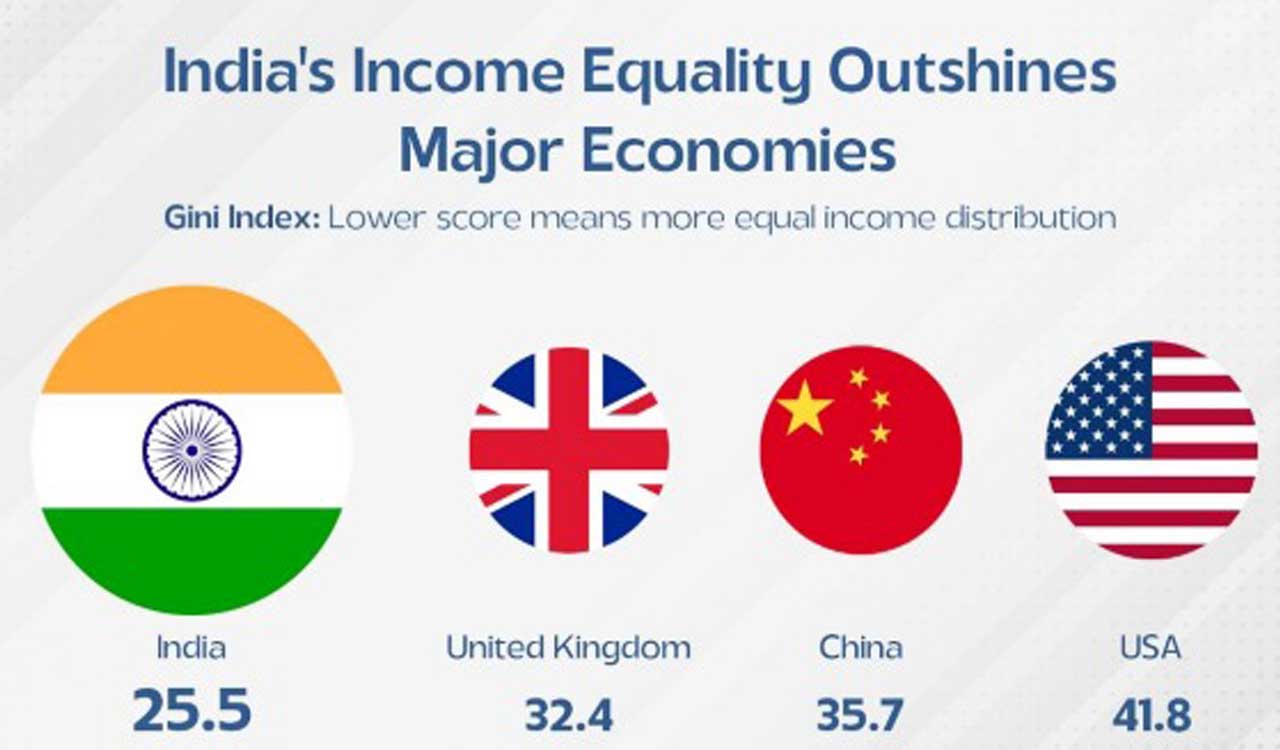
In a major recognition of its inclusive growth model, the World Bank has ranked India as the fourth most equal society in the world, according to its Spring 2025 Poverty and Equity Brief. With a Gini Index of just 25.5, India now outperforms the United States (41.8), China (35.7), and every G7 and G20 country in terms of income equality.
A Decade of Inclusive Growth
This achievement follows more than a decade of focused economic reforms and welfare outreach. Between 2011 and 2023, the World Bank estimates that India lifted 171 million citizens out of extreme poverty. The country’s poverty rate fell sharply from 16.2% to just 2.3%, based on the international poverty line of $2.15 per day.
The narrowing income gap demonstrates India’s firm commitment to inclusive development. Back in 2011, the Gini Index stood at 28.8 — already ahead of many global peers. Since then, a 3.3-point drop underscores the impact of India’s digital governance and targeted welfare strategies.
 What’s Driving This Transformation?
Several policy instruments have collectively fueled this change. The government’s emphasis on direct, digital, and grassroots-level support plays a key role. According to the Ministry of Social Welfare, major schemes include:
- PM Jan Dhan Yojana: Over 55 crore citizens now hold bank accounts for financial inclusion.
- Aadhaar Digital ID: Authorities have linked over 142 crore individuals under a universal digital identity system.
- Direct Benefit Transfer (DBT): The government has saved ₹3.48 lakh crore by March 2023 through leakage-free digital transfers.
- Ayushman Bharat: Over 41 crore people now benefit from the world’s largest public health insurance scheme.
- Stand-Up India & PM Vishwakarma Yojana: These schemes provide capital and training to first-time entrepreneurs and artisans.
- PMGKAY: Nearly 80 crore Indians received free food grains during the pandemic and beyond.
India’s Model vs the World
India’s digital-first approach to welfare delivery now sets a global standard. In contrast, many developed countries still struggle with widening inequality. The high Gini scores in the U.S. and China reflect the flaws of trickle-down economics and uneven wealth distribution.
The Ministry emphasized in a statement: “This ranking reaffirms our vision of Antyodaya — reaching the last person first. It proves that tech-driven governance and direct transfers uplift communities.”
Challenges Remain
Though the data offers hope, experts caution that sustaining this progress will demand ongoing investments in healthcare, education, and rural employment. India’s growing youth population also needs skill development opportunities to avoid slipping back into inequality.
In addition, India must continue to address regional and rural-urban disparities to maintain this momentum.
Final Word
India’s emergence among the top four most equal societies signals a quiet revolution. The change stems not just from GDP growth, but from deliberate efforts to share prosperity more evenly. As other nations confront growing inequality, India’s digital-led, welfare-based development model offers a blueprint worth following.