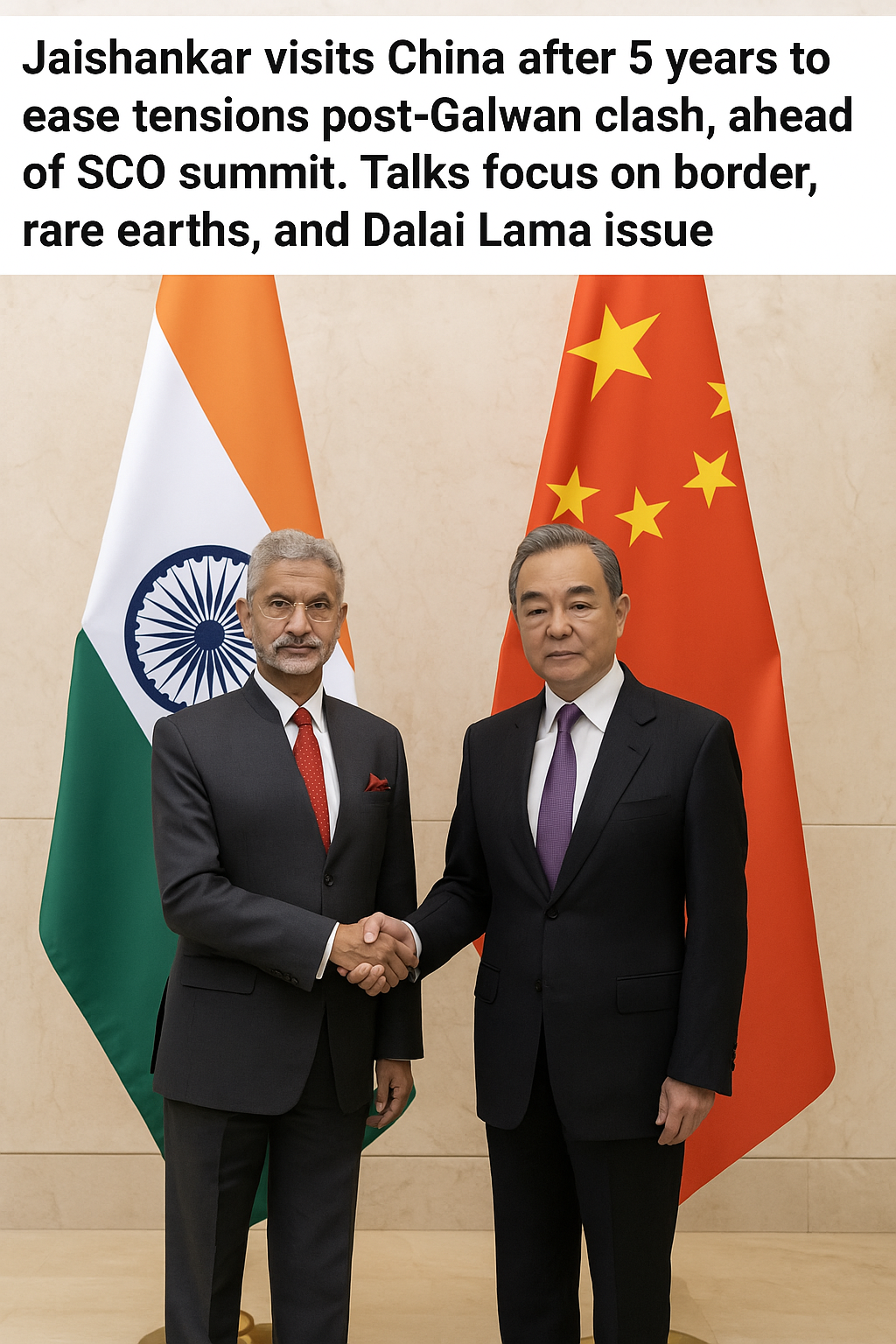
Beijing, July 14, 2025 — After five tense years, External Affairs Minister S. Jaishankar has landed in China. This marks his first visit since the deadly 2020 Galwan standoff, which deeply strained India-China relations. The visit is aimed at stabilizing bilateral ties, with key discussions planned around sensitive topics like rare earth trade, the Dalai Lama’s succession, and the border issue.
 First Step Toward Rebuilding Trust
Jaishankar’s visit is not just symbolic—it reflects India’s cautious willingness to re-engage. His meeting with Chinese Foreign Minister Wang Yi is scheduled ahead of the Shanghai Cooperation Organisation (SCO) Foreign Ministers’ summit in Tianjin on July 15. The timing signals both urgency and intent to normalize ties amid shifting geopolitics in the Indo-Pacific.
Spotlight on Border and SCO Talks
Since the Galwan clash in 2020, India and China have engaged in multiple military and diplomatic dialogues. In October 2024, troops finally disengaged from the last face-off site. However, deep mistrust remains.
The SCO meet offers a rare multilateral stage for both countries to talk formally and informally. China’s chairmanship of the SCO this year puts Beijing in the spotlight, giving Jaishankar a platform to push India’s agenda while testing the waters of trust.
Key Issues on the Table
- Rare Earth Supplies: India is keen to diversify its critical mineral supply chain. China dominates rare earth exports and India’s dependence makes it strategically vulnerable.
- Dalai Lama Succession: Beijing views this as a sovereignty issue. India maintains its support for the Tibetan religious leadership but also respects diplomatic boundaries. China’s recent warning on this topic highlights ongoing friction.
- India-Pakistan Tensions: With recent incidents across the border, Jaishankar may raise concerns about China’s ties with Pakistan.
- Resumption of Flights: Direct air connectivity between India and China has remained suspended since the pandemic. Reopening flights could signal growing normalcy.
Rajnath Singh and Doval Set the Stage
Defence Minister Rajnath Singh recently visited Qingdao for the SCO Defence Ministers’ meet. However, the meet failed to produce a joint communique—India refused to sign it without mention of the Pahalgam terror attack.
National Security Adviser Ajit Doval has also held two rounds of talks with Wang Yi in recent months. These set the foundation for Jaishankar’s current mission, showing India’s layered approach to diplomacy—security, defence, and external affairs working in tandem.
China’s Firm Position on Dalai Lama
In a pointed message on X, Chinese embassy spokesperson Yu King reiterated that India has “politically committed” not to allow anti-China activities by Tibetan exiles. This was a reminder ahead of the visit, showing that Beijing remains sensitive to issues concerning Xizang (Tibet).
Singapore Stopover Before Beijing
Before heading to China, Jaishankar visited Singapore on July 13. There, he met President Tharman Shanmugaratnam and other senior leaders. The stop signaled India’s balancing act—reinforcing ties with ASEAN while preparing for China talks.
Why This Visit Matters
India and China together shape much of Asia’s economic and political landscape. With elections around the corner in both countries, this visit may not lead to breakthrough announcements. But it may open up new channels for regular engagement—something the region desperately needs amid global uncertainty.
What Lies Ahead
The next steps will depend on how openly both sides talk about their red lines. Border peace remains a non-negotiable priority for India. For China, it’s about maintaining control and global stature through the SCO. Jaishankar’s diplomacy will be tested, not just by words, but by the tone and trust reflected behind closed doors.
Conclusion
Jaishankar’s Beijing visit could signal the beginning of a new chapter—or just another pause in a long, complex rivalry. Either way, it is a critical moment in India-China relations that deserves close global attention.