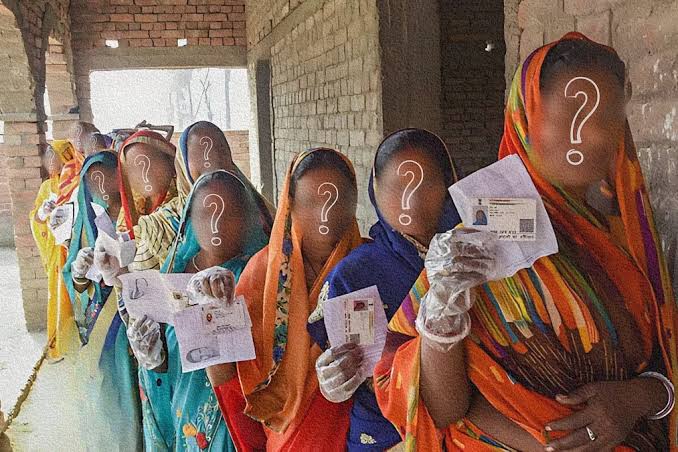
India’s democracy thrives on trust. But in Bihar, that trust may be under serious threat. A new research study reveals that the state’s voter list is inflated by 77 lakh unverifiable names, raising red flags over electoral fraud and the credibility of election outcomes.
 How Many Extra Voters Does Bihar Really Have?
According to the Election Commission of India, Bihar has 7.89 crore registered voters as of July 2025. However, a new demographic reconstruction conducted by Dr. Vidhu Shekhar and Dr. Milan Kumar estimates that only 7.12 crore voters are demographically legitimate.
That’s a discrepancy of nearly 9.7% — roughly 77 lakh ghost entries.
These are not just clerical errors. They are names of people who are either dead, migrated, or never existed in the first place. Yet, they remain on the rolls—able to “vote” and sway results.
The Three-Step Method Behind the Research
The researchers followed a rigorous three-step method, using only official data:
- Step 1: Estimating Survivors – Based on the verified 2003 voter roll, and life expectancy data from the Sample Registration System, only 3.41 crore of the original 4.96 crore voters are likely to still be alive in 2025.
- Step 2: Adding New Voters – Using birth cohort data from 1985 to 2007, adjusted for survival, an estimated 4.83 crore new voters were added.
- Step 3: Adjusting for Migration – With nearly 1.12 crore people permanently migrating out of Bihar since 2003, these names should have been deleted but were not.
Why It Matters: The Impact on Elections
Bihar’s elections are closely contested. In 2020, nearly 20% of Assembly seats were won by less than a 2.5% margin. Seventeen of those were decided by under 1%.
In such cases, phantom voters—averaging 30,000 per constituency—can tip the balance. They make the difference between victory and defeat, legitimacy and manipulation.
How Do These Phantom Names Stay?
India’s voter deletion system is broken. While Form 8 allows voters to request removal after death or migration, few ever use it. And state agencies do not proactively update the list.
There’s also no central tracking system to detect duplicate registrations across states. Someone who moves from Patna to Pune can stay registered in both places. That’s not just a loophole—it’s a gateway to fraud.
Trusted IDs Are Not Always Trustworthy
The researchers warn that using unreliable documents like Ration Cards or Aadhaar for voter verification is dangerous. Aadhaar, in particular, was never intended to prove citizenship. Yet, it has been widely used in voter ID linking, raising questions about the system’s integrity.
A National Problem, Not Just Bihar’s
States like West Bengal, Jharkhand, Odisha, and Uttar Pradesh face similar issues. If Bihar has 10% inflated rolls, imagine the national scale. We may be talking about millions of excess voters across India.
This undermines electoral legitimacy and opens the door to widespread manipulation. The problem is not just administrative—it’s constitutional.
Election Commission’s Response: Will It Be Enough?
The Election Commission of India has started a Special Intensive Revision in Bihar. This is the first such effort since 2003. But unless this revision is conducted with strict standards and field-level verification, it won’t solve the issue.
Documents can be forged. Digital linking is not enough. Only physical verification and integrated death-migration records can clean the rolls.
The Ledger of Democracy Must Be Fixed
The presence of 77 lakh illegitimate names is not a data glitch. It’s a democratic fault line. The voter roll is the foundation of every election. If the foundation is flawed, the entire system is at risk.
This issue must be treated as a national emergency. Legislative action is required to mandate automatic deletions upon death or migration. Until then, our elections will remain vulnerable to ghost voting, fraud, and public distrust.
“An election begins not when ballots are cast, but when voter rolls are compiled.”
That’s where India must begin—by fixing the very ledger that powers our democracy.