What Are Critical Minerals and Why Do They Matter?
Critical minerals, including rare earth elements like yttrium, are essential for electronics, defense, renewable energy, and EV batteries. These minerals are vital for India’s growth in technology, manufacturing, and green energy transitions.
Currently, India imports nearly all of its REE requirements. Reducing import dependency has become a national priority—and coal mine waste may hold the key.
 High REE Concentrations Found in Coal Ash
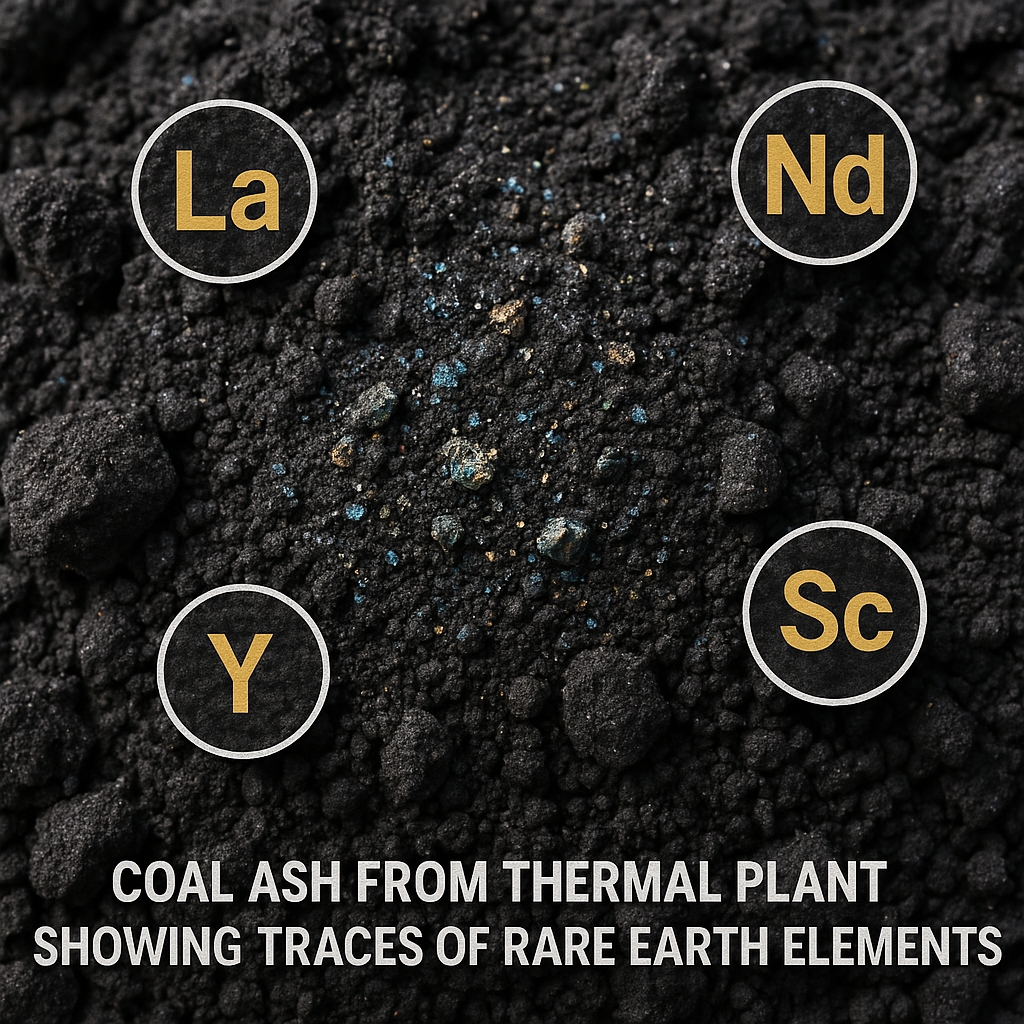
Recent analysis from Singareni Thermal Power Plant (STPP) shows about 400 ppm of total REE in fly ash and overburden clay. At NLC India’s Neyveli plants, fly ash contains up to 2100 mg/kg of REE, including a significant 300 mg/kg of yttrium.
These findings are game-changing. They show that India’s coal byproducts are not just industrial waste, but untapped reservoirs of strategic minerals.
National Critical Mineral Mission Launched
To capitalize on these discoveries, the Government approved the National Critical Mineral Mission (NCMM) on January 29, 2025. The mission will run from 2024–25 to 2030–31.
₹100 crore has been earmarked for pilot projects to recover critical minerals from unconventional sources like fly ash, red mud, overburden, and tailings.
In addition, the government has approved guidelines to set up a Centre of Excellence (CoE) under NCMM, which will support research and indigenous technology development.
Research Led by Coal India and Partners
Coal India Limited (CIL) is spearheading several research projects focused on rare earth elements in coalfields across India:
- In the North Eastern Region (NER) Coalfields, while total REE concentration is low, the proportion of heavy REEs is relatively high.
- In the Singrauli coalfields, REE content in coal is around 250 ppm, and in non-coal samples (clay/shale) it’s up to 400 ppm.
- Efforts are underway to develop indigenous REE extraction technologies from acid mine drainage and coal overburden using ion-exchange resins.
These projects aim to create cost-effective, scalable, and eco-friendly extraction processes tailored to Indian conditions.
Singareni Collieries Leads Collaborative Research
The Singareni Collieries Company Limited (SCCL) is actively collaborating with top institutions to boost critical mineral extraction research.
SCCL has signed MoUs with IIT Hyderabad, Institute of Minerals and Materials Technology (IMMT), Bhubaneswar, and Non-Ferrous Materials Technology Development Centre (NFTDC), Hyderabad.
These partnerships will foster breakthrough technologies and strengthen India’s capabilities in rare earth element recovery.
A Sustainable Mining Future
Coal-based industries are often criticized for environmental damage. However, this shift towards extracting critical minerals from coal waste could make mining more sustainable and economically rewarding.
By turning waste into value, India is not only reducing imports but also minimizing environmental hazards.
Economic and Strategic Benefits
Recovering rare earth elements from coal ash and mine waste could position India as a regional leader in critical mineral supply. This move supports the country’s goals under Atmanirbhar Bharat and accelerates the transition to clean energy.
It could also open new job opportunities in mineral processing, R&D, and sustainable mining sectors.
What Lies Ahead?
The road to full-scale recovery of REE from coal ash will require more pilot projects, technical innovation, and industry-academic partnerships.
But with the launch of NCMM, India has taken a bold first step. As pilot results come in, we may soon see the transformation of ash into assets at scale.