BioE3 Challenge for Youth Launched
The Minister launched the BioE3 Challenge for Youth, a nationwide competition designed to engage young innovators in creating safe, sustainable biological solutions. The challenge invites entries from school students, university researchers, faculty, startups, and Indian nationals. The top 10 winners each month will receive ₹1 lakh in prize money, while 100 selected projects can access up to ₹25 lakh in funding through BIRAC.
These projects will focus on solutions in health, agriculture, environment, and industry. Winners will also receive incubation support at BRIC+ institutions, enabling them to translate ideas into proof-of-concept innovations. The initiative follows the “DESIGN” framework: Define, Evidence, Sustainability, Integration, Go-to-market, and Net-positive impact.
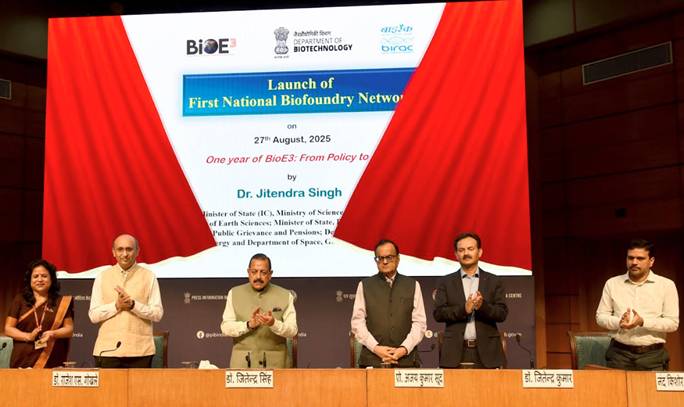
First National Biofoundry Network
Dr. Singh also launched India’s first National Biofoundry Network, connecting six institutions to scale up indigenous biomanufacturing and accelerate the commercialization of biotechnology solutions. The network will help convert laboratory research into industry-ready applications, boosting employment and entrepreneurship in the bioeconomy sector.
 Key Milestones Under BioE3 Policy
Highlighting progress made since the policy was introduced, Dr. Singh cited the establishment of India’s first Biomanufacturing Institute at Mohali, new bio-artificial intelligence hubs, and a series of joint research calls. More than 2,000 proposals have been received in areas including cell and gene therapy, carbon capture, climate-smart agriculture, and functional foods.
Partnerships have also expanded globally. A memorandum of understanding was signed between the Department of Biotechnology (DBT) and the Indian Space Research Organisation (ISRO) to explore biotechnology in space. Three DBT-backed experiments were already conducted aboard the International Space Station by Group Captain Subhanshu Shukla earlier this year.
National and International Collaborations
Domestically, DBT has partnered with states like Assam to set up dedicated BioE3 Cells. Internationally, India’s missions in 52 countries have shared inputs to strengthen collaborations under the policy framework. These steps highlight India’s intent to position biotechnology as a cornerstone of its Atmanirbhar Bharat vision.
Expert Voices on BioE3’s Future
Prof. Ajay Kumar Sood, Principal Scientific Adviser to the Government of India, emphasized that biotechnology is now converging with engineering, architecture, and space sciences. He pointed to innovations like algae-based carbon capture, organ-on-chip systems, biodegradable plastics, and space biology research as examples of the expanding role of biosciences in shaping India’s future.
Other experts, including DBT Senior Adviser Dr. Alka Sharma and BIRAC Managing Director Dr. Jitendra Kumar, outlined plans to integrate artificial intelligence, advanced manufacturing, and climate solutions into the BioE3 ecosystem.
A Vision for a Sustainable Bioeconomy
Dr. Singh reiterated that biotechnology is no longer a niche but a critical driver of India’s development. By fostering innovation, empowering youth, and building global partnerships, the government aims to ensure that India’s bioeconomy contributes significantly to employment, environmental protection, and economic growth.