
The Bench comprising Justice Vikram Nath, Justice Sandeep Mehta, and Justice N.V. Anjaria noted that repeated incidents of dog bites in schools, hospitals, railway stations, and sports complexes expose serious administrative and systemic failures. The Court observed that the brunt of such attacks is borne mostly by children, elderly citizens, and economically weaker sections who lack timely medical access.
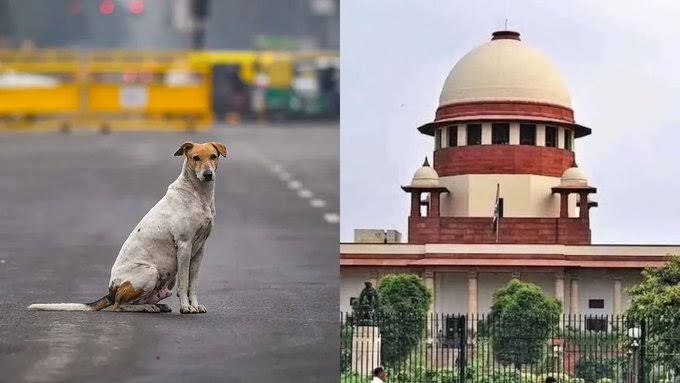 “Dog Bite Menace” Endangers Public Life
Terming the issue a “dog bite menace,” the Court cited alarming reports of attacks in educational and healthcare institutions. It mentioned incidents at the National Law School of India University (NLSIU), Bengaluru, where stray dogs reportedly threaten students and faculty, and in hospitals like the Institute of Mental Health, Chennai, where patients were bitten on campus. Similar incidents were reported from Ernakulam General Hospital, Kochi, where five people, including a patient, were attacked.
“Spaces meant for learning, healing, and recreation cannot become unsafe due to administrative neglect,” the Bench remarked. It held that failure to safeguard such premises amounted to a violation of citizens’ constitutional rights.
Foreign Nationals Also Attacked, Says Court
Highlighting the global image concerns, the Court referred to media reports, including one from NDTV, detailing how even foreign nationals have been victims of stray dog attacks. The judges noted the case of a Welsh entrepreneur bitten in Bengaluru, underscoring that the menace is no longer limited to vulnerable citizens or rural regions but has become a nationwide public safety threat.
Failure to Implement Animal Birth Control Rules
The Supreme Court criticized the poor enforcement of the Animal Birth Control Rules, 2001, framed under the Prevention of Cruelty to Animals Act, 1960. These rules mandate a humane Capture-Sterilize-Vaccinate-Release (CSVR) model to control stray populations. However, the Court observed that implementation remains “ineffective to say the least,” leading to recurring dog attacks.
Directions Issued to State Governments
In its order titled “In Re: City Hounded by Strays, Kids Pay Price” (SMW (C) No. 5/2025), the Supreme Court issued detailed directions to all States and Union Territories:
- Identify all schools, hospitals, sports complexes, railway stations, and bus depots within two weeks.
- Secure these institutions with fencing, gates, and preventive measures within eight weeks.
- Appoint Nodal Officers responsible for cleanliness and dog prevention.
- Municipal authorities must inspect these premises every three months.
- Stray dogs found on campuses must be removed, sterilized, vaccinated, and shifted to shelters not released back to the same location.
- Hospitals must maintain a regular stock of anti-rabies vaccines and immunoglobulins.
- Educational institutions must conduct awareness sessions on animal safety and first aid.
- The Animal Welfare Board of India must issue detailed SOPs within four weeks to manage stray dogs in institutional areas.
“Public Safety Must Take Precedence”
The Court reiterated that state authorities must prioritize public safety over administrative delays, stating that citizens cannot be exposed to avoidable injuries or disease in public spaces. It emphasized that the government bears an affirmative duty to ensure safety in “spaces of learning, healing, and recreation.”