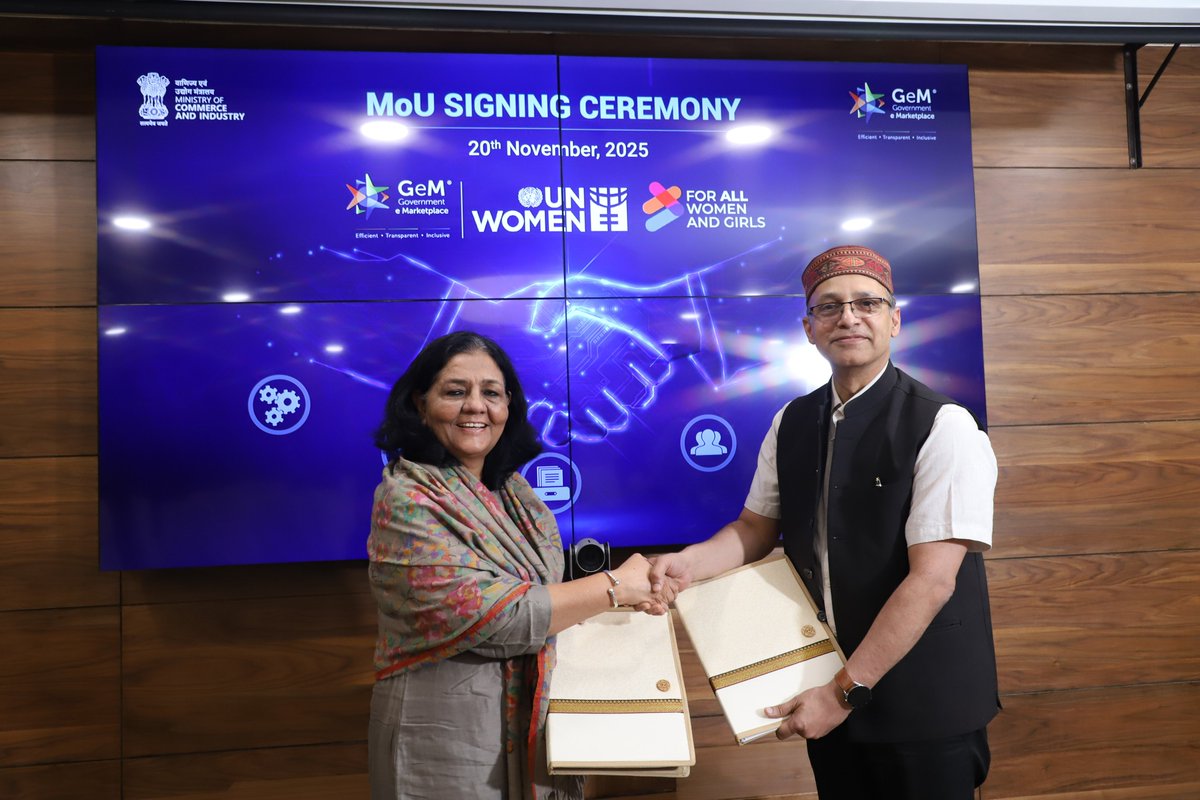
The MoU was signed by UN Women India Country Representative Kanta Singh and GeM Additional CEO Ajit B. Chavan, with GeM CEO Mihir Kumar presiding. The ceremony brought together representatives from UNRCO India, trade associations and government stakeholders to mark a formal partnership focused on practical steps for market inclusion.
Objective: Gender-responsive procurement and market access
The collaboration targets three linked outcomes: improving onboarding of women-led enterprises on GeM, building buyer awareness for gender-responsive procurement, and strengthening supply-side readiness through training and product development. GeM will make it easier for women entrepreneurs and SHGs to register and sell a wide range of products—handicrafts, handloom, jute and coir, bamboo goods, organic food, spices, home décor and office furnishings—by maintaining generic product categories and streamlined onboarding.
UN Women will support these efforts by designing training modules, sharing international best practices, and helping develop validation criteria for women-led businesses that seek access to public buyers. The agency will also mobilise women trainers and help integrate UN programme participants into GeM’s onboarding drives.
 Practical measures: training, validation and vernacular outreach
Under the MoU, GeM will conduct targeted training programmes and sensitisation workshops for government buyers to encourage procurement from women-led suppliers. The portal will produce vernacular training materials and run onboarding workshops to reduce entry barriers for micro-entrepreneurs and SHGs located in smaller towns and rural areas.
UN Women’s role will include curating success stories, recommending global best practices for gender-responsive procurement, and advising on validation criteria to ensure business readiness and quality standards. The partnership emphasises co-creating locally relevant solutions while drawing on international experience.
Linking product development with market readiness
GeM will also connect women entrepreneurs with Government Labs and R&D institutes to improve product quality and market fit. This technical handholding—paired with trade association support and alignment with schemes such as Udyam registration—aims to help enterprises move from informal production to formal participation in public tenders and direct supply contracts.
By building capacity on both supply and demand sides—trainings for sellers and sensitisation for buyers—the partners expect to unlock larger, sustainable market opportunities across central and state procurement channels.
Stakeholders and strategic impact
The signing was attended by officials from the UN Resident Coordinator’s Office (UNRCO), senior GeM officers, and representatives from trade bodies including Laghu Udyog Bharti, PHDCCI and SEWA Bharat. The presence of diverse stakeholders signals intent to coordinate public, private and civil-society actors in enabling women’s entrepreneurship at scale.
Officials said the MoU directly contributes to Sustainable Development Goal 5 on gender equality by expanding economic opportunities for women. It also complements national priorities such as Vocal for Local and broader MSME development efforts.
What to expect next
In the coming months, partners plan to roll out pilot onboarding batches, vernacular training toolkits and buyer sensitisation campaigns. They will also establish monitoring benchmarks to track increases in procurement from women-led suppliers and SHGs, measure the economic impact on participating enterprises, and refine validation criteria based on field feedback.
The MoU marks a practical step toward opening government markets to women entrepreneurs, offering technical support, simplified onboarding and access to institutional buyers—elements that could significantly scale incomes and formalisation for many women producers across India.