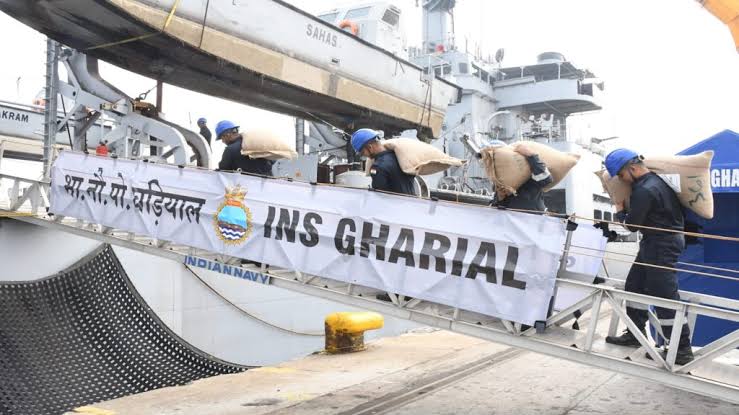
The deployment follows earlier efforts by INS Vikrant, INS Udaygiri and INS Sukanya, which provided relief assistance and heliborne search-and-rescue support in affected areas. The three LCUs arrived in Colombo on the morning of 7 December 2025 and handed over critical relief stores to Sri Lankan authorities. INS Gharial is scheduled to arrive at Trincomalee on 8 December 2025 to continue distribution operations.
Strong people-to-people ties and rapid response
India’s rapid mobilisation underscores long-standing people-to-people ties with Sri Lanka and demonstrates the Navy’s preparedness to assist neighbours in the Indian Ocean Region. The 1,000 tonnes of supplies comprising food, medical aid, shelter material and other essential relief items are being routed to regions most in need, coordinated closely with Sri Lankan agencies to ensure timely distribution.
 Naval platforms offer unique capabilities for HADR
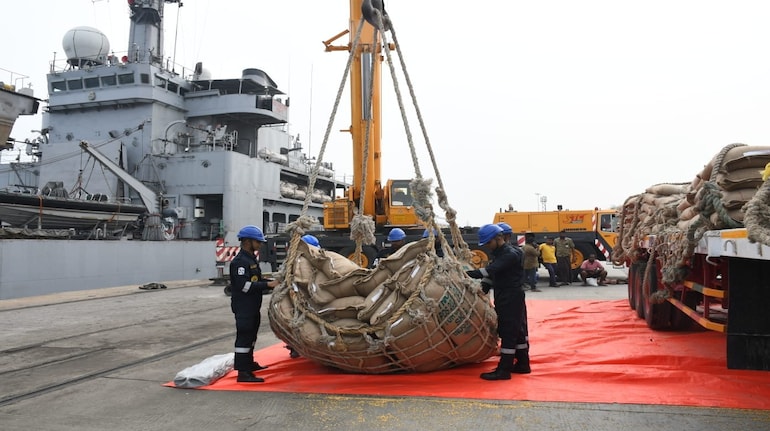
Landing Craft Utility vessels (LCUs) and larger warships are especially effective for HADR in coastal and island environments. LCUs can transfer heavy cargo directly to littoral zones or smaller ports where shore infrastructure may be compromised. Larger ships, including INS Vikrant and INS Udaygiri, provide helicopter support for search-and-rescue (SAR) and rapid aerial delivery of critical items to otherwise inaccessible areas.
Operational coordination and humanitarian diplomacy
Operation Sagar Bandhu reflects operational coordination between the Indian Navy, the Ministry of Defence and Sri Lankan authorities. HADR missions also serve a diplomatic role: rapid assistance during natural disasters fosters goodwill, builds resilience networks and reinforces regional cooperation on maritime security and humanitarian response.
Logistics, scale and speed
Delivering 1,000 tonnes of HADR material requires complex logistics — from loading and manifesting supplies to routing ships, coordinating port clearances and synchronising shore-based distribution teams. The Indian Navy’s ability to sustain such operations at short notice highlights robust logistics planning, pre-positioned stocks and inter-agency collaboration.
Humanitarian impact on the ground
Relief materials delivered so far have included dry rations, drinking water, medical kits, temporary shelters, hygiene supplies and power-generation equipment. These items are critical in early recovery phases where local supply chains are disrupted and immediate relief is essential to prevent secondary crises like outbreaks of water-borne disease.
Voices from the mission
Naval commanders involved in Operation Sagar Bandhu emphasise the mission’s humanitarian imperative. “Our ships are trained and equipped to respond swiftly to human suffering in the region,” a senior officer said. “We coordinate closely with local authorities to ensure relief reaches the vulnerable populations first.”
Regional context and preparedness
The Indian Ocean Region is frequently affected by cyclones and monsoon-related disasters. Regional navies and coast guards regularly exercise HADR scenarios, and India’s sustained investments in maritime assets have bolstered its capacity to provide timely assistance. Such missions also provide valuable operational experience that improves future disaster response.
Doctrine, coordination and port strategy
India’s HADR doctrine emphasises speed, capacity and interoperability. The Navy’s doctrine outlines pre-authorised procedures for rapid deployment, enabling assets to respond while diplomatic clearances are secured. Ships carrying relief consignments routinely include medical teams, engineering detachments and humanitarian liaison officers who work with local agencies to assess needs and manage distributions.
Colombo and Trincomalee act as primary maritime gateways for humanitarian assistance in Sri Lanka. Colombo’s port infrastructure allows rapid offloading at scale, while Trincomalee’s deep-water harbour and proximity to eastern districts make it strategically valuable for distributing aid to coastal and island communities. The Indian Navy’s use of multiple ports helps decongest single entry points and speeds up last-mile delivery.
Looking ahead: sustained support and accountability
With INS Gharial due to arrive at Trincomalee, Indian naval teams will continue handover and distribution operations in coordination with Sri Lankan counterparts. Beyond immediate relief, long-term recovery will require rebuilding infrastructure, restoring livelihoods and supporting health and sanitation systems. India has signalled readiness to extend technical assistance as needed.
The Indian Navy and partnering agencies are documenting handovers and maintaining manifests to ensure transparency in aid delivery. Open coordination with Sri Lankan authorities aims to reduce duplication and ensure that aid meets on-ground needs efficiently.