Industrial Revival and Farmer-Centric Growth
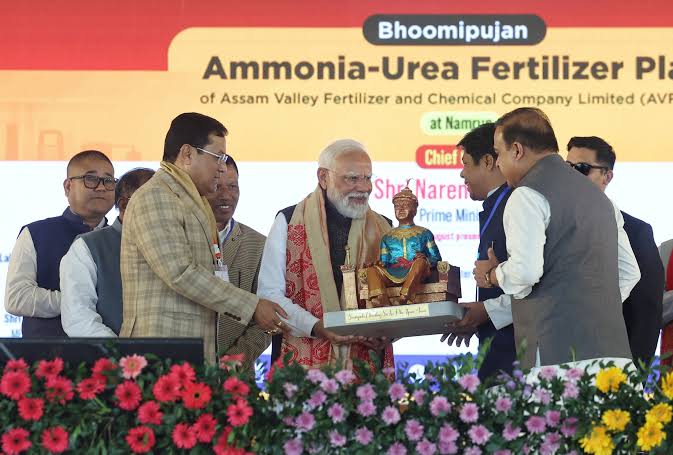
Highlighting the importance of the project, PM Modi said the new urea plant would ensure a steady supply of fertilizers to farmers while reducing logistics costs. The project, with an investment of around ₹11,000 crore, will produce more than 12 lakh metric tonnes of urea annually, strengthening fertilizer availability across the Northeast and eastern India.
He said local production would benefit farmers in Assam as well as states like Bihar, Jharkhand, West Bengal and eastern Uttar Pradesh. According to the Prime Minister, this initiative reflects the Centre’s commitment to making India self-reliant in the fertilizer sector.
 Employment and Youth Opportunities
The Prime Minister noted that the Namrup unit would generate thousands of employment and self-employment opportunities. Once operational, the plant will provide permanent jobs and create demand in allied sectors such as maintenance, supply chains and construction.
He emphasised that local youth would be the biggest beneficiaries of this industrial revival, adding that employment generation remains central to the government’s development strategy in the Northeast.
Contrast with Previous Governments
PM Modi criticised previous Congress governments for neglecting fertilizer plants across the country, including Namrup, leading to shutdowns and hardships for farmers. He recalled a time when farmers were forced to stand in long queues for urea and police deployment became common outside fertilizer shops.
He said that while fertilizer production declined earlier, the current government has revived and established plants in Gorakhpur, Sindri, Barauni and Ramagundam. These efforts, he added, are paving the way for India to achieve self-reliance in urea production.
Rising Urea Production and Subsidy Support
The Prime Minister said urea production in India had increased from 225 lakh metric tonnes in 2014 to about 306 lakh metric tonnes today. He acknowledged that the country’s annual requirement stands at around 380 lakh metric tonnes and assured that the government is working tirelessly to bridge the gap.
He highlighted that despite high international prices, farmers in India receive urea at around ₹300 per bag, while the government bears the remaining cost through subsidies. This, he said, reflects the Centre’s sensitivity towards farmers’ interests.
Call for Sustainable Farming
PM Modi urged farmers to use fertilizers judiciously and protect Mother Earth. Drawing an analogy with medical dosage, he said excessive use of fertilizers harms soil health and long-term productivity.
He encouraged natural farming and expressed hope that Assam would lead by example, with some tehsils adopting 100 percent natural farming practices.
Broader Agricultural Support
The Prime Minister highlighted key farmer welfare initiatives, including direct income support under PM-Kisan, through which nearly ₹4 lakh crore has been transferred directly to farmers’ bank accounts. He also mentioned new schemes worth ₹35,000 crore aimed at strengthening agriculture and achieving self-reliance in pulses.
He said benefits under the Kisan Credit Card scheme have been extended to livestock and fish farmers, with assistance exceeding ₹10 lakh crore. Additional support through crop insurance, procurement reforms and reduced GST on bio-fertilizers was also underlined.
Assam’s Identity and the Northeast’s Role
Reaffirming the government’s commitment to Assam’s culture and identity, PM Modi said the BJP respects the state’s heritage and symbols of pride. He cited initiatives such as honouring Mahavir Lachit Borphukan, celebrating Bhupen Hazarika and promoting Assamese tea, crafts and the traditional gamosa globally.
He asserted that Eastern India and the Northeast would emerge as major growth engines of the country, describing the region as the “Ashtalakshmi” of a self-reliant India.