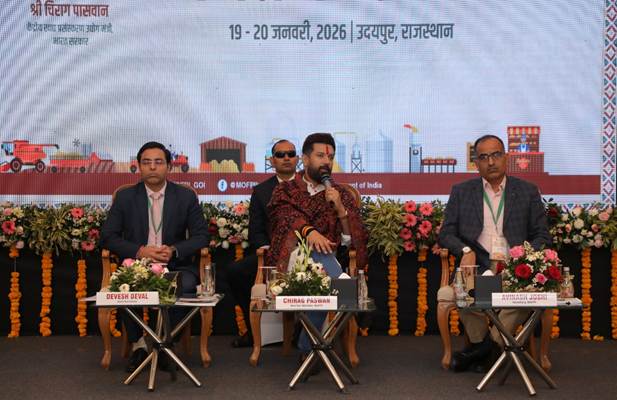
The Ministry of Food Processing Industries (MoFPI) organised a two-day Chintan Shivir in Udaipur, Rajasthan, bringing together policymakers, industry leaders, academic institutions, and state representatives to chart a roadmap for a modern, globally competitive, and inclusive food processing sector.
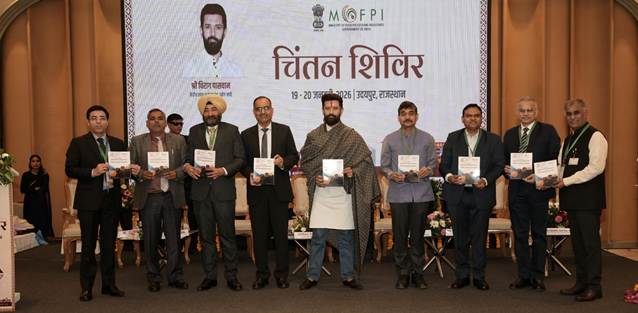 Inaugural Vision: Strengthening India’s Food Processing Ecosystem
Union Minister for Food Processing Industries, Shri Chirag Paswan, inaugurated the Shivir, highlighting the government’s commitment to enhancing farmer incomes, reducing post-harvest losses, promoting value addition, ensuring food safety and nutrition, and generating employment for youth and women. He emphasised food processing as a key pillar for strengthening agri-value chains, expanding exports, and positioning India as a trusted global supplier of sustainable, high-quality processed foods.
The session also marked the release of publications showcasing technological advancements in food processing and the achievements of Start-up Grant Challenge winners, underscoring MoFPI’s focus on innovation and entrepreneurship.
Strategic Deliberations and Recommendations
Participants engaged in six thematic group discussions addressing critical aspects of the sector, including doubling food processing levels, enhancing exports, developing high-growth segments such as nutraceuticals, plant-based proteins, and alcoholic beverages, strengthening food safety, and promoting evidence-based public awareness about processed foods.
Key recommendations included:
- Strengthening farm-level aggregation and MSME participation.
- Expanding modern processing capacity, cold-chain, and logistics infrastructure.
- Improving quality and safety standards to boost processing levels.
- Developing export-oriented infrastructure and promoting “Brand India”.
- Establishing a National Food Processing Promotion Council and introducing a Bharat Quality Food Mark.
- Promoting cluster-based agri-food processing hubs with integrated value-chain financing and AI-enabled traceability systems.
- Supporting indigenous food processing machinery manufacturing and R&D-driven product innovation.
- Conducting scientific communication campaigns and integrating food science education in school curricula.
These recommendations aim for practical, forward-looking, and implementable solutions to accelerate sectoral growth.
State Best Practices Drive Holistic Development
States and Union Territories shared initiatives to strengthen regional food processing ecosystems. Uttar Pradesh outlined a roadmap to double processing capacity through incentives, food parks, and single-window clearance. Maharashtra highlighted women-led enterprise promotion and fortified food initiatives under the PMFME scheme. Andhra Pradesh showcased cluster-based interventions in coffee, cocoa, and fisheries supported by central schemes.
Other states, including Chhattisgarh, Madhya Pradesh, Uttarakhand, Bihar, Telangana, and Andaman & Nicobar Islands, presented innovative models for value-chain development, export growth, and horticulture-led processing, fostering cross-state learning and collaboration.
Empowering Local Entrepreneurs and Inclusive Growth
On the sidelines, the Minister inaugurated the Common Incubation Facility at Krishi Upaj Mandi Samiti (KUMS), Udaipur, supporting the processing of minor forestry products like custard apple, jamun, amla, aloe vera, and spices. Developed under the PMFME scheme, this facility aims to enhance value addition, promote local entrepreneurship, and ensure sustainable utilisation of regional produce.
Way Forward
Concluding the Shivir, Shri Paswan praised participants for actionable recommendations and called for collaborative, time-bound implementation. He emphasised sustained coordination between the Centre, States, industry, and institutions to realise India’s vision of becoming a global leader in food processing.