 IBC’s Transformative Impact Highlighted
Justice (Retd.) Ramalingam Sudhakar, President of the National Company Law Tribunal (NCLT), who graced the conclave as Chief Guest, traced the remarkable journey of the IBC since its enactment in 2016. He highlighted that the establishment of a dedicated adjudicatory framework through the NCLT has been a defining feature of the Code’s success.
He noted that the IBC has significantly improved credit discipline by acting as a credible deterrent against default. According to him, the consistent improvement in NCLT performance and stakeholder coordination has ensured faster and more effective insolvency resolution compared to the pre-IBC regime.
Justice Sudhakar also observed that India’s insolvency framework has evolved into a potential reference model for emerging economies seeking to modernise their resolution mechanisms.
Banking Sector Health and NPAs
In his special address, Mr. M. Nagaraju, Secretary, Department of Financial Services, Ministry of Finance, underscored the crucial role played by the IBC in strengthening the banking sector. He pointed to the reduction in non-performing assets (NPAs) and improvement in bank profitability as tangible outcomes of the Code’s implementation.
He highlighted the behavioural shift in the debtor-creditor ecosystem, noting that the threat of timely resolution under IBC has encouraged better repayment discipline. While acknowledging the progress made, he stressed that certain challenges remain and require continued policy attention.
Mr. Nagaraju said the proposed amendments to the insolvency framework, along with ongoing initiatives by the Department of Financial Services, are expected to further strengthen the effective implementation of the Code.
IBC’s Evolution and Global Standing
IBBI Chairperson Mr. Ravi Mital, in his special address, reflected on the evolutionary journey of the Insolvency and Bankruptcy Code over the past decade. He noted that the framework has matured considerably, placing India among countries with the most robust insolvency regimes globally.
He highlighted that the Code has delivered positive outcomes on multiple fronts, including improved credit discipline, faster resolutions and better post-resolution performance of companies. Referring to studies conducted by IIM Ahmedabad and IIM Bangalore, he pointed out evidence of improved borrower behaviour and enhanced operational and financial outcomes for resolved entities.
INSOL India’s Role and Ecosystem Building
Ms. Pooja Mahajan, President of INSOL India, in her welcome address, highlighted the organisation’s role in strengthening India’s insolvency ecosystem. She outlined several initiatives undertaken by INSOL India to promote best practices, capacity building and international cooperation in insolvency resolution.
The inaugural session concluded with a vote of thanks by Dr. Bhushan Kumar Sinha, Whole Time Member, IBBI, who reiterated the positive impact of the IBC on the banking sector and the broader economy.
Panel Discussions on Key Insolvency Themes
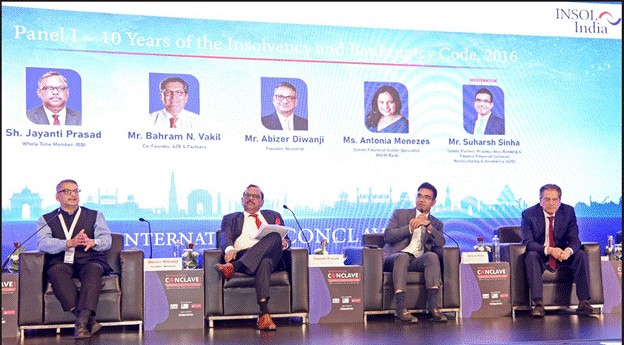
The conclave featured five in-depth panel discussions covering critical aspects of insolvency law and practice. The first panel reviewed “10 Years of the Insolvency and Bankruptcy Code, 2016”, examining achievements, persistent challenges and reform priorities.
Subsequent panels addressed asset tracing and recovery, out-of-court workouts and pre-pack solutions, financing of distressed acquisitions and special situations, and cross-border insolvency under the UNCITRAL Model Law. Experts shared international experiences and assessed India’s readiness to adopt global best practices.
A strong focus was placed on the need for timely resolutions, enhanced enforcement mechanisms and deeper coordination among regulators, courts and market participants.
Looking Ahead
The 3rd International Conclave concluded with broad consensus that while the IBC has delivered substantial gains over the past decade, continuous reforms are essential to address emerging challenges in a dynamic economic environment.
With participation from insolvency professionals, legal practitioners, financial institutions, regulators, academia and government officials, the conclave reaffirmed the collective commitment to strengthening India’s insolvency framework in line with global standards.