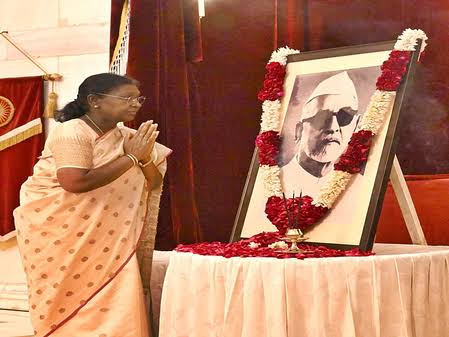
 Honouring a Scholar-President
Dr Zakir Hussain holds a unique place in Indian history as the country’s third President and its first Muslim head of state. Born on February 8, 1897, he was known for his deep commitment to education, national integration, and ethical public life. His presidency, though brief, was marked by dignity, simplicity, and intellectual depth.
President Murmu’s tribute highlighted the continued relevance of Dr Hussain’s ideals in contemporary India. Rashtrapati Bhavan officials noted that remembering national leaders on their birth anniversaries is an important tradition that connects present-day governance with the values of the past.
A Life Dedicated to Education
Before assuming the highest constitutional office, Dr Zakir Hussain was widely celebrated for his pioneering work in education. He was among the founders of Jamia Millia Islamia, an institution that emerged as a symbol of nationalist education during the freedom struggle.
Dr Hussain firmly believed that education should nurture moral values alongside intellectual growth. His philosophy emphasised character-building, social responsibility, and inclusivity—principles that continue to guide educational institutions across the country.
His contribution to India’s education system was formally recognised when he became the Governor of Bihar and later the Vice-President of India, roles in which he consistently advocated for learning as the foundation of democracy.
Presidency Marked by Integrity
Dr Zakir Hussain assumed office as President of India in May 1967. His tenure, though cut short by his untimely death in 1969, is remembered for its moral authority and commitment to constitutional values. He was known to approach the office not as a seat of power, but as a platform for service.
As President, Dr Hussain maintained a strong connect with students, teachers, and ordinary citizens. His speeches often focused on national unity, discipline, and the responsibility of citizens in shaping India’s future.
Rashtrapati Bhavan Remembers National Icons
The floral tribute ceremony is part of a long-standing tradition at Rashtrapati Bhavan, where the President of India honours former Presidents and national leaders on significant anniversaries. Such events serve as reminders of India’s democratic journey and the individuals who shaped it.
According to information released by the Press Information Bureau (PIB), President Murmu’s tribute was a gesture of respect towards Dr Hussain’s lifelong service to the nation.
Enduring Relevance of Dr Zakir Hussain’s Ideals
Even decades after his passing, Dr Zakir Hussain’s ideas on education, secularism, and ethical leadership continue to resonate. Scholars often describe him as a bridge between tradition and modernity, someone who combined intellectual rigor with humility.
President Murmu’s tribute comes at a time when India is reflecting on the role of education and values in national development. By honouring leaders like Dr Hussain, the country reaffirms its commitment to the principles that have guided its democratic framework.
The ceremony concluded quietly, in keeping with the simplicity that Dr Zakir Hussain himself valued throughout his life.