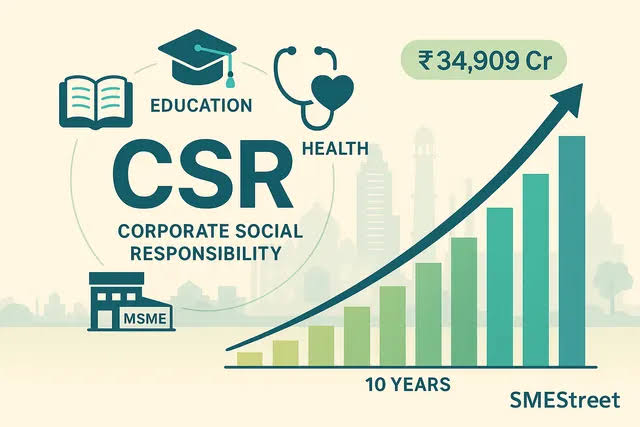
The steady rise in spending underscores the expanding role of Corporate India in addressing social, economic, and environmental challenges. From education and healthcare to sanitation, skill development, and rural infrastructure, CSR initiatives have become a key pillar of inclusive growth.
 CSR Spending Shows Consistent Year-on-Year Growth
Official figures show a clear upward trajectory in CSR expenditure across the five-year period. In FY 2019-20, companies spent ₹24,965.82 crore on development projects. This increased to ₹26,210.95 crore in FY 2020-21, despite economic disruptions caused by the COVID-19 pandemic.
The growth momentum continued in subsequent years, with CSR spending touching ₹27,141.45 crore in FY 2021-22 and rising sharply to ₹30,932.08 crore in FY 2022-23. The highest spending was recorded in FY 2023-24, when companies collectively spent ₹34,908.75 crore.
Experts note that the consistent increase reflects greater compliance, improved reporting, and a growing recognition among corporate boards of CSR as a long-term strategic responsibility rather than a regulatory formality.
CSR Is a Board-Driven, Mandated Process
Under the Companies Act, 2013, CSR is a board-driven process. Company boards are empowered to plan, approve, execute, and monitor CSR activities, ensuring that projects align with statutory requirements and societal priorities.
The law mandates eligible companies to spend at least 2 percent of their average net profits from the preceding three financial years on CSR activities listed under Schedule VII of the Act. There is no provision for government allocation of CSR funds, reinforcing the autonomy and accountability of corporate decision-making.
Existing legal safeguards include the formation of CSR committees, formulation of CSR policies, preparation of annual action plans, certification of CSR expenditure by the Chief Financial Officer, and statutory audit of CSR spending.
Mandatory Impact Assessment Enhances Accountability
To strengthen transparency and outcomes, the Companies (CSR Policy) Rules, 2014 require companies with an average CSR obligation of ₹10 crore or more to conduct independent impact assessments. These assessments apply to projects with outlays of ₹1 crore or more that have been completed for at least one year.
Details of CSR activities, impact assessments, and annual action plans must be disclosed in the Annual Report on CSR, which forms part of the company’s Board Report. This ensures public scrutiny and helps measure real-world impact beyond financial outlays.
The government maintains that these mechanisms collectively promote responsible corporate behaviour and data-driven social investment.
Statement in Parliament
The information on CSR expenditure was shared in a written reply in the Rajya Sabha by Minister of State for Corporate Affairs and Minister of State for Road Transport and Highways, Shri Harsh Malhotra.
The disclosure comes at a time when CSR is increasingly seen as a vital complement to public welfare programmes, leveraging private sector resources, innovation, and managerial expertise for national development goals.