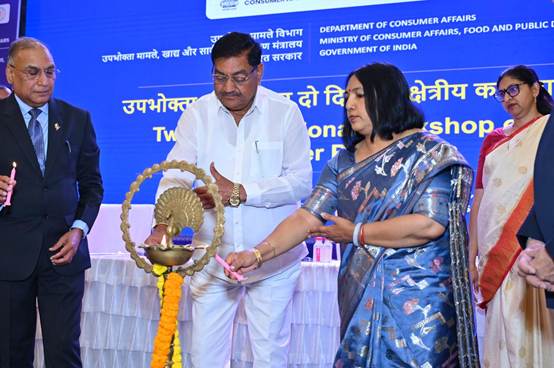
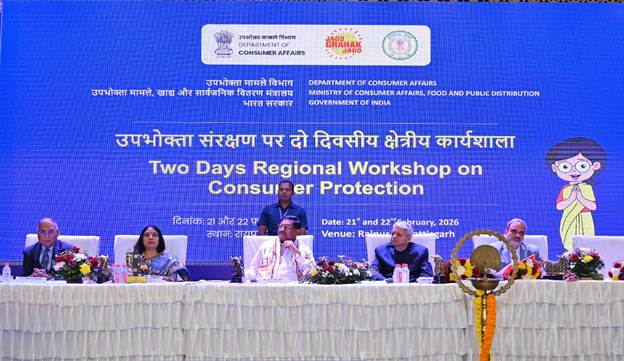
Raipur, February 22: A two-day Regional Workshop on Strengthening Consumer Protection Mechanisms was inaugurated in Raipur, Chhattisgarh, reaffirming the Centre’s commitment to technology-driven, accessible and speedy consumer justice delivery across India.
 Centre and State Join Hands
The workshop has been jointly organised by the Department of Consumer Affairs, Government of India, and the Government of Chhattisgarh. It brings together representatives from Bihar, Chhattisgarh, Goa, Uttar Pradesh, Madhya Pradesh, Maharashtra, Odisha and Jharkhand to share best practices and strengthen institutional coordination.
The event was inaugurated in the presence of Shri Dayaldas Baghel, Minister for Food, Civil Supplies and Consumer Affairs, Government of Chhattisgarh; Justice A.P. Sahi, President of the National Consumer Disputes Redressal Commission (NCDRC); Justice Gautam Chourdiya, President of the Chhattisgarh State Consumer Disputes Redressal Commission; and Smt. Nidhi Khare, Secretary, Department of Consumer Affairs, Government of India.
Focus on Digital Transformation
Addressing the gathering, Shri Dayaldas Baghel highlighted the growing need to modernise consumer justice systems. He stressed the importance of e-filing, virtual hearings and Artificial Intelligence tools to ensure faster and affordable redressal of grievances.
Special attention was given to emerging challenges in digital commerce, including deceptive online practices known as “dark patterns.” The Minister underscored the necessity of effective execution of orders passed by Consumer Commissions to ensure real relief for consumers.
National Consumer Helpline as Pre-Litigation Platform
In her keynote address, Smt. Nidhi Khare emphasised that the government is committed to hassle-free and time-bound grievance redressal with minimal financial burden on citizens. She highlighted the growing role of the National Consumer Helpline (NCH) as a pre-litigation platform, particularly in low-value disputes where consumers may hesitate to approach commissions.
According to official data shared during the session, over ₹52 crore has been refunded to consumers across 31 sectors through the NCH between April 2025 and January 2026. This, she noted, demonstrates the effectiveness of technology-enabled grievance resolution mechanisms.
She also discussed the implementation of the e-Jagriti platform for end-to-end digital case management in Consumer Commissions. The platform aims to enhance transparency, streamline case monitoring and reduce pendency.
Strengthening Consumer Justice Under the 2019 Act
Justice A.P. Sahi underlined the evolving landscape of consumer protection under the Consumer Protection Act, 2019. He stressed the importance of timely disposal of cases and stronger collaboration between national, state and district commissions.
While advocating for the responsible use of Artificial Intelligence, he clarified that AI should serve as a supportive tool rather than replace judicial discretion. He also called for regular performance reviews and timely filling of vacancies to strengthen institutional capacity.
Key Technical Sessions
The workshop features six thematic sessions covering operational and emerging areas. These include digital tools such as e-Jagriti and AI integration, procedures for admission of complaints, tackling dark patterns in e-commerce, speedy execution of orders and discussions on potential amendments to the Consumer Protection Act.
A parallel session on Legal Metrology addressed topics like E-Maap, deregulatory measures and reforms under the Jan Vishwas framework, aiming to simplify compliance while safeguarding consumer interests.
Minimising Adjournments and Reducing Pendency
Deliberations also focused on minimising unnecessary adjournments, promoting procedural uniformity across commissions and enhancing execution mechanisms. Officials from NIC, State Governments and voluntary consumer organisations actively participated in knowledge-sharing discussions.
Since June 2022, the Department of Consumer Affairs has conducted regional consultations nationwide to systematically review pendency and strengthen grievance redressal systems. The Raipur workshop continues this effort by fostering inter-state collaboration and data-driven reforms.
Technology as the Backbone of Reform
The overarching message of the workshop was clear: consumer justice in India must be technology-enabled, transparent and citizen-centric. By leveraging platforms such as e-Jagriti and the National Consumer Helpline, authorities aim to ensure quicker resolutions and improved trust in the system.