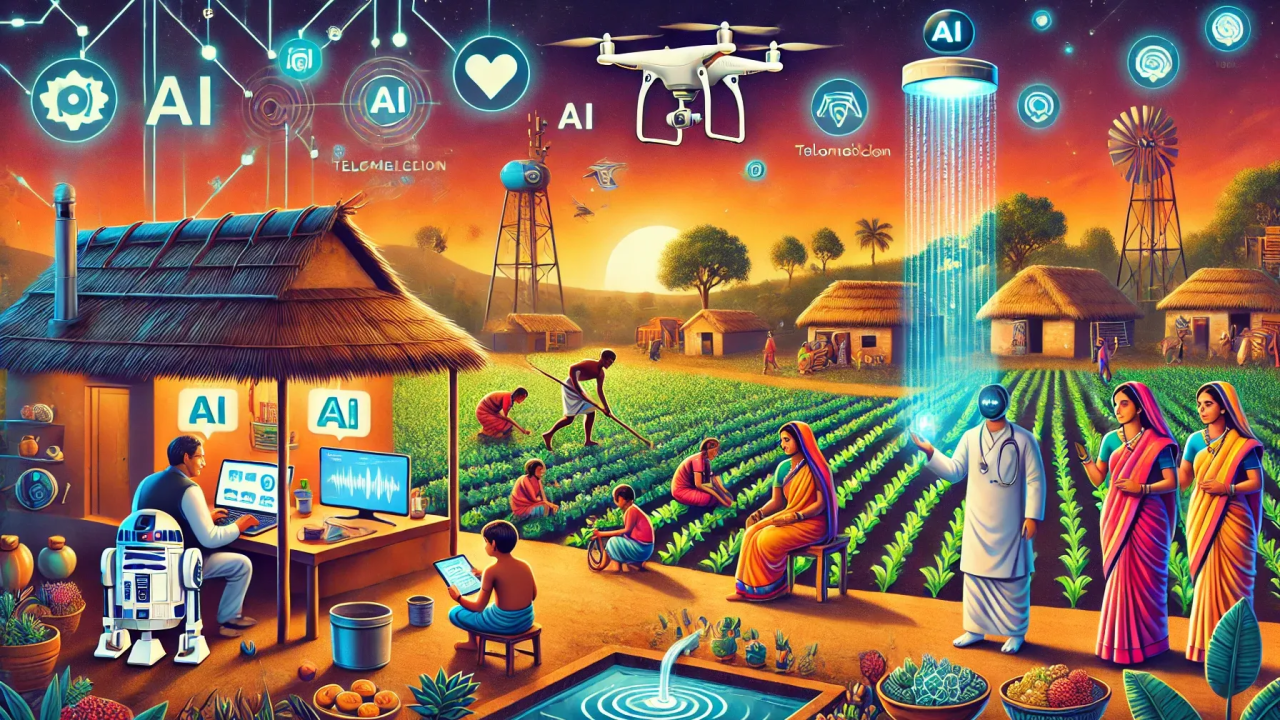
India’s approach positions AI as a public good aimed at expanding access, improving transparency, and strengthening service delivery, especially in underserved rural regions.
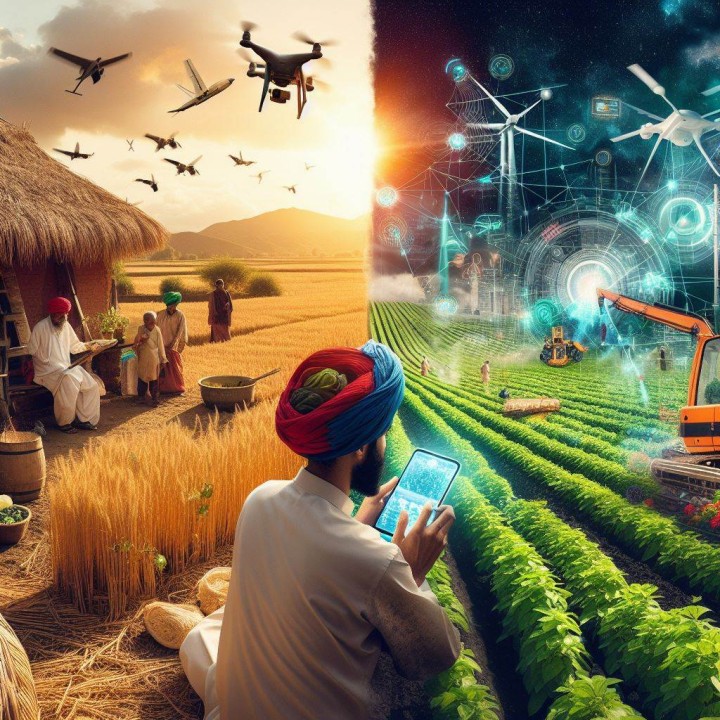 AI for All: Policy Anchored in Inclusion
The National Strategy for Artificial Intelligence, launched by NITI Aayog, frames AI as a tool to address developmental challenges in sectors such as agriculture, healthcare, and education. The emphasis is on augmentation rather than replacement of human labour.
Under the “AI for All” vision, technology is designed to support farmers, frontline health workers, teachers, and administrators. AI-powered decision systems help extend services to remote villages without requiring massive physical infrastructure expansion.
Complementing this strategy, the AI Governance Guidelines introduced by the Ministry of Electronics and Information Technology in November 2025 lay out safeguards for fairness, accountability, and transparency. The framework stresses India-specific risk assessments, especially in welfare systems where automated decisions affect beneficiaries.
Strengthening Rural Governance
AI integration within Panchayati Raj Institutions is enhancing transparency and administrative efficiency. Tools such as SabhaSaar generate structured minutes of Gram Sabha meetings from audio or video recordings, reducing manual documentation burdens and ensuring consistency.
Digital platforms like eGramSwaraj and Gram Manchitra further strengthen decentralised governance by enabling data-driven planning and GIS-based monitoring of rural assets. These systems help local bodies prepare evidence-based Gram Panchayat Development Plans.
AIKosh, a national repository of datasets and AI models, is accelerating innovation by providing ready-to-use resources for public-sector applications. With thousands of datasets and models available, it lowers entry barriers for developing rural governance solutions.
AI in Agriculture and Livelihoods
Agriculture remains a key focus area for AI deployment. Decision-support tools assist farmers with weather forecasting, pest detection, crop health monitoring, and irrigation planning.
Initiatives such as Kisan e-Mitra provide information on government schemes and advisories, while satellite-based systems integrate soil and meteorological data for real-time recommendations. These interventions help reduce production risks and strengthen income security.
In parallel, geospatial platforms like BhuPRAHARI monitor rural development assets, including water bodies and employment-linked infrastructure, improving accountability in large-scale programmes.
Education, Skilling and Informal Workers
AI is also enhancing rural education and skilling ecosystems. The DIKSHA platform incorporates AI-based search and accessibility features, while programmes like YUVAI aim to equip students with foundational AI skills.
For informal workers, the Digital ShramSetu Mission leverages AI to improve service delivery and livelihood support. By aligning technological innovation with regulatory safeguards, the initiative promotes sustainable rural employment.
Multilingual AI for Last-Mile Inclusion
Language diversity has often limited digital participation in rural India. Platforms such as BHASHINI are addressing this challenge by offering AI-driven translation and speech services across more than 36 Indian languages.
BharatGen, India’s government-funded multilingual AI model, supports 22 Indian languages and multimodal capabilities. Similarly, Adi Vaani focuses on tribal language inclusion, ensuring culturally sensitive digital access to governance and public services.
These initiatives reduce literacy and linguistic barriers, allowing citizens to interact with welfare systems in their native languages. By integrating voice-enabled and multilingual features, AI is expanding participatory governance.
Road to Viksit Bharat@2047
The India–AI Impact Summit 2026 reflects a coordinated shift from pilot projects to scalable implementation. By embedding AI into Digital Public Infrastructure and rural institutions, India is institutionalising technology as part of its long-term development architecture.
As the country moves toward the vision of Viksit Bharat@2047, responsible and inclusive AI deployment will remain central to strengthening grassroots governance, bridging service gaps, and ensuring equitable growth across rural landscapes.