 CBRN as an Operational Environment
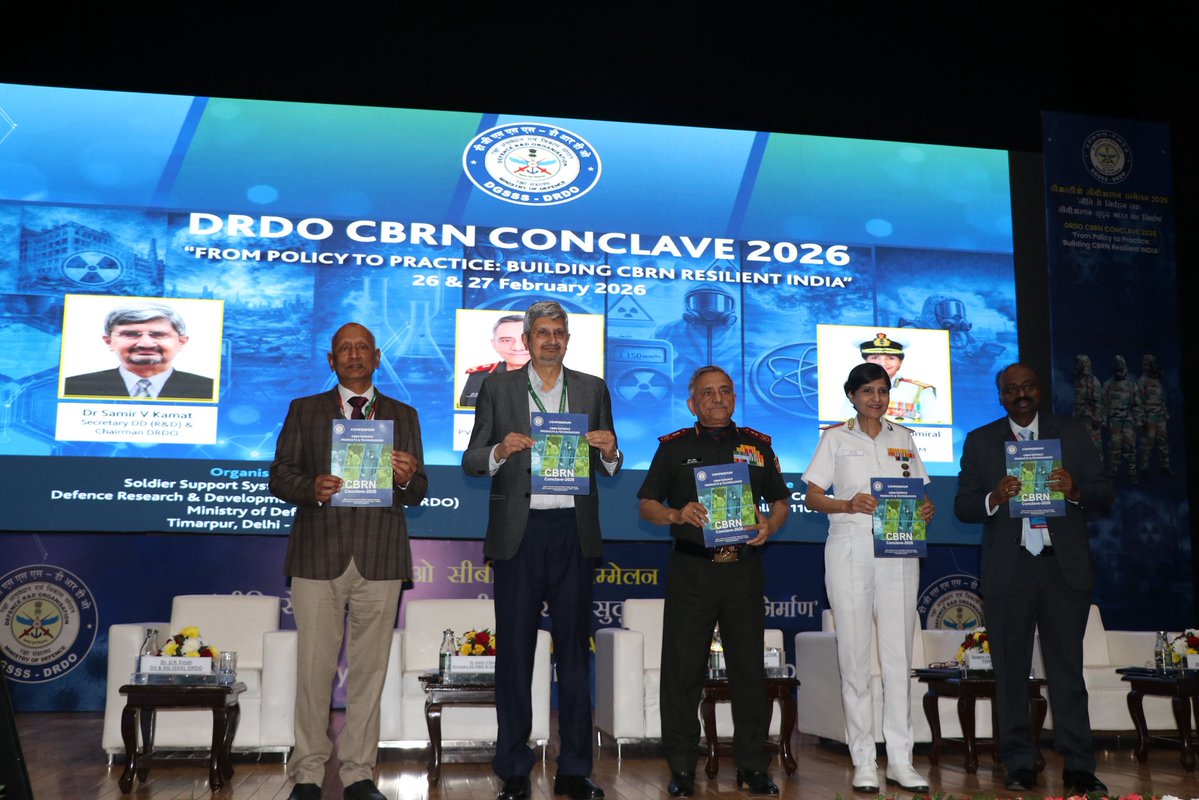
Addressing the gathering, General Anil Chauhan commended DRDO for its efforts toward self-reliance in CBRN defence technologies. He stressed that India must remain prepared to operate effectively even in contaminated environments.
Quoting Prime Minister Narendra Modi, the CDS asserted that India will not be deterred by nuclear blackmail. He emphasised that CBRN should be viewed not merely as a threat but as an operational environment where forces must learn to function with resilience and adaptability.
He called for indigenous, state-of-the-art CBRN defence equipment, including advanced early warning systems, lightweight individual protective gear, and well-researched Standard Operating Procedures (SOPs). He also highlighted the need for seamless coordination between military and civilian establishments during any CBRN contingency.
DRDO’s Commitment to Indigenous Solutions
Secretary, Department of Defence R&D and Chairman DRDO, Dr. Samir V Kamat reiterated the organisation’s commitment to building a CBRN-resilient India. He noted that specialised DRDO laboratories and centres are dedicated to developing advanced technologies to counter CBRN threats.
Dr. Kamat urged participants to treat the conclave as a platform for peer learning and collaborative innovation. He emphasised that cross-sectoral knowledge exchange is essential to accelerate research and deliver relevant, mission-ready solutions.
Strengthening Medical Preparedness
Surgeon Vice Admiral Arti Sarin, Director General Armed Forces Medical Services (AFMS) and Guest of Honour at the event, lauded DRDO for organising the conclave at a critical juncture. She underlined the importance of integrating user perspectives into future technology development.
She also praised the ‘Vikiran Prehri’ programme, a joint initiative of DRDO and AFMS aimed at training medical professionals from the Armed Forces and CAPFs in managing radiological emergencies. According to her, the programme has significantly strengthened India’s medical preparedness by building trained manpower capable of responding to radiological events.
Stakeholder-Centric Approach
Director General (Soldier Support System) Dr. U.K. Singh outlined the broad contours of the conclave and encouraged stakeholders to present realistic operational scenarios. He said that identifying operational criticalities will help create a comprehensive roadmap for technology development aligned with emerging CBRN challenges.
The two-day event focuses on integrating stakeholder feedback into training modules and technological infusion. Organisers emphasised the importance of a network-centric command and control framework powered by advanced sensors and Artificial Intelligence and Machine Learning tools to strengthen national CBRN defence capabilities.
The conclave also aims to improve coordination among security agencies to ensure a swift and unified response in the event of any CBRN incident. Participants are expected to deliberate on practical measures to enhance readiness, logistics, and inter-agency cooperation.
Building National Resilience
The DRDO CBRN Conclave 2026 underscores India’s broader strategic vision of self-reliance in defence technologies and preparedness against unconventional threats. With evolving global security dynamics, experts believe that building resilience against CBRN threats is not optional but imperative.
As India continues to modernise its defence architecture, platforms such as this conclave serve as crucial forums for aligning policy with practice. The emphasis on indigenous innovation, medical readiness, and inter-agency synergy reflects a comprehensive national approach to CBRN security.