
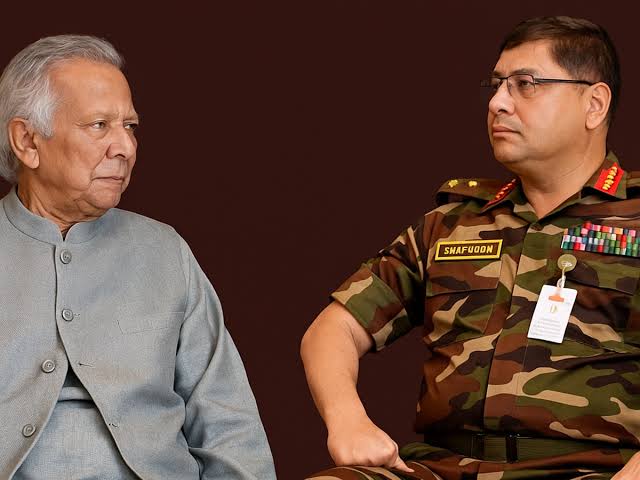
Bangladesh is witnessing a deepening political crisis as tensions escalate between the unelected caretaker regime led by Chief Adviser Muhammad Yunus and the country’s military establishment. What was once a transitional arrangement is now turning into a prolonged struggle for control, drawing widespread concern both within the country and in neighbouring India.
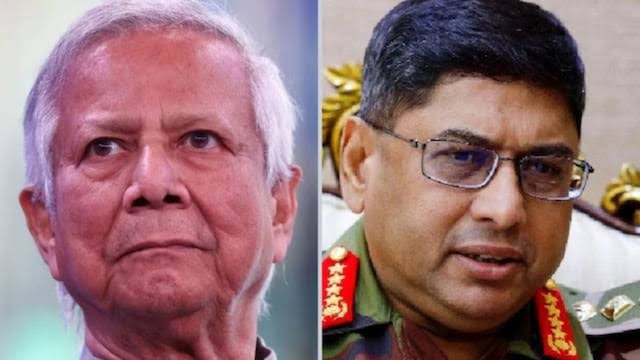

At the heart of the storm is the growing discontent of the Bangladesh Army, particularly under the leadership of General Waker-uz-Zaman. The army, which has traditionally played a stabilizing role in the nation’s politics, has voiced strong opposition to Yunus’ refusal to hold elections. In a rare public statement, General Waker emphasized the need for an elected government, asserting, “We must return to our barracks after the election.”
The flashpoint appears to be the controversial “Rakhine Corridor,” a proposed humanitarian route connecting Bangladesh’s Cox’s Bazar to Myanmar’s Rakhine state. Though presented as a humanitarian initiative, the corridor has raised alarm bells within the military and among regional experts. Critics, including General Waker, fear that it could serve as a conduit for foreign military logistics, undermine national sovereignty, and embroil Bangladesh in conflicts involving Myanmar’s military junta and various insurgent groups.
In recent weeks, Yunus’ international overtures have added fuel to the fire. From China and the U.S. to the Vatican and Qatar, he has visited nearly a dozen nations, raising suspicions that he is leveraging foreign relationships to prolong his grip on power. This impression was only reinforced when French President Emmanuel Macron reportedly refused to meet him, leading Yunus to cancel his trip altogether.
Meanwhile, back home, the political climate is increasingly volatile. Posters advocating “reforms before elections” and backing a five-year term for Yunus have cropped up across Dhaka. His support base includes radical student groups and Islamist parties such as Jamaat-e-Islami—factions that lack broad public appeal but are increasingly vocal. Yunus recently banned Sheikh Hasina’s Awami League, the country’s most popular party, raising fears that democratic opposition is being deliberately silenced.
India, a longstanding ally of Bangladesh, is watching these developments with a mixture of alarm and vindication. Relations with the Yunus regime have hit a low point. Trade tensions are rising, with Bangladesh restricting yarn imports and India responding in kind. Projects have stalled, and mutual trust has eroded. But beyond commerce, the strategic implications are more troubling. Yunus’ overtures to China—including a reported offer to allow Chinese access to the Lalmonirhat airbase near India’s vulnerable Siliguri Corridor—pose a direct security threat to India.
For New Delhi, General Waker, despite his imperfections, appears to be the only institutional force advocating for a return to democratic norms and resisting foreign interference. His firm stance against the Rakhine corridor and his insistence on holding elections by December 2025 align with India’s core concerns. However, the risk of a military takeover remains a real, albeit undesirable, possibility if Yunus continues to defy calls for democracy.
Sheikh Hasina, speaking from exile, has added her voice to the growing criticism of Yunus. In a passionate audio message, she accused him of “selling out” Bangladesh to foreign interests, invoking painful memories of her father’s assassination over similar refusals to cede sovereignty. Her words echoed the frustration of many Bangladeshis who feel that their country’s hard-won independence and democratic identity are now being traded for political survival.
Today, Bangladesh stands at a critical juncture. The current regime’s legitimacy is waning, while the country’s future hinges on its ability to return to democratic governance. Elections alone will not solve all the nation’s problems, especially given the rise of extremism and political violence. But a free, fair, and inclusive electoral process remains the only path forward to restore public trust and regional stability.
India and the international community must support this transition, not for strategic gains, but for the sake of the Bangladeshi people who deserve a government that is accountable to them—not to foreign powers or radical fringes. As history has shown, sovereignty cannot be safeguarded by unelected rule or foreign alliances—it can only be upheld by the will of the people.