
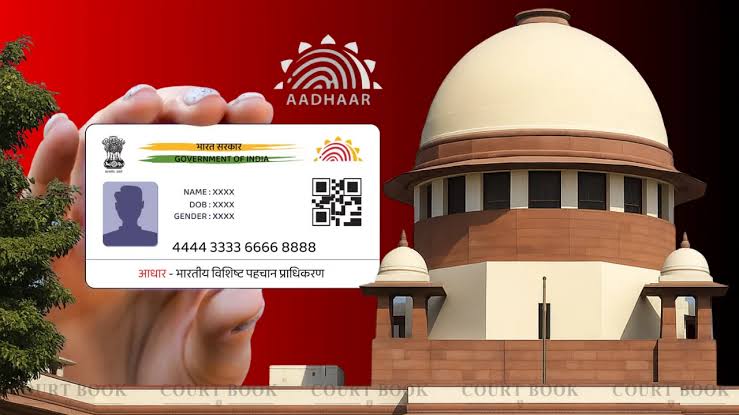
The Election Commission of India (ECI) has told the Supreme Court that Aadhaar cards, voter IDs, and ration cards are not valid on their own to prove voter eligibility. This comes during the ongoing Special Intensive Revision (SIR) of electoral rolls in Bihar.
ECI Defends Its Stance Before Supreme Court
On July 10, the Supreme Court had asked the ECI to reconsider including Aadhaar, voter ID, and ration cards as valid documents to confirm voter eligibility. But in a detailed affidavit submitted on July 21, the commission made it clear—none of these can be used as standalone documents to determine citizenship for voting rights.
The ECI asserted that only documents proving Indian citizenship should be used. It stressed that its constitutional powers under Article 324 allow it to manage all aspects of elections, including the voter registration process.


Why Aadhaar and EPIC Aren’t Enough
The poll body explained that Aadhaar and the Elector Photo Identity Card (EPIC) serve identification purposes but don’t confirm citizenship. Similarly, ration cards are meant for welfare benefits, not for determining nationality.
Therefore, accepting these alone could allow non-citizens to vote—something that goes against the very principle of free and fair elections.
SIR: A Constitutional and Inclusionary Exercise
The ongoing Special Intensive Revision (SIR) has sparked debates across political circles. But the ECI insists that SIR is a well-intentioned, inclusionary process to ensure the integrity of India’s electoral system. The aim is to weed out ineligible entries like deceased persons, duplicate voters, and non-citizens.
The Commission emphasized that a person denied voter registration is not losing citizenship. It’s simply a case of not fulfilling criteria under Article 326 for voting eligibility.
Massive Turnout in Bihar Enumeration
Despite political objections, ground-level data shows that the exercise is already making headway. As of July 18, 2025, the ECI has collected forms from over 7.11 crore voters in Bihar. That accounts for a whopping 90.12% of the state’s total 7.9 crore electors.
When adjusted for deaths, permanent relocations, and multiple registrations, the ECI says its coverage has reached 94.68%. This overwhelming participation supports the legitimacy of the SIR process.
Political and Legal Fallout
Several petitions have challenged the legality of the SIR. However, the ECI has called these petitions premature and unsupported by hard evidence. It argued that these were mostly based on media reports, not concrete facts.
The affidavit also claimed that most political parties had welcomed the revision drive and were cooperating at every stage. This collective support weakens the argument that the process is politically motivated.
What Happens Next?
The Supreme Court has yet to pass a final judgment. It has, however, directed that the draft rolls must not be finalised until further orders. Meanwhile, the ECI continues to defend its process, stating that its document list is “illustrative, not exhaustive.” This means more documents can be added, but only those that prove Indian citizenship.
Why This Matters to You
This case affects over 900 million eligible voters across India. If Aadhaar or voter ID alone won’t suffice, many may be excluded unless they provide additional citizenship proof. The decision will impact voter lists ahead of crucial state elections and Lok Sabha 2029.
It’s also a reminder for citizens to keep proper documentation ready—not just to access government schemes, but to exercise their democratic right.
Conclusion
The ECI’s stand may seem harsh, but it’s rooted in constitutional responsibility. By excluding Aadhaar, voter ID, and ration cards as sole proof, it hopes to preserve the sanctity of India’s electoral rolls. Whether the Supreme Court agrees will shape the future of voter identification in India.