
A Decade-Old Institution Becoming a National Scientific Force
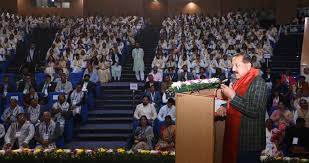
Dr. Singh highlighted that although AcSIR is just over a decade old, it has already cemented its status as one of the country’s most influential research ecosystems. He noted that the Academy has brought together talent from CSIR, ICMR, MoES, ICAR, DST, and top universities, forming a unique national hub for multidisciplinary scientific training.
He emphasised that AcSIR has “achieved far more than its age,” reflecting India’s rising scientific ambition under the leadership of Prime Minister Narendra Modi. Science and innovation, he said, have now become central to India’s economic growth, technology missions, and global competitiveness.


The Minister described the i-PhD program as a pathbreaking step that bridges the gap between academia and emerging industries. Every scholar in the program is required to develop a technology relevant to translational research or StartUps—making research training directly responsive to India’s industrial ecosystem.
“The ‘i’ in i-PhD stands for industry, imagination, and innovation,” Dr. Singh said, explaining how the program encourages scholars to create practical, scalable, and industry-ready solutions.
One of India’s Largest and Most Diverse Research Ecosystems
AcSIR currently hosts nearly 7,000 students mentored by more than 3,100 scientists across 79 campuses, making it one of India’s largest STEM research networks. The Academy has effectively evolved into a “shared national university” that unites scholars from across scientific disciplines and geographies.
Dr. Singh noted that the expansion of campuses and the surge in applications reflect India’s readiness for an institution that transcends traditional academic boundaries and accelerates deep-tech innovation.
Leading India’s Future in Frontier Technologies
As India aims to transition from the world’s fifth-largest economy to a technology-driven global leader, Dr. Singh said AcSIR scholars will serve as “torchbearers of this journey.” He identified several frontier domains where AcSIR-trained researchers are expected to play a critical role:
- Deep technology & AI
- Climate and Earth sciences
- Sustainable agriculture
- Health and biomedical research
- Advanced materials and energy sciences
National and Global Recognition
AcSIR’s growing stature is evident from its strong performance in leading national and international rankings, including:
- 9th in NIRF 2025 (Research Category)
- Top 3.5% globally in CWUR 2025
- 10th in Nature Index
- 9th in Scimago 2025
With over 25,000 publications, numerous patents, and 831 PhDs awarded in 2024 alone, AcSIR is now India’s largest doctoral research institution in STEM fields.
Expanding Global Presence
AcSIR has strengthened its international footprint through partnerships with top global institutions, including RMIT University, the University of Melbourne, Deakin University, the University of Western Australia, Turku University (Finland), and AIST Japan. These collaborations enable dual-degree pathways, joint supervision, and access to global research facilities.
Building a Vibrant Intellectual Culture
Dr. Singh praised AcSIR’s vibrant academic culture shaped by initiatives like the Dr. A.P.J. Abdul Kalam Transdisciplinary Lecture Series, the AcSIR Science Club, and the student-driven annual publication Bravura. He credited both faculty and students for nurturing a community of curiosity, creativity, and collaboration.
Dignitaries and Acknowledgements
The convocation was attended by prominent figures, including Chancellor Prof. P. Balaram, NITI Aayog member Dr. V.K. Paul, senior leaders of CSIR, and distinguished scientists. Dr. Singh especially acknowledged Director CSIR-IMTECH Dr. Manoj Dhar for his leadership in shaping one of CSIR’s youngest and most dynamic institutions.
A Call to Young Researchers
Concluding his address, Dr. Singh urged graduating scholars to continue driving India’s scientific and economic aspirations. He encouraged them to embrace innovation, entrepreneurship, and nation-centric research as India moves toward becoming a technologically self-reliant and globally competitive powerhouse.