
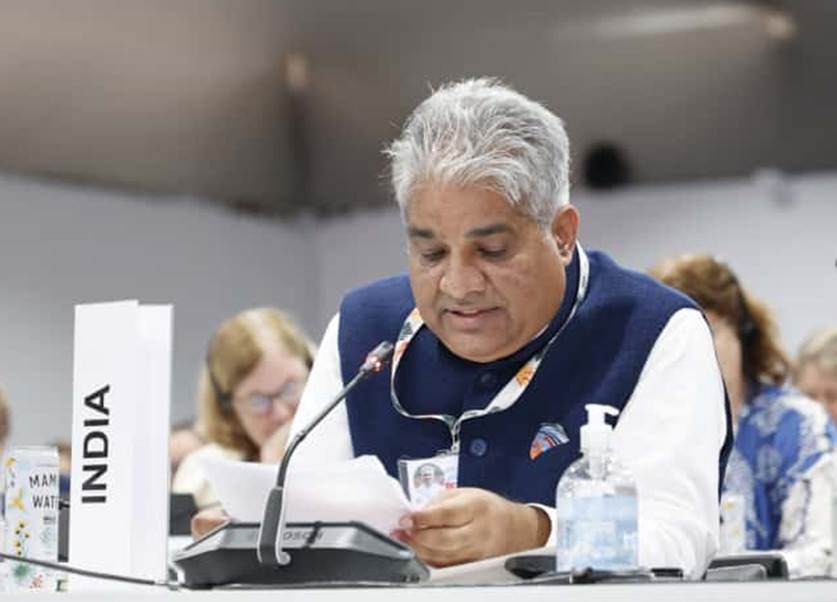
India flags widening gap and calls for global collective action
The minister warned that the Glasgow Pact target of doubling public adaptation finance from 2019 levels (to roughly $40 billion by 2025) risks being missed unless donors scale up support urgently. “It will take nothing less than a global collective effort to increase climate finance to the levels articulated in the Baku to Belém Roadmap,” he said, referring to the $1.3 trillion mobilisation goal by 2035.


Shri Yadav stressed India’s strong domestic commitment: adaptation-relevant spending in India rose by 150% as a share of GDP between 2016–17 and 2022–23, reflecting mainstreaming of resilience measures in national and state plans. He pointed to flagship efforts such as the National Adaptation Fund on Climate Change and the National Innovations in Climate Resilient Agriculture as examples of community-facing initiatives that have supported climate-resilient crops, soil restoration and improved water efficiency.
Yet the minister cautioned that many promising pilots remain small in scale due to limited finance, technology and capacity — reinforcing his call for easier, predictable access to international adaptation finance.
Barriers to access: transaction costs, capacity, and risk
India identified a set of systemic barriers constraining adaptation finance: slow multilateral fund processes, high transaction costs, limited institutional capacity at national and sub-national levels, weak revenue streams for projects, and inadequate risk-sharing instruments that deter private capital.
Shri Yadav urged developed countries and fund managers to streamline access, boost readiness support, and prioritise grant-based and concessional instruments to prevent debt burdens on vulnerable economies.
Principles for the Global Goal on Adaptation and next steps
Reaffirming India’s principled stance, the minister said adaptation must remain country-driven, gender-responsive, inclusive and rooted in science and traditional knowledge. He recommended that indicators under the Global Goal on Adaptation (GGA) remain voluntary, non-prescriptive and nationally interpreted to avoid onerous reporting that could hamper implementation.
Shri Yadav urged a shift from expert-led to Party-driven engagement so countries can assess feasibility, identify capacity needs and align proposed approaches with national planning before scaling them up internationally.
What the minister wants from CoP30 and CoP31
India called for CoP30 to send a clear political message: adaptation is essential and deserves predictable finance. The minister urged greater readiness support, reduction in transaction costs, and stronger information-sharing to scale up locally proven solutions in agriculture, water security, resilient infrastructure and ecosystem restoration.
“Adaptation finance must improve in both quantity and quality and must be provided through grants and not debt-creating instruments,” Shri Yadav said, adding that global ambition will be judged by real improvements in the resilience of communities, ecosystems and economies.