
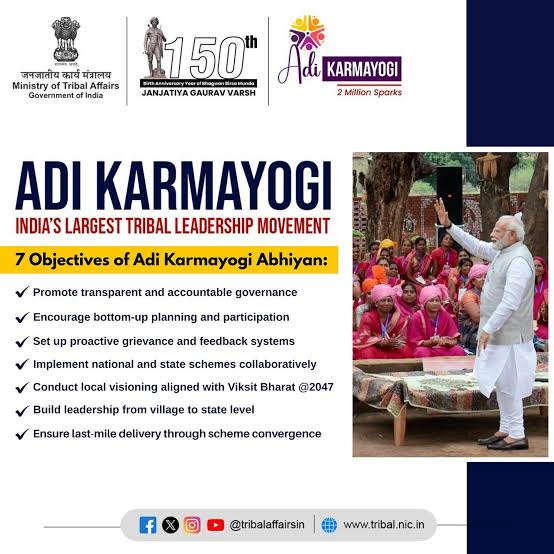

The Adi Karmayogi Abhiyan is designed around three core outcomes: the establishment of Sewa Kendras as single-window centers for grievance redressal and services, the saturation of critical welfare schemes, and the formulation of Village Action Plans under the Village Vision 2030 framework. These steps aim to institutionalize responsive governance and ensure convergence of flagship schemes across departments.
State representatives showcased best practices in community mobilization, institutional convergence, and capacity-building. Emphasis was placed on digitization of Forest Rights Act (FRA) titles, Community Forest Resource Management Plans, and reconciling conservation with tribal rights in tiger reserves. Discussions also highlighted the role of PM-JANMAN in reaching underserved tribal households.
Launch of Adi Sanskriti Platform
One of the key highlights was the launch of the beta version of “Adi Sanskriti”, a digital platform showcasing tribal culture, knowledge, and livelihoods. Introduced by Shri Uikey, the portal will function as:
- An e-learning hub offering courses on tribal art forms, cuisine, and dance traditions.
- A repository of cultural heritage, preserving indigenous knowledge and practices.
- An online marketplace to promote tribal products and create sustainable livelihood opportunities.
This initiative is expected to connect India’s tribal communities with global audiences, promoting both cultural preservation and economic empowerment.
Deliberations and Roadmap
Day one of the conference featured the release of the Adi Karmayogi Abhiyan Status Report and a keynote by Secretary of Tribal Affairs Shri Vibhu Nayar on “The Role of Tribal Leadership in Viksit Bharat @2047.” Breakout sessions reviewed progress on District and Block Process Labs, training of master trainers, and preparations for Special Gram Sabhas on October 2, 2025 under the Adi Sewa Parv.
The second day focused on consolidating learnings into a roadmap of ten critical activities, including timely conduct of Village Action Plans, operationalizing Adi Sewa Kendras, and strengthening livelihood linkages for FRA patta holders. States also showcased 20 best practice models, highlighting innovations in digital monitoring, CSO partnerships, and grassroots mobilization.
Strengthening Tribal Leadership for the Future
The conference concluded with a call to embed the mechanisms of Adi Karmayogi Abhiyan into local governance structures and Panchayati Raj institutions. Participants stressed that Adi Sewa Hour, Village Action Plans, and Adi Sewa Kendras must become permanent fixtures of tribal governance to ensure sustainability.
The Abhiyan is positioned as a cornerstone of India’s tribal empowerment journey, aiming to empower millions of tribal citizens, preserve cultural identity, and foster inclusive growth. By combining responsive governance with digital innovation, it seeks to place tribal leadership at the heart of India’s development story.