
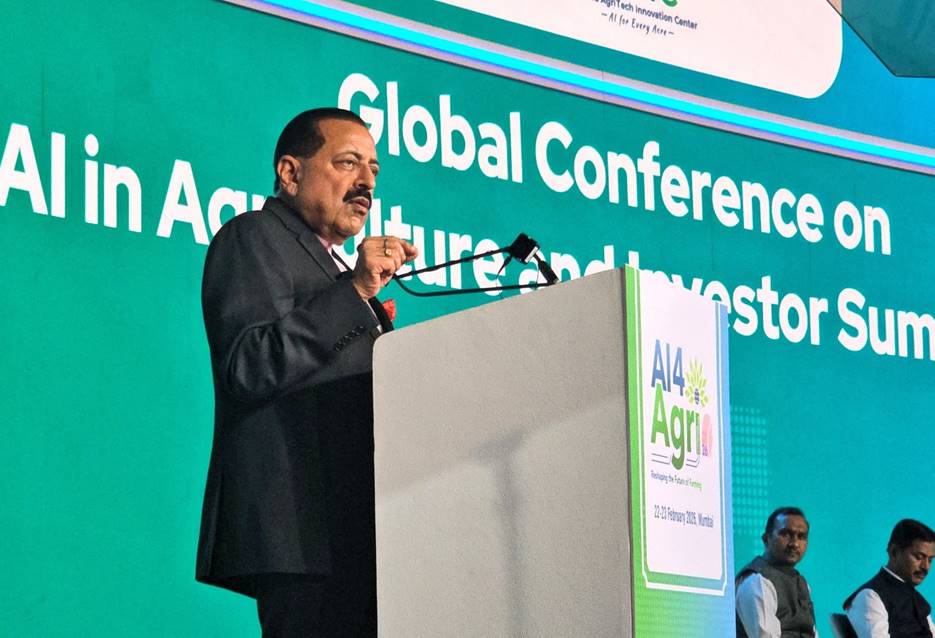
“What AI offers is not a new diagnosis. It offers, finally, a prescription that can scale,” he said, referring to persistent issues such as erratic weather, fragmented landholdings and information gaps that affect millions of farmers.
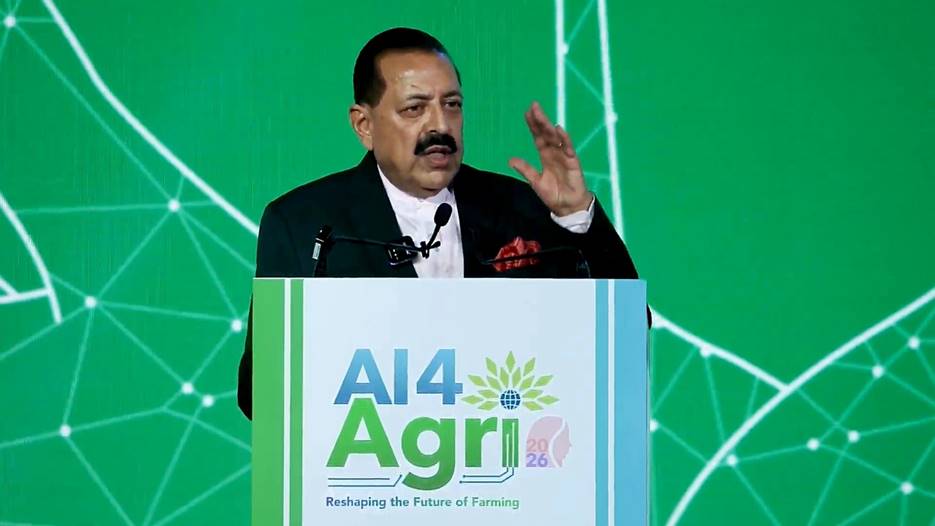

Dr Singh highlighted that India’s nearly 140 million farm holdings, mostly small and marginal, stand to gain significantly from AI-enabled advisory services. If each farmer saves just ₹5,000 annually through better crop planning, pest prediction and market linkages, the combined value could reach an estimated ₹70,000 crore per year.
He described agri-AI as the “largest untapped productivity market in the world,” urging investors to back scalable platforms rather than limited pilot projects. According to him, even a 10 percent productivity gain across the Global South’s vast farming population could become the single biggest poverty-reduction opportunity of this century.
India AI Mission and BharatGen
The Minister linked the agricultural push to the ₹10,372-crore India AI Mission, which aims to build sovereign compute infrastructure, curated datasets and startup support systems. More details about the initiative are available on the official portal of the Ministry of Electronics and IT.
He also highlighted BharatGen, India’s government-owned large language model ecosystem. Under this initiative, “Agri Param,” a domain-specific agriculture model, has been launched in 22 Indian languages. This multilingual capability ensures that farmers can access advisory support in their native languages, enhancing inclusivity and digital adoption.
National Agri-AI Research Network Planned
Calling for a federated architecture, Dr Singh announced plans to build a National Agri-AI Research Network. The proposed collaboration will involve the Department of Science and Technology (DST), state governments, ICAR, ICRISAT and other global research institutions.
The objective is to create India-specific foundational datasets covering crops, soil types and climate zones. He emphasised that small, purpose-built AI models tailored to Indian conditions would be more effective than generic global systems.
He further suggested that digital public infrastructures such as state-level agri platforms should evolve into a national Agri Data Commons framework to ensure interoperability and transparency.
Climate Intelligence, Drones and Biotechnology
Dr Singh noted that drone and satellite mapping technologies are already strengthening initiatives such as Soil Health Cards and the Swamitva Mission by providing verified land and soil data. Integrating Earth Sciences with AI, he said, would help build early warning systems so that farmers can “plan, not panic.”
Biotechnology will also play a key role in developing disease-resistant and climate-resilient crops. The Minister pointed to advancements in early asymptomatic detection of pest and plant diseases as critical to reducing crop losses.
Budget Push and Bharat-VISTAAR
The Union Budget 2026–27 has proposed “Bharat-VISTAAR,” a multilingual AI tool integrating AgriStack portals and ICAR’s best-practice packages. The platform aims to deliver customised advisories and reduce farm risk by combining real-time data with AI systems.
Dr Singh underscored that these solutions are being designed to function even in low-connectivity rural areas through mobile devices and farm equipment, ensuring last-mile delivery.
Concluding his address, he said India intends to be a co-architect of global agri-AI frameworks rather than merely a technology recipient. “The farmer does not need AI simply for the sake of it. He needs it to be useful. Let that be our compass,” he remarked.