
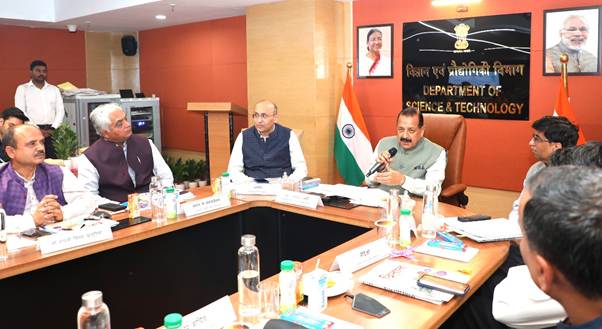
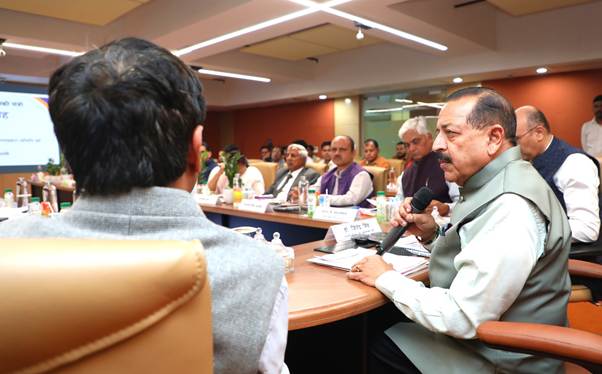

Dr. Singh highlighted that the integration of Hindi in scientific discourse is crucial for advancing India’s self-reliance in research and innovation. He stated that “the promotion of Hindi in science and technology is not merely linguistic it is a strategic move towards national empowerment.”
He observed that Hindi is increasingly being adopted by employees from southern India, signaling its growth as a unifying communication language across regions. “Hindi is emerging as a pan-Indian medium that bridges linguistic gaps and connects scientific communities,” he remarked.
AI-driven Translation Transforming Knowledge Access
Focusing on the role of technology, Dr. Singh said that AI-driven translation platforms are making complex scientific information more accessible to Hindi-speaking audiences. These tools, he explained, are “enhancing the dissemination and interpretation of scientific content in Hindi,” ensuring that knowledge reaches citizens in their preferred language.
He also emphasized that all Ministry websites should be equally functional in Hindi, allowing users to access research updates, publications, and policy documents in both English and Hindi. This, he added, would democratize information and make science more inclusive.
Encouraging Hindi Excellence in Government Work
The Minister announced that employees and officers who demonstrate excellence in Hindi communication will be recognized and awarded. He encouraged ministries and departments to actively use Hindi in official work and documentation to strengthen its institutional presence.
Dr. Singh also noted that the University Grants Commission (UGC) is providing Hindi-based digital tools and resources for government employees. These efforts, he said, are helping bridge the gap between science communication and the general public.
Equal Promotion for Regional Languages
While stressing the importance of Hindi, Dr. Singh also underlined that the promotion of regional languages is equally vital. “India’s scientific and technological advancement must reflect the linguistic diversity of our nation,” he said. Hindi and regional languages together, he added, can act as powerful engines of innovation and communication.
He reiterated that linguistic inclusivity strengthens India’s democratic and scientific foundations by ensuring that knowledge is not limited by language barriers. “Our goal should be to make science reach every citizen in their mother tongue,” Dr. Singh stated.
Committee Recommendations
During the meeting, members of the Hindi Advisory Committee recommended greater use of Hindi in departmental proceedings and official communication. They suggested that scientific materials, reports, and training content should be regularly translated into Hindi and disseminated widely.
Committee members also proposed the enhanced use of social media platforms to spread Hindi content and promote the achievements of Indian science in native languages. Recognizing employees who actively use Hindi in their work was identified as another key motivation strategy.
Building a Technological Bridge for Language Inclusion
Concluding his address, Dr. Jitendra Singh reaffirmed that combining AI technology with Hindi and regional languages will enable India to achieve linguistic inclusivity in science and technology. He said this approach aligns with the government’s Digital India and Viksit Bharat 2047 vision, ensuring that scientific knowledge is not confined to English-speaking elites but becomes a shared national resource.
The meeting was attended by Secretary DST, Prof. Abhay Karandikar; Secretary DBT, Dr. Rajesh S. Gokhale; CEO ANRF, Dr. Shivkumar Kalyanaraman; and senior officials from various departments.
By leveraging AI, translation tools, and language diversity, the Ministry of Science and Technology aims to build a knowledge ecosystem that empowers every Indian to engage with science in their own language truly embodying the spirit of “One Nation, Many Languages.”