 National Incubator Assessment Framework Unveiled
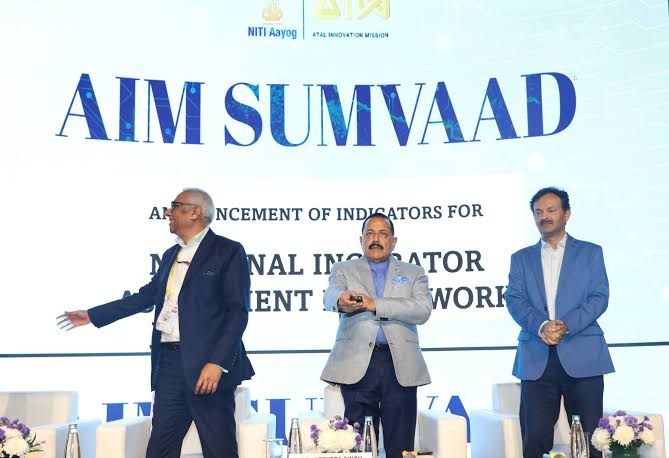
A key highlight of the conclave was the announcement of the National Incubator Assessment Framework indicators by the Hon’ble Minister of State (Independent Charge) for Science and Technology, Dr Jitendra Singh. The framework is a joint initiative of AIM, the Department of Biotechnology (DBT), the Department of Science and Technology (DST) and the Department for Promotion of Industry and Internal Trade (DPIIT).
Dr Singh said the framework would evolve into a centralised digital national repository, enabling transparency, benchmarking and peer learning across incubators. He noted that the initiative would foster healthy competition, improve institutional confidence and help stakeholders assess impact and scale innovation more effectively.
India’s Expanding Innovation Landscape
Highlighting the transformation driven by the Atal Innovation Mission, Dr Singh said that nearly 50,000 Atal Tinkering Labs have ensured that innovation reaches almost every district of the country. He observed that India’s startup ecosystem has grown from just 350 startups to over two lakh, generating more than 21,000 jobs and reshaping national attitudes towards entrepreneurship.
Referring to the Union Budget 2026–27, the Minister pointed to strong alignment between national priorities and innovation-led growth, particularly in bio-manufacturing, biotechnology, bio-refinery and bio-pharma. He also highlighted India’s growing global standing in bio-capacity.
Incubators as Strategic National Infrastructure
Speaking at the conclave, Principal Scientific Adviser to the Government of India, Prof. Ajay Kumar Sood, emphasised the evolving role of incubators as strategic national infrastructure. He noted that deep-tech startups would be critical for India’s development, adding that a significant share of startups must emerge from advanced technology domains.
NITI Aayog Vice Chairperson Shri Suman Bery reinforced this view, stating that India’s aspiration of achieving Viksit Bharat 2047 depends on faster growth driven by productivity and startup-led innovation.
Policy, Industry and Startup Collaboration
CEO of NITI Aayog Shri B.V.R. Subrahmanyam highlighted AIM’s unique presence across schools, colleges, communities and global networks. He said that with nearly 10 percent of India’s incubators under AIM, the mission is actively shaping markets and nurturing innovation at every level.
The conclave also featured a Trailblazer session on artificial intelligence, along with insights from startup founders and investors, who discussed pathways from innovation to scale and the importance of long-term capital for deep-tech ventures.
Strengthening India’s Incubation Ecosystem
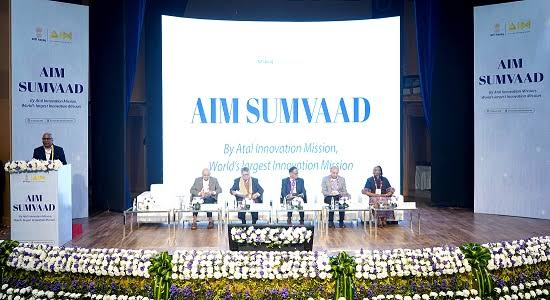
Discussions during AIM SUMVAAD underscored the need for incubators to function as Technology Transfer Organisations, enabling commercialisation of research, intellectual property management and startup scale-up. Sessions also explored the role of language diversity, cultural context and ethical AI in shaping inclusive innovation ecosystems.
With over 5,000 startups incubated and more than 50,000 jobs created, AIM-supported incubators were recognised as a cornerstone of India’s innovation economy. The conclave reaffirmed AIM’s role as an umbrella institution driving collaboration between government, industry, academia and civil society.