
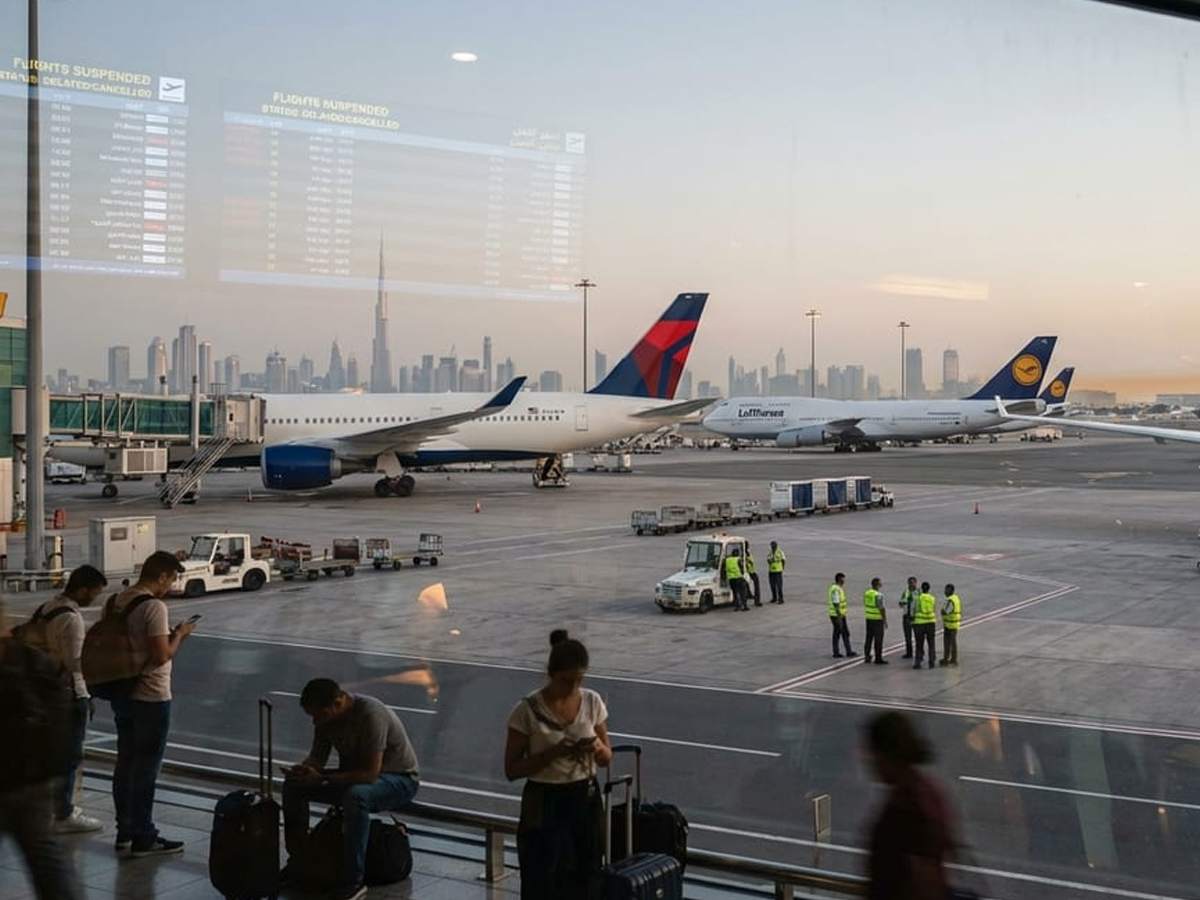
New Delhi: Indian airlines are scrambling to maintain westbound connectivity to the United States and Europe after escalating tensions in the Middle East forced widespread airspace closures, triggering hundreds of flight cancellations and major rerouting operations.
The Ministry of Civil Aviation (MoCA) confirmed it is closely coordinating with airlines and airport operators to manage passenger support and monitor operational safety.


Air India, currently the only Indian carrier operating direct services to the United States, said all its North America-bound flights will operate as scheduled starting Monday. However, the airline cancelled nearly 50 international flights on Sunday due to the airspace crisis.
Flights to destinations including the UAE, Saudi Arabia, Israel and Qatar were suspended until late Monday night. Select European services were also cancelled, including specific sectors to Birmingham, Zurich and Copenhagen.
To keep transatlantic routes operational, Air India announced that flights to New York’s JFK and Newark airports will operate with technical stops at Rome’s Fiumicino Airport. Other Europe and North America services will use alternative routings through available airspace, increasing travel time by up to two hours in some cases.
IndiGo Cancels 360 Flights
IndiGo, India’s largest airline by market share, announced cancellation of approximately 360 flights until March 3. The airline has extended flexibility options and fee waivers for affected passengers.
Airspace closures across Tehran, Kuwait, Israel and Baghdad Flight Information Regions have severely impacted the northern corridor typically used for India-Europe overflights. Industry officials described the closure of the Baghdad FIR as particularly disruptive.
Doha’s airspace has also remained restricted since late February, further complicating route planning for carriers operating westbound services.
Operational and Financial Impact
Aviation analysts estimate that the weekly financial impact on Indian and international airlines operating to and from India could run into hundreds of crores. The simultaneous closure of Pakistani, Iranian and certain Gulf airspaces has effectively blocked the most efficient routes to Europe and the US.
Experts warn that avoiding Middle Eastern airspace not only increases fuel consumption and crew costs but also lengthens flight durations significantly. Technical stops, such as those planned in Rome, add logistical complexity but are being used as temporary solutions.
The Directorate General of Civil Aviation (DGCA) continues to assess the evolving situation and issue advisories through its official portal at dgca.gov.in.
Metro Airports Under Strain
The cascading effect of cancellations and diversions has begun to strain metro airports. Mumbai recorded the highest number of cancellations, with around 160 flights affected. Delhi reported over 20 cancellations and accommodated diverted aircraft.
Due to shortage of aircraft parking stands, Mumbai temporarily declined diversion traffic and issued a Notice to Airmen (NOTAM) restricting additional diversions until Monday morning. Ahmedabad also briefly limited diversion acceptance.
Other major hubs, including Bengaluru, Hyderabad, Chennai and Kolkata, reported varying levels of cancellations as airlines recalibrated schedules in what officials described as a fluid operational scenario.
Dynamic Decision-Making
Industry insiders indicated that contingency planning had been underway for over two weeks amid rising regional tensions. However, the rapidly changing security environment has forced airlines to make operational decisions on a day-to-day basis.
While immediate improvements in airspace availability appear unlikely, airlines remain focused on preserving essential connectivity between India and key global destinations.
Passengers are advised to check flight status regularly and stay in touch with airlines for updates. As the Iran conflict continues to reshape global aviation routes, Indian carriers face one of their most complex operational challenges in recent years.