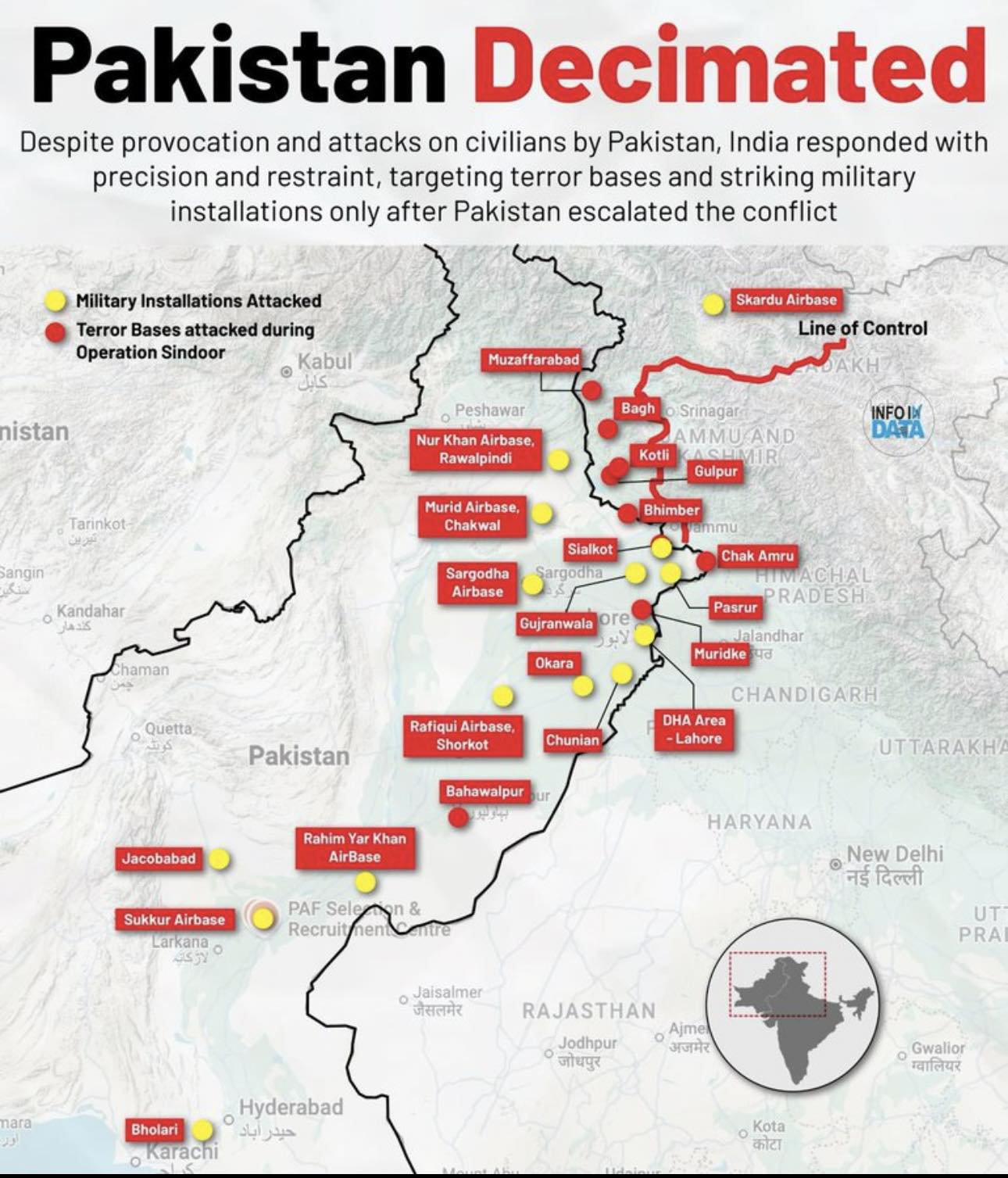
The ongoing military conflict has torn down the walls of secrecy, exposing deep-rooted divisions and revealing long-suppressed truths. It has also dismantled misleading historical narratives, stripping away the illusions that have dictated geopolitical perceptions for decades.
Geopolitics thrives on perception, and few narratives have been as strategically crafted as Pakistan’s nuclear capabilities. Often paraded as a testament to national sovereignty, Pakistan’s nuclear infrastructure, when stripped of its layers of secrecy, appears less like an independent defense system and more like an extension of American strategic interests.
For decades, Pakistan’s nuclear threats have proven to be political posturing rather than actionable deterrence. The remote access and ultimate control of its nuclear facilities rest with Washington, a fact that becomes increasingly apparent with each conflict. The origins of these bases date back to Cold War calculations, with America seeking to counter both Soviet expansionism and India’s regional ascendancy. Whenever these installations face potential threats—especially from India—Washington responds with urgency, not out of concern for Pakistan’s sovereignty, but to safeguard its own strategic investments.
Pakistan’s financial reliance on the U.S. is inextricably linked to the presence of these bases. American aid, though often framed as economic support, is a calculated exchange—continued military assistance in return for hosting strategic assets. The assertion that F-16 fighter jets were supplied solely for counterterrorism operations in Afghanistan crumbles under scrutiny. Their use in the Balakot airstrike and Operation Sindoor provides compelling evidence that these aircraft were deployed with a different purpose—strengthening Pakistan’s position against India.
Another persistent geopolitical fiction involves Israel’s supposed intent to destroy Pakistan’s nuclear sites—an idea that, upon closer examination, dissolves into myth. Two fundamental contradictions expose the implausibility of this claim:
1) Had Israel genuinely sought to neutralize Pakistan’s nuclear bases, it possessed the technological capability to execute the mission independently rather than seeking external assistance.
2) Israel’s deep strategic dependence on the U.S. in the 70s and 80s made such an attack unfeasible. Both Israel and Pakistan were functioning within America’s geopolitical framework, making it highly improbable that Israel would disrupt a nuclear program aligned with Washington’s broader interests.
The notion that America intervened out of fear of a nuclear exchange is a simplistic reading of events. Washington’s primary concern was the potential compromise of its own nuclear bases in Pakistan. With five decades of military investment embedded in Islamabad’s defense apparatus, the U.S. is unlikely to allow these assets to be jeopardized under any circumstances.
Looking ahead, America will likely dispatch teams to assess Pakistan’s nuclear sites for potential vulnerabilities and ensure operational integrity. If weaknesses are detected, corrective measures will swiftly follow. The possibility of deploying U.S. Patriot missile defense systems in Pakistan is also under discussion—a move that would further entrench American strategic control over the region’s nuclear landscape.
Regardless of whether the White House is occupied by Trump or Biden, the United States’ policy towards Pakistan remains dictated by cold strategic calculus rather than shifting political leadership. For India, this reality serves as a reminder of the enduring complexities of South Asian nuclear diplomacy.
[With inputs from FB post of Mr Avijit Sahai]