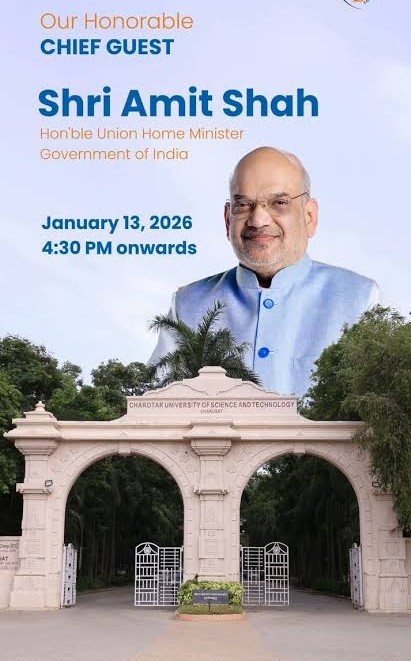
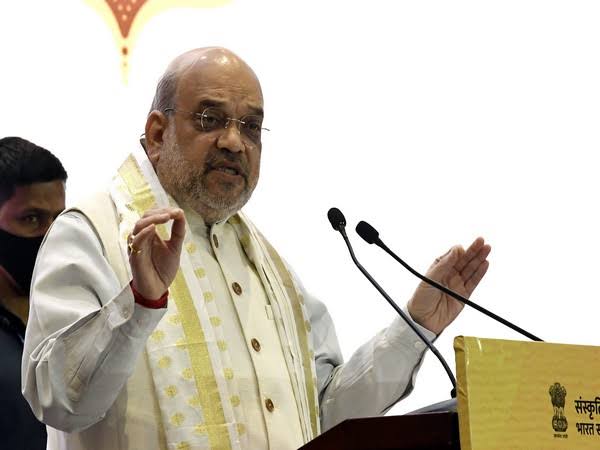
Union Home Minister and Minister of Cooperation Shri Amit Shah on Tuesday addressed the 15th Convocation Ceremony of Charotar University of Science and Technology (CHARUSAT) in Anand district of Gujarat, calling upon the youth to combine education with character and dedicate their lives to nation-building. Addressing thousands of graduating students, Shah said that India’s journey towards becoming a global leader by 2047 will be driven by today’s educated and value-oriented young generation.
 Education Must Build Character
Quoting Sardar Vallabhbhai Patel, Shah reminded students that “education without character building is meaningless.” He underlined that knowledge alone cannot bring welfare to society unless it is guided by integrity, discipline, and responsibility. Education, he said, should shape individuals who are conscious of their duties towards society and the nation, not merely focused on personal success.
Shah urged graduates to reflect not only on what they wish to become in life but also on what they intend to give back to society and the country. According to him, a clear sense of purpose is essential for achieving meaningful success and contributing to national progress.
Youth at the Centre of Amrit Kaal
Highlighting that the students are graduating during India’s “Amrit Kaal,” Shah described the period between 75 and 100 years of Independence as both a time of opportunity and responsibility. He noted that India has made significant progress since 2014, moving from the 11th to the 4th largest economy in the world, with a target to become the third largest economy by 2027.
This economic rise, he said, has created a strong platform for Indian youth to compete globally. With expanding opportunities in manufacturing, technology, innovation, and entrepreneurship, the coming decades belong to India’s young minds.
India’s Global Rise Under PM Modi
Shah credited Prime Minister Narendra Modi’s leadership for establishing a tradition of sustainable development over the past 11 years. He said India has emerged as a global manufacturing hub and a key player in sectors such as green energy, space technology, defence production, pharmaceuticals, and semiconductors.
In pharmaceuticals alone, India now produces around 60 percent of the world’s medicines. The country’s rapid progress in green hydrogen, space missions, and defence manufacturing has earned global recognition, he added.
Transformations in Higher Education
Emphasising reforms in higher education, Shah said the last decade has witnessed fundamental changes in infrastructure and access. The number of higher education institutions has risen from 51,000 before 2014 to 71,000 today. Universities have increased from 760 to 1,391, while medical colleges have more than doubled.
MBBS seats have increased from 51,000 to over 1.29 lakh, and postgraduate medical seats have nearly tripled. These reforms, Shah said, are aimed at ensuring that India’s youth are equipped with quality education and ample opportunities for growth.
Six Messages for the Youth
Sharing personal guidance, Shah offered six key messages to the graduating students. He urged them to dream big, overcome the fear of failure, and work relentlessly. He encouraged technically trained youth to use technology for social good and stressed the importance of lifelong learning.
He also cautioned against shortcuts in acquiring knowledge and reminded students that nothing stands above the nation. Every effort, he said, should be aligned with the vision of making India a developed and leading nation by 2047.
Charotar’s Legacy of Cooperation
Recalling the contributions of Charotar region to India, Shah mentioned leaders like Sardar Vallabhbhai Patel and Tribhuvandas Patel. He highlighted the success of Amul, founded on cooperative principles, which today stands as the world’s largest cooperative with a turnover of over ₹1 lakh crore.
He said the establishment of Tribhuvan Sahkari University in Anand reflects the enduring relevance of cooperation in India’s development journey, a model admired globally.