He emphasized that Delhi, being the nation’s capital and the center of democratic institutions, demands security standards of the highest global level. The presence of the President’s and Prime Minister’s offices, along with frequent international events, significantly increases the responsibility of the force, he said.
 Modern Infrastructure to Boost Counter-Terror Capabilities
Shah laid the e-foundation stone for the Integrated Headquarters of Delhi Police’s Special Cell, being constructed at a cost of ₹368 crore. He described it as one of the country’s most modern facilities to tackle narcotics networks and terrorism.
The new complex will house an advanced indoor firing range, cyber laboratory, war room, training facilities, and other state-of-the-art infrastructure. The Home Minister said it would serve as a model for police forces across India.
He also inaugurated the first phase of the Safe City Project worth ₹857 crore, including the Integrated Command, Control, Communication and Computer Centre (C4I). Under the initiative, 2,100 new cameras have gone live, and over 15,000 existing cameras have been integrated into the system.
Golden Era of Internal Security
The Home Minister asserted that the 12-year period from 2014 to 2026 under Prime Minister Narendra Modi’s leadership would be remembered as a “golden era” in India’s internal security history.
He highlighted progress made in tackling three longstanding challenges Jammu and Kashmir, Left-wing extremism, and unrest in the Northeast. According to Shah, more than 10,000 youths in the Northeast have joined the mainstream following multiple peace agreements.
On Naxalism, he declared that the government is close to completely eliminating the threat and aims to make India free from Naxal violence before March 31, 2026.
New Nyaya Sanhita to Transform Justice Delivery
Shah said the implementation of the three new Nyaya Sanhitas would significantly modernize India’s criminal justice system. He noted that colonial-era laws have been replaced with a justice-centric framework that integrates technology and accountability.
He stated that within two years of full implementation, any FIR registered anywhere in the country would reach a final decision up to the Supreme Court within three years. The reforms are expected to increase the conviction rate substantially.
The new laws provide legal backing to e-FIR and Zero FIR, mandate forensic visits for serious crimes, and define terrorism explicitly. They also introduce trial in absentia for fugitives and allow attachment of properties of declared offenders abroad.
Technology-Driven Policing and Border Security
The Integrated Criminal Justice System (ICJS) now digitally links police, judiciary, forensic science, prosecution, and prisons. Electronic and digital records have been granted legal recognition.
Shah also announced plans to expand CCTV coverage across the country to build a stronger security network. The Ministry of Home Affairs will focus on modernizing border infrastructure to ensure that no infiltrator is able to cross India’s borders.
He stressed that security modernization, strict enforcement, and swift justice are central pillars of the government’s approach to internal security.
Delhi Police’s Expanding Role
The Home Minister praised Delhi Police for its track record in handling high-profile terror investigations, cybercrimes, organized crime syndicates, and narcotics cases.
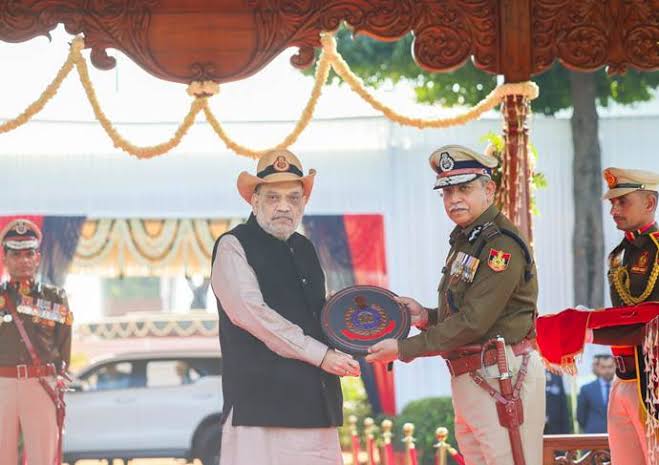
He said the modernization projects announced on Raising Day would empower the force further and enhance public safety in the capital. Delhi Police Commissioner Shri Satish Golchha and other senior officials were present at the ceremony.
Detailed information about the event and initiatives is available on the Press Information Bureau website (https://pib.gov.in) and the Ministry of Home Affairs portal (https://mha.gov.in).