
Kolkata | June 1, 2025
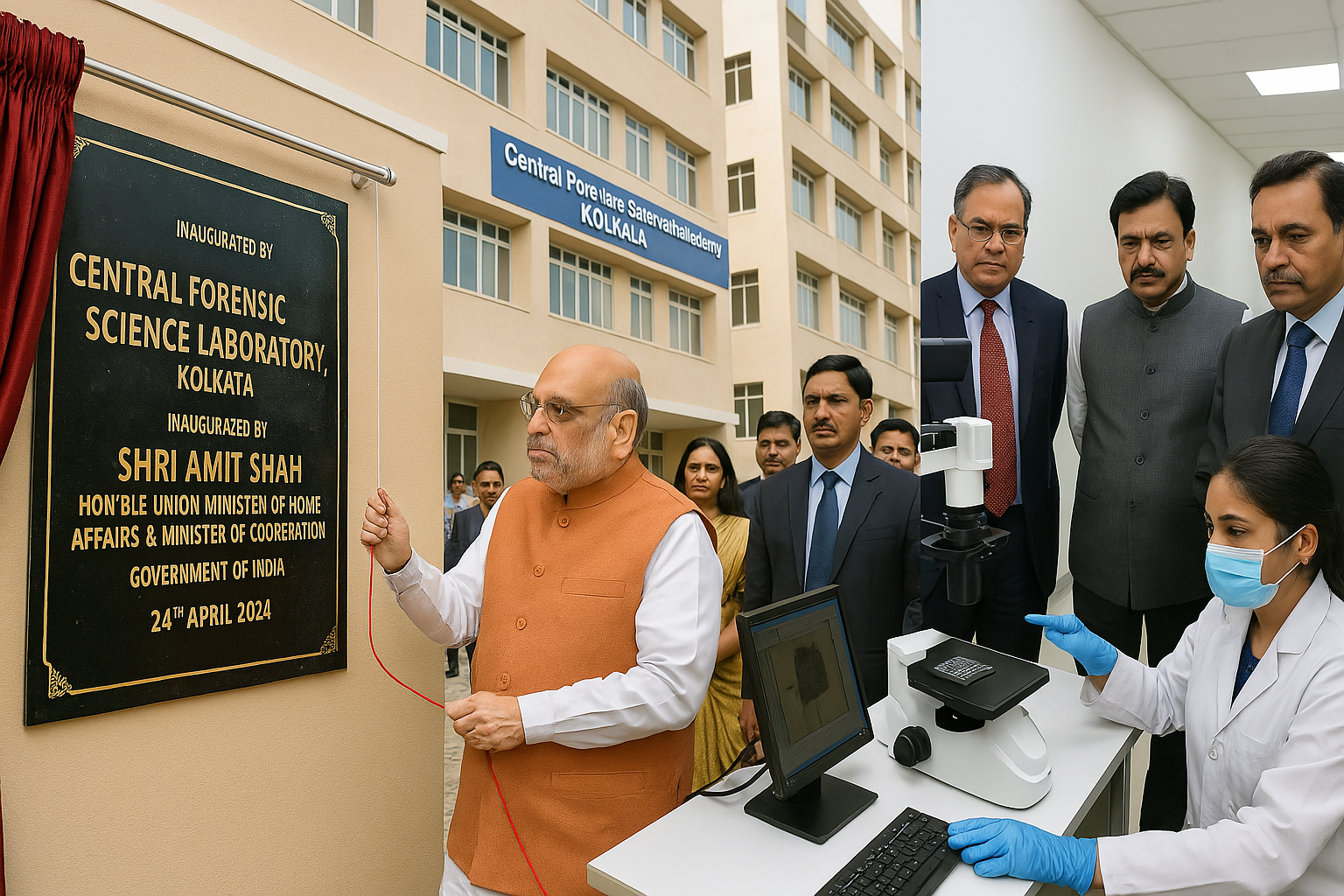
In a landmark move towards modernizing India’s criminal justice system, Union Home Minister and Minister of Cooperation, Shri Amit Shah inaugurated the newly constructed Central Forensic Science Laboratory (CFSL) building in Kolkata, West Bengal. The lab, built at a cost of ₹88 crore, aims to serve not just West Bengal, but also neighboring states including Jharkhand, Bihar, Odisha, Assam, Sikkim, and the entire Northeast.
This inauguration marks a critical step in the Government of India’s broader mission — under the leadership of Prime Minister Narendra Modi — to establish a secure, transparent, and evidence-based criminal justice system.
A Major Boost to Forensic Infrastructure
Speaking at the event, Shri Amit Shah emphasized that the CFSL in Kolkata is a vital addition to the national vision of transforming India’s justice system from one based on arguments to one rooted in scientific evidence. The lab will support police investigations, prosecutors, and courts in building stronger, fact-based cases, ensuring that the guilty cannot escape justice and the innocent are protected.
To promote this transformation, the Modi government is planning a forensic mobile van in every district and a National Forensic Science University (NFSU) in every major state. Currently, 16 campuses have been approved, with 7 already operational. The target is to graduate 36,000 trained forensic professionals annually, exceeding the national requirement of 30,000.
New Laws to Support Evidence-Based Trials
The inauguration comes in the wake of India’s new criminal laws — Bharatiya Nyaya Sanhita (BNS), Bharatiya Nagarik Suraksha Sanhita (BNSS), and Bharatiya Sakshya Adhiniyam (BSA) — replacing 160-year-old colonial laws. These new laws legally mandate forensic science team visits for serious crimes (punishable by over 7 years), ensure faster filing of charge sheets (within 60 days in nearly 60% of cases), and support trial in absentia for absconders through international cooperation.
Shah highlighted that these laws also account for technological advancements expected in the next 100 years, and make the use of digital forensics, psychological profiling, and call detail analysis part of the legal process.
Cluster Approach & Awareness Campaign
To expand forensic access, the government will adopt a cluster approach — grouping 3–4 states together to share forensic resources. Starting January 2026, a nationwide awareness and training campaign will be launched targeting every police station, public prosecutor, and court official to promote the use of forensic science in criminal justice.
Shah noted that forensic audits have already helped uncover major financial scams and DNA evidence has led to convictions in 20-year-old cases, demonstrating the transformative power of science in law enforcement.
Strengthening National Capabilities
The Ministry of Home Affairs is investing ₹2,080 crore to modernize forensic capabilities and build a National Forensic Data Centre at a cost of ₹200 crore. Additionally, 9 new NFSU campuses and 7 more CFSLs will be established in Uttar Pradesh, Chhattisgarh, Odisha, Rajasthan, Tamil Nadu, Kerala, and Bihar, enhancing national coverage.
Currently, 17,184 police stations are connected through the Crime and Criminal Tracking Network System (CCTNS), making data sharing and real-time updates possible across the nation.
Justice for All, Especially the Poor
Shri Amit Shah concluded with a powerful message: “Even the poorest person in India should be able to walk into a police station with dignity, confidence, and the assurance of timely justice.” He emphasized that the government is committed to making this a reality through advanced laws, modern forensic infrastructure, and nationwide training programs.