
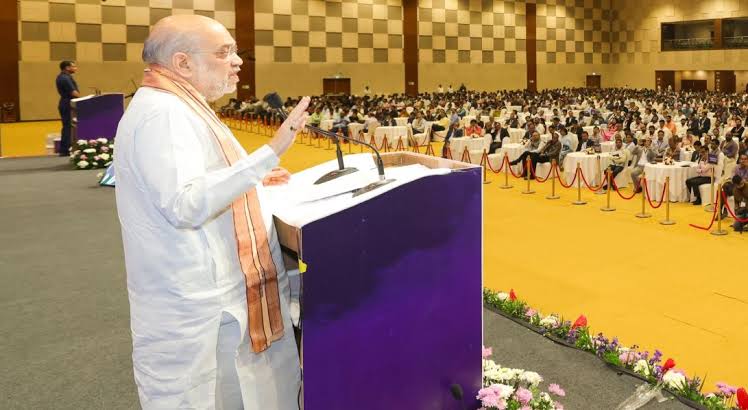
New Delhi, February 16: Union Home and Cooperation Minister Shri Amit Shah will chair a high-level “Manthan” meeting of Cooperation Ministers from States and Union Territories on February 17 in Gandhinagar, Gujarat. The meeting is expected to shape the next phase of reforms in India’s cooperative sector, with a strong focus on legal restructuring, dairy expansion, digitisation, cooperative banking, and rural economic growth.

A major agenda item will be the progress of establishing two lakh new Multi-Purpose Primary Agricultural Credit Societies (PACS), along with dairy and fisheries cooperative societies. The Centre aims to infuse fresh momentum into the rural economy by expanding grassroots cooperative institutions.
States will also deliberate on the world’s largest grain storage plan under the cooperative framework. The expansion of modern warehouses is expected to improve storage capacity, stabilise prices, and ensure better market access for farmers.
Strengthening National Cooperative Bodies
The Manthan meeting will review the role and participation of States in newly formed national cooperative institutions such as National Cooperative Exports Limited (NCEL), National Cooperative Organics Limited (NCOL), and Bharatiya Beej Sahkari Samiti Limited (BBSSL).
These institutions are intended to strengthen cooperatives in exports, organic farming, and quality seed distribution. States are expected to share feedback and propose strategies for deeper integration at the grassroots level.
Legal Reforms and Constitutional Alignment
Another key area of discussion will be time-bound reforms in State cooperative laws in line with the 97th Constitutional Amendment. The adoption of model legislation is expected to make cooperatives more transparent, democratic, and professionally managed.
The meeting will also examine ways to enhance the economic viability of cooperative sugar mills and promote sustainability in the dairy sector through circular economy practices. Plans to form new dairy cooperative societies in collaboration with leading institutions such as Amul and NDDB are also on the agenda.
Banking, Digitisation and HR Development
Issues concerning cooperative banks, including operational challenges and regulatory improvements, will be discussed in detail. Strengthening Shared Service Entities (SSE) and umbrella structures to provide financial stability will be a priority.
Digitisation of PACS and Registrar of Cooperative Societies (RCS) offices will also be reviewed. States are expected to provide feedback on the implementation of computerisation drives and utilisation of the National Cooperative Database.
Human resource development, training programmes, and improved execution of schemes under the National Cooperative Development Corporation (NCDC) will also be part of the comprehensive discussions.
Membership Expansion and Awareness
Expanding membership in cooperative societies and strengthening public awareness campaigns are also key objectives of the Manthan meeting. The Centre believes broader participation will enhance transparency, accountability, and financial sustainability.
Deliberations will include the promotion of pulses and maize production through cooperatives, along with improved communication strategies to ensure better outreach to farmers and rural communities.
Strengthening Cooperative Federalism
The Manthan meeting is expected to reinforce cooperative federalism by fostering closer coordination between the Centre and States. Officials say that collaborative planning and policy alignment will ensure that cooperative institutions become effective instruments for employment generation and rural prosperity.
With structural reforms, digitisation, and enhanced financial mechanisms on the agenda, the Gandhinagar meeting is likely to provide strategic direction to India’s cooperative movement in the coming years.