

Dr Singh stressed that the fragile island ecosystems of Andaman and Nicobar play a decisive role in buffering climate impacts, protecting coastlines, sustaining marine life, and supporting livelihoods dependent on fisheries and tourism. He noted that credible scientific data is essential for informed policymaking in the face of climate change.
Institutions like the Zoological Survey of India, he said, form the backbone of India’s biodiversity governance by providing authentic, long-term scientific evidence that shapes national conservation strategies and ocean-based economic planning.
ZSI’s Five Decades of Scientific Contribution
Established in 1977, the Andaman and Nicobar Regional Centre of ZSI has completed nearly five decades of sustained research service. The Centre has emerged as a nodal institution for tropical island biodiversity, completing close to 90 research programmes covering diverse faunal groups.
Scientists from the Centre have published 85 books and more than 850 research papers in national and international journals, significantly strengthening India’s biodiversity knowledge base. Over 20 species new to science have been reported, including the rare Narcondam Tree Shrew.
Public Outreach Through ZSI Museum
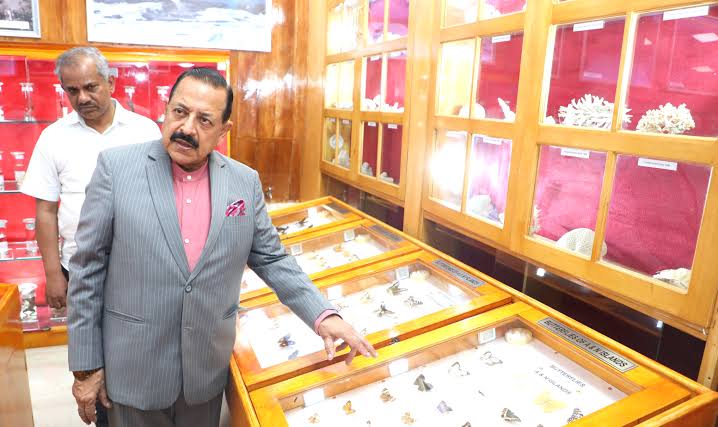
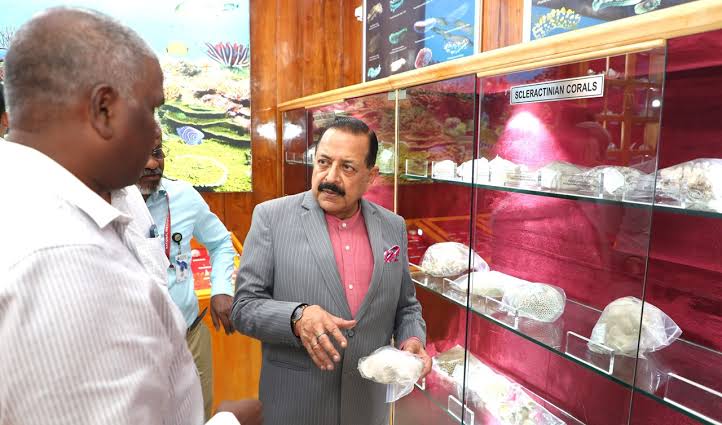
The Minister also visited the ZSI Museum, a key educational and tourist destination in the islands. The museum houses nearly 3,500 specimens across 22 faunal groups and attracts between 75,000 and 1,00,000 visitors annually.
Dr Singh appreciated the museum’s role in raising public awareness about endemic, endangered, and threatened species, noting that well-curated collections inspire scientific curiosity while strengthening conservation consciousness among citizens.
Strengthening India’s Blue Economy Vision
During the interaction, scientists briefed the Minister on ZSI Port Blair’s role as the nodal centre for India’s first National Coral Reef Research Institute. The initiative aims to enhance coral reef monitoring and marine ecosystem protection in Indian waters.
Dr Singh emphasized that strengthening scientific institutions is indispensable for realizing India’s Blue Economy vision, which seeks balanced growth through marine resources while ensuring ecological sustainability.
He called for deeper integration between scientific research, public policy, and community participation to ensure that environmental conservation and economic development advance hand in hand.