
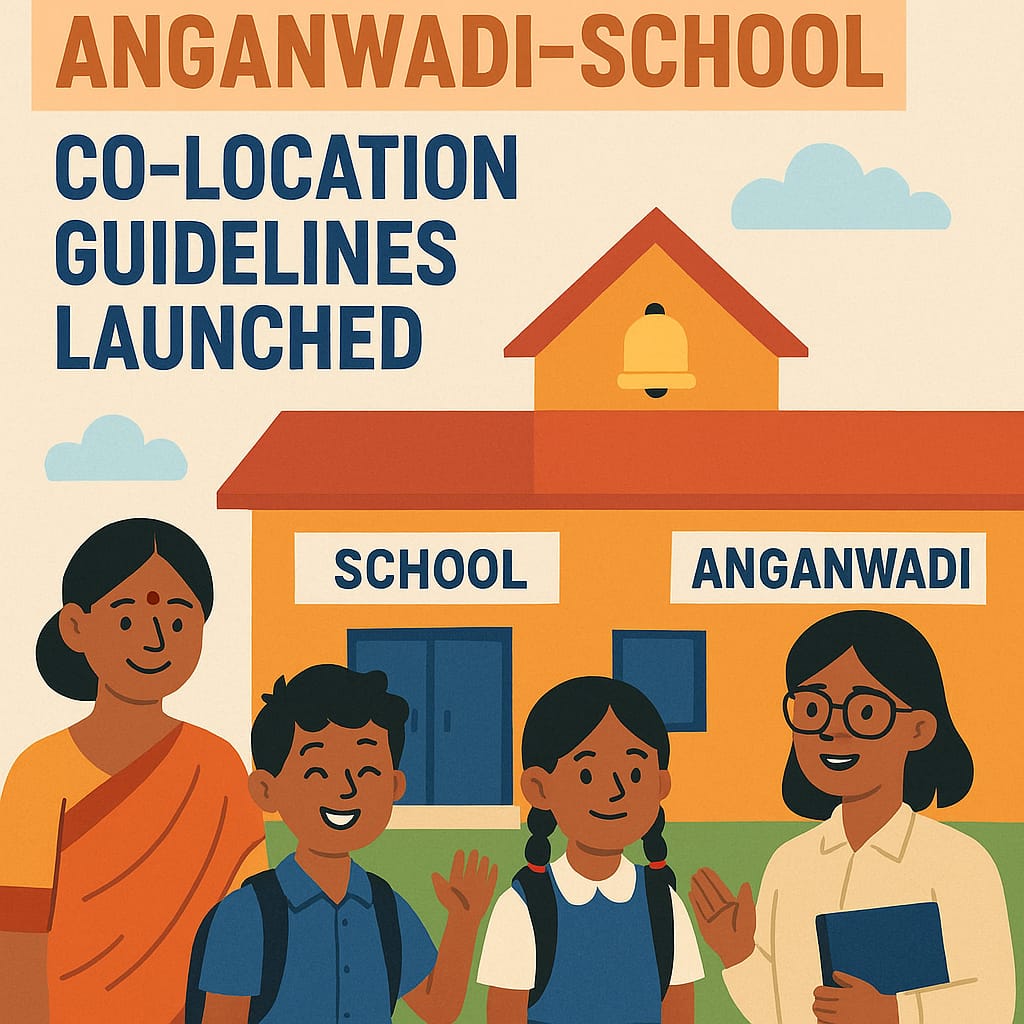

The guidelines focus on Early Childhood Care and Education (ECCE), a critical stage in child development. By integrating Anganwadi services with primary schools, the government aims to ensure that children aged 3–6 years receive holistic learning and nutrition support before transitioning into formal education.
Currently, more than 2.9 lakh Anganwadi Centres are already co-located with schools across the country. The new framework provides operational clarity for states and union territories to expand the model further, making it easier to streamline infrastructure, staffing, and curriculum integration.
A Step Towards Viksit Bharat
The co-location model is closely aligned with the National Education Policy (NEP) 2020, which emphasizes foundational literacy and numeracy. By bringing together early childhood services and primary education under one roof, the initiative reduces duplication of efforts and ensures children are better prepared for school learning outcomes.
Union Minister Annpurna Devi highlighted that the move is not just about physical infrastructure but about seamless service delivery. She stressed that integration will help in improving nutritional services, health check-ups, and early learning for children. Minister Dharmendra Pradhan added that the initiative will create an enabling environment for children to transition smoothly into the school system.
Implementation at the State and UT Level
Under the new guidelines, states and UTs will be encouraged to expand co-location by identifying suitable school campuses for Anganwadi integration. The model provides flexibility for local adaptation while ensuring adherence to national standards.
Officials noted that the co-location strategy will also improve resource utilization by sharing classrooms, playgrounds, and facilities between schools and Anganwadis. Teachers and Anganwadi workers will benefit from joint training modules, ensuring a more coordinated approach to early childhood education.
Looking Ahead
Experts believe that scaling up co-location will be vital for addressing challenges in rural and underserved areas. The guidelines offer a structured pathway to reduce dropouts, enhance nutritional outcomes, and boost the participation of young children in learning activities.
As India works towards becoming a knowledge-driven economy, initiatives like this are seen as cornerstones of human capital development. By integrating care and education at the foundational stage, the government hopes to equip the next generation with the skills and support needed for lifelong learning.