
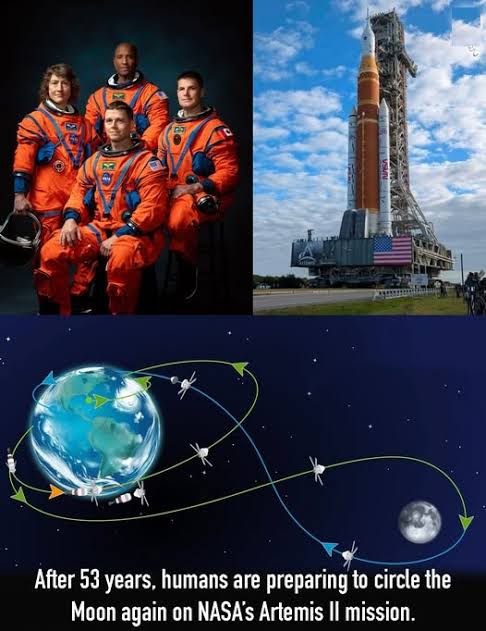

Artemis II is designed to replicate the pioneering journey of Apollo 8 in 1968, when humans first orbited the Moon and witnessed Earth rising above the lunar horizon. That iconic moment reshaped how humanity viewed its place in the universe.
The upcoming mission will carry four astronauts aboard NASA’s Orion spacecraft, sending them farther from Earth than any human crew has travelled before. The flight will not land on the Moon but will circle it, testing critical systems needed for future landings.
The Crew and the Mission Goals
The Artemis II crew includes NASA astronauts Reid Wiseman, Victor Glover and Christina Koch, along with Canadian Space Agency astronaut Jeremy Hansen. The mission will make history by including the first woman and the first African American to orbit the Moon, as well as the first non-American astronaut to undertake the journey.
The primary objective is to test the performance of the Orion crew module, life-support systems, navigation, communications and emergency procedures in deep space. These tests are essential before astronauts attempt a lunar landing later this decade.
How Artemis Differs from Apollo
While Orion’s cone-shaped design resembles the Apollo command module, the technology inside represents decades of advancement. Modern flight computers are vastly more powerful, redundant and reliable, ensuring higher safety standards for astronauts.
The spacecraft is also larger, allowing astronauts space to move, exercise and manage basic needs during the nearly ten-day mission. The European-built service module will provide propulsion, electricity, water and oxygen, using solar panels rather than fuel cells.
Powerful Rocket and Global Cooperation
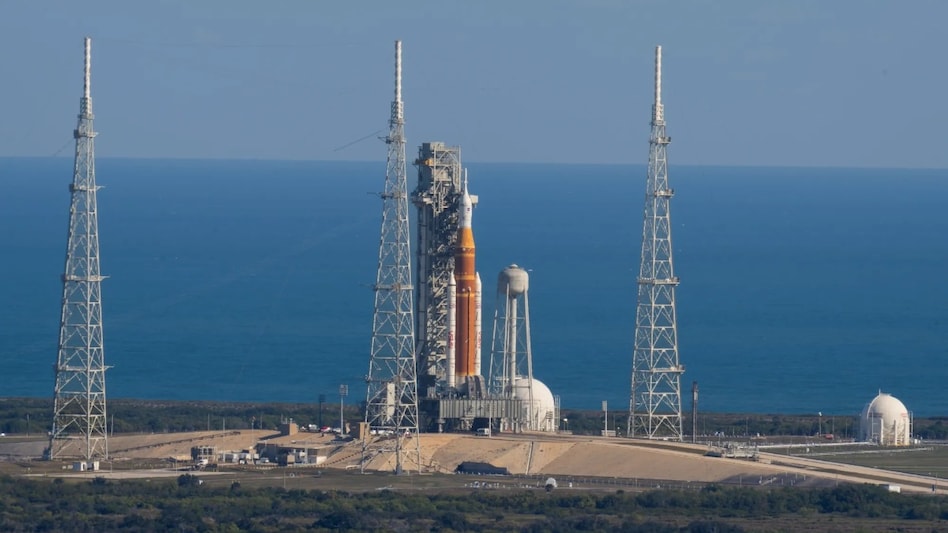
Artemis II will launch atop NASA’s Space Launch System (SLS), the most powerful rocket ever built. Though shorter than the Saturn V used during Apollo, the SLS produces even greater thrust, enabling heavier payloads and safer missions.
The programme also reflects growing international cooperation. Europe, Canada and other partners are contributing technology, expertise and astronauts, signalling a more inclusive era of space exploration.
Why Artemis II Matters
The mission is a crucial bridge between past achievements and future ambitions. NASA plans to land astronauts near the Moon’s south pole under the Artemis III mission, no earlier than 2027, and eventually establish a sustained human presence on the Moon.
These efforts are expected to support scientific research, resource exploration and preparation for future missions to Mars. India, too, has expressed interest in international collaboration in space exploration, as highlighted by initiatives discussed on government platforms such as PIB.
A New Chapter in Human Spaceflight
Since the last Apollo astronauts walked on the Moon in 1972, human spaceflight has largely remained in low Earth orbit. Artemis II represents a decisive shift back to deep space, reviving the spirit of exploration that defined the Apollo era.
If successful, the mission will reaffirm humanity’s ability to travel beyond Earth and inspire a new generation to look toward the stars.