
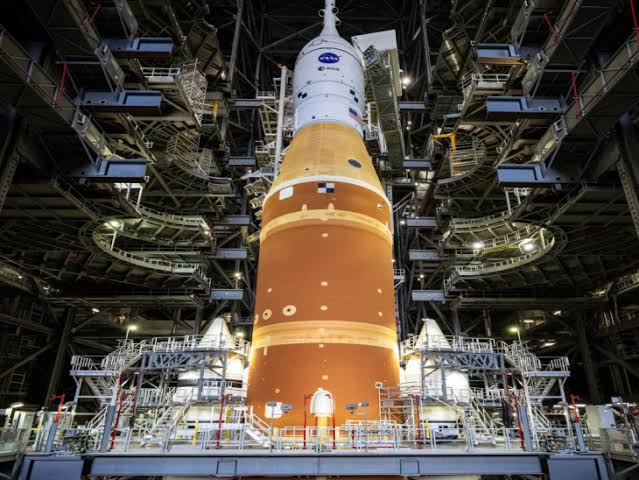
NASA’s Artemis II Reaches Launch Pad Ahead of Historic Moon Mission
The Space Launch System (SLS) rocket, integrated with the Orion spacecraft that will carry four astronauts, arrived at Launch Pad 39B late Saturday evening. The rollout signals that the mission is entering its final stages of preparation ahead of a planned lunar orbit later this year.
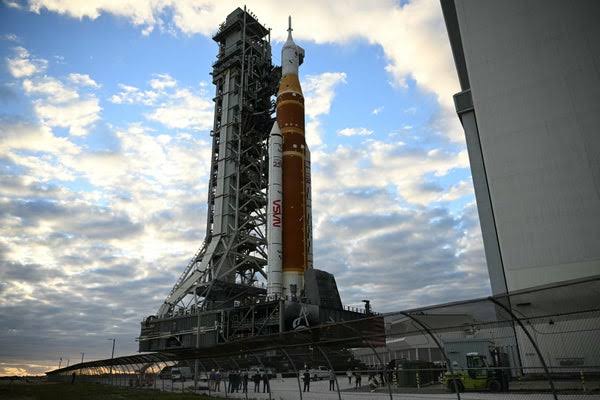

The movement of the Artemis II rocket stack from NASA’s Vehicle Assembly Building to the launch pad was itself a remarkable engineering feat. Weighing nearly 11 million pounds, the integrated rocket and spacecraft traveled a distance of about four miles.
The slow and carefully controlled journey took nearly 12 hours to complete, reflecting the scale and complexity of the mission hardware. NASA teams monitored every stage of the rollout to ensure the integrity of the rocket ahead of final checks.
Mission to Orbit the Moon
Artemis II is designed to send a crew of four astronauts on a 10-day mission that will take them into lunar orbit. After initially circling Earth, the spacecraft will travel around the Moon without landing, testing critical systems needed for future lunar landings.
The crew includes NASA astronauts Christina Koch, Victor Glover, and Reid Wiseman, along with Canadian Space Agency astronaut Jeremy Hansen. The mission marks the first time a Canadian astronaut will travel to the Moon.
Part of a Larger Vision
The Artemis program represents NASA’s long-term strategy to establish a sustained human presence on the Moon and prepare for future missions to Mars. Artemis II follows the successful Artemis I mission in 2022, which sent an uncrewed Orion spacecraft around the Moon.
NASA Administrator Jared Isaacman said the SLS and Orion systems form the foundation of future exploration architecture. He emphasized that repeated missions will allow the agency to refine spacecraft design and reduce costs over time.
Possible February Launch Window
NASA officials indicated that the Artemis II launch could take place as early as February 6, depending on technical readiness and weather conditions. The coming weeks will involve final system checks, fueling rehearsals, and safety reviews.
If successful, the mission will mark the first time astronauts travel beyond low Earth orbit since the Apollo 17 mission in 1972. The achievement is expected to inspire a new generation of scientists, engineers, and astronauts.
Global Interest in Lunar Exploration
The Artemis program has drawn worldwide attention, including interest from India’s scientific community. Experts note that international cooperation in space exploration is expanding, with agencies such as ISRO contributing to complementary lunar and deep-space research.
A Promise to Return to the Moon
NASA officials have described Artemis II as more than a technical mission, calling it a commitment to return humans to the Moon after decades. The mission is intended to demonstrate the capability to conduct safe, repeatable, and sustainable lunar journeys.
As Artemis II awaits its launch window, the spacecraft’s arrival at the launch pad stands as a powerful symbol of renewed ambition in human spaceflight.