
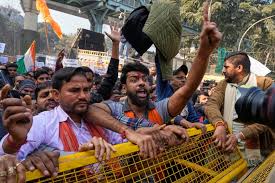
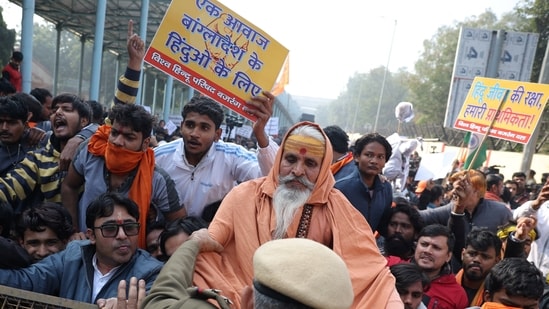

In the national capital, members of Hindu organisations including the Vishwa Hindu Parishad (VHP), Bajrang Dal, and Sarbo Bharatiya Hindi Bangali Sangathan gathered near the Bangladesh High Commission and adjoining areas. Protesters attempted to march towards the diplomatic premises, breaking through police barricades before being stopped by multi-layered security arrangements involving Delhi Police and paramilitary forces.
Demonstrators raised slogans demanding protection for Hindus in Bangladesh and accountability for the lynching. Emotional scenes unfolded as some protesters accused the Bangladeshi authorities of failing to safeguard minorities, while asserting India’s moral responsibility to raise the issue firmly at the international level.
Visa Services Suspended Amid Rising Tensions
Amid the escalating protests, Bangladesh suspended visa services at its High Commission in New Delhi and at missions in Tripura and Siliguri, citing unavoidable circumstances. The decision followed days of demonstrations near diplomatic premises and came shortly after India temporarily halted visa operations at its Chittagong mission following a security breach attempt.
Officials in New Delhi maintained that all protests were brief and effectively managed, rejecting allegations of security lapses. The Ministry of External Affairs reiterated that diplomatic missions and their staff remain fully protected under Indian law.
Diplomatic Exchanges and Official Responses
As tensions mounted, Bangladesh summoned India’s High Commissioner in Dhaka to lodge a formal protest. In response, India called in Bangladesh’s envoy and conveyed strong concerns over extremist threats to minorities and diplomatic establishments. New Delhi also urged Dhaka to ensure swift justice in the lynching of Dipu Chandra Das.
Bangladesh’s interim government hinted at reviewing the scale of its diplomatic presence in India if the situation deteriorates further. However, Indian officials dismissed reports in sections of Bangladeshi media as misleading and emphasised the need for responsible communication during sensitive times.
What Triggered the Flashpoint?
The lynching of Dipu Chandra Das in Mymensingh reportedly followed allegations of religious defamation, which minority rights groups claim were false. The incident occurred against the backdrop of political unrest in Bangladesh after the killing of a prominent activist linked to last year’s July Uprising.
The twin developments intensified public anger and brought renewed international attention to the condition of religious minorities in Bangladesh. India has consistently raised the issue of minority safety through diplomatic channels, calling for adherence to human rights and rule of law.
Broader Impact on India Bangladesh Relations
The current episode marks one of the sharpest downturns in bilateral ties in recent years. While both countries share deep historical and cultural links, repeated incidents involving minority violence have emerged as a sensitive fault line.
Experts believe sustained dialogue and transparent investigations will be crucial to prevent further escalation. India has signalled that protecting minorities and ensuring diplomatic security remain non-negotiable priorities in its engagement with Dhaka.