

Prabhas Patan, located near the confluence of history, faith, and architecture, remains one of India’s most significant heritage landscapes. Epigraphic records, copper plates, memorial stones, and architectural remnants scattered across the region narrate the story of prosperity, invasions, destruction, and revival associated with the Somnath Temple. These invaluable artefacts are preserved at the Prabhas Patan Museum, which currently operates from the ancient Sun Temple complex.
The museum safeguards remains of earlier Somnath structures destroyed during invasions, serving as enduring symbols of resilience, devotion, and cultural continuity. Together, these records establish Prabhas Patan not merely as an archaeological site but as a living chronicle of Sanatan civilisation.
The Bhadrakali Temple Inscription
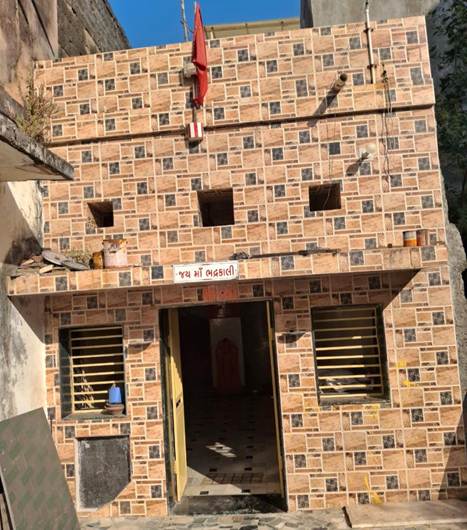
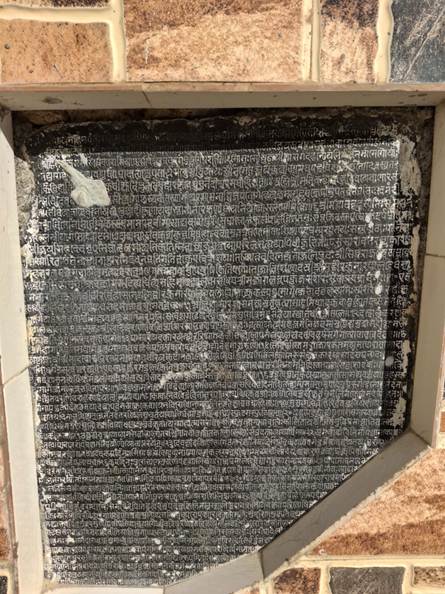
One of the most significant inscriptions lies near the old Ram Temple in Bhadrakali lane at Prabhas Patan. Embedded within the wall of the ancient Bhadrakali Temple in a residential courtyard, the inscription is preserved at the residence of Sompura Brahmin Dipakbhai Dave and protected by the State Department of Archaeology.
According to Prabhas Patan Museum Curator Tejal Parmar, the inscription dates back to 1169 CE, corresponding to Valabhi Samvat 850 and Vikram Samvat 1255. It is a eulogistic record dedicated to Param Pashupata Acharya Shriman Bhavabrihaspati, the revered spiritual preceptor of Solanki ruler Maharajadhiraj Kumarapala of Anhilwad Patan.
Chronicle of Somnath Across the Four Yugas
The inscription offers a rare narrative of Somnath’s sacred origins across the four yugas of Hindu cosmology. It records that in the Satya Yuga, Chandra, also known as Soma, constructed the temple in gold. During the Treta Yuga, Ravana rebuilt it in silver, while in the Dvapara Yuga, Lord Krishna reconstructed the shrine using wood.
In the Kali Yuga, the inscription attributes the construction of a grand stone temple to King Bhimdev Solanki, marking a defining phase in Somnath’s architectural history. This continuity underscores the temple’s spiritual permanence despite repeated destruction.
Kumarapala and the Solanki Renaissance
Historical evidence confirms that Bhimdev Solanki built the fourth Somnath temple upon earlier remains, while the fifth major reconstruction was undertaken by Kumarapala in 1169 CE at the same sacred site. Under Solanki patronage, Prabhas Patan evolved into a prominent centre of religion, literature, and temple architecture.
The reign of Siddharaj Jaysinh, known for administrative justice, and Kumarapala, revered for devotion and reform, elevated Somnath into a powerful symbol of Gujarat’s Golden Age. The Bhadrakali inscription stands as written proof of this renaissance.
Sanatan Culture Etched in Stone
Beyond historical documentation, the Bhadrakali inscription reflects the philosophical depth of Sanatan Dharma. Teachings of devotion, resilience, and cultural self-respect resonate through its verses, affirming the spiritual identity of Prabhas Patan.
Experts believe such inscriptions are crucial in understanding India’s civilisational narrative, particularly how faith and culture endured invasions and political upheavals without losing continuity.
Preservation and Contemporary Relevance
Today, the Prabhas Patan Museum continues to preserve inscriptions and remains that illuminate Somnath’s past for scholars, pilgrims, and future generations. These artefacts serve as reminders that heritage is not confined to ruins but lives through collective memory and preservation.
As India places renewed emphasis on cultural conservation, sites like Prabhas Patan reaffirm the timeless relevance of heritage in shaping national identity.