
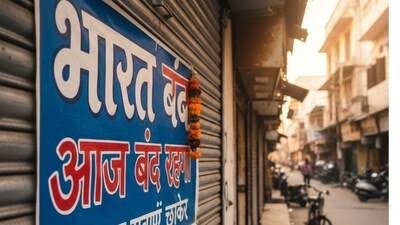
New Delhi: A nationwide Bharat Bandh called by a joint platform of trade unions and farmer groups has disrupted several public services across India on Wednesday, February 12. While essential services are functioning, banking operations, state transport and certain government offices are witnessing significant impact in multiple states.

The strike has been organised by a coalition of 10 central trade unions, supported by farmer bodies and agricultural labour associations. The groups allege that the Centre’s economic and labour policies are “anti-worker” and “anti-farmer,” and demand stronger safeguards for workers’ rights and rural employment.
Union representatives have claimed that nearly 30 crore workers may participate in the protest nationwide. They say mobilisation efforts have reached more than 600 districts, surpassing previous strike actions held last year.
The Samyukt Kisan Morcha (SKM) has extended support to the bandh, particularly focusing on rural distress and the implementation of employment schemes such as MGNREGA. For more information on MGNREGA provisions, readers can visit the official government portal at nrega.nic.in.
What Is Likely to Be Affected?
Several public-facing sectors are expected to face disruption, depending on local participation and administrative responses.
- Public sector banks and insurance offices
- State-run bus services in select states
- Government offices and public sector undertakings
- Industrial units and manufacturing hubs
- Coal and steel production units in protest-heavy regions
- Rural employment works in areas where worker participation is high
Banking services, especially in public sector institutions, may see delays in transactions and limited staff attendance. Customers are advised to rely on digital banking services wherever possible.
State transport services in parts of Odisha, Assam and other states are also reporting partial suspension of bus operations. Commuters have been urged to check local advisories before planning travel.
What Will Remain Open?
Despite the widespread strike call, essential services are largely operational. Authorities have reiterated that emergency and healthcare services will not be disrupted.
- Hospitals and emergency medical services
- Ambulance services
- Pharmacies and essential supply stores
- Milk distribution and daily essentials
- Metro rail services (subject to local decisions)
- Private offices and IT companies in many regions
- Schools and colleges, depending on state-level decisions
In metropolitan cities, metro services are functioning normally unless local authorities issue specific restrictions. Private sector offices are operating in several urban centres, though attendance may vary.
Political and Administrative Response
Trade union leaders have asserted that participation will be significant even in states governed by parties not aligned with the protest groups. However, no official nationwide shutdown order has been issued by the Centre.
State administrations are monitoring the situation to maintain law and order. Police deployment has been increased in sensitive districts to prevent any untoward incidents.
Citizens are encouraged to follow verified updates from official government channels such as the Press Information Bureau (pib.gov.in) and respective state authorities.
Advisory for Citizens
People planning travel or official work are advised to check with local authorities or service providers before stepping out. Digital services, online banking and private transport options may help minimise inconvenience.
The Bharat Bandh highlights ongoing debates over labour reforms, agricultural concerns and employment schemes. While disruptions are visible in several districts, essential services remain safeguarded to ensure public safety and continuity.