
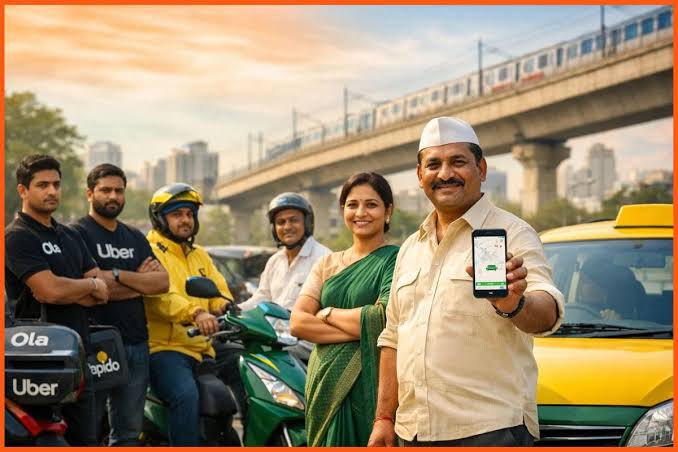
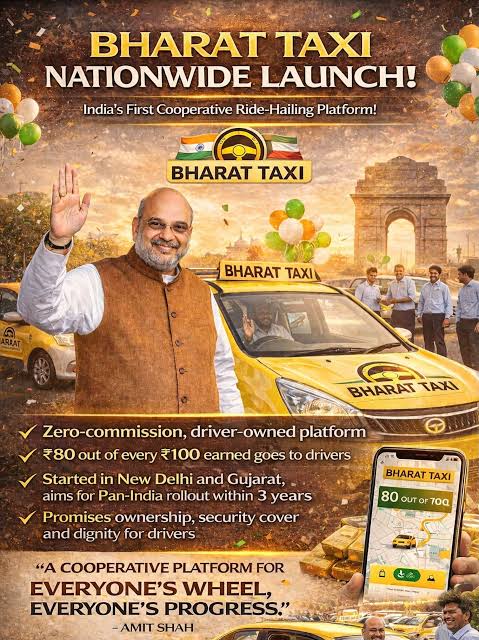

Unlike conventional ride-hailing platforms driven by private investment and high commissions, Bharat Taxi operates on a cooperative ownership model. Drivers, referred to as “Sarathis,” are not just service providers but stakeholders who directly benefit from the platform’s growth and revenue.
The platform follows a zero-commission structure, ensuring that profits are distributed directly among drivers. This approach is designed to provide sustainable incomes, financial dignity, and long-term economic security, particularly for those who rely on driving as their primary livelihood.
Legal Framework and Institutional Backing
Bharat Taxi is registered under the Multi-State Cooperative Societies Act, 2002, providing it with a strong legal and institutional foundation. The cooperative was formally established on June 6, 2025, by eight national-level institutions working in the cooperative sector.
This institutional backing reflects the Ministry of Cooperation’s commitment to building scalable, professionally managed cooperatives that can compete with private players while retaining their social and democratic character.
Current Operations and User Base
As of now, Bharat Taxi services are operational in key urban and pilgrimage centres. In the National Capital Region, the platform is active in Delhi, Gurugram, and Noida. In Gujarat, services are available in Ahmedabad, Rajkot, Somnath, and Dwarka.
The platform has registered over 9.9 lakh customers and more than three lakh drivers. Together, they have completed nearly 2.9 lakh rides, indicating steady adoption and trust among both riders and Sarathis.
Transparent Pricing and No Hidden Charges
One of the key differentiators of Bharat Taxi is its transparent pricing policy. Currently, no convenience fees, platform charges, or commissions are levied on either riders or drivers through the app.
However, at airport prepaid booths operated by Bharat Taxi, a modest 7 percent service charge is applied to fares. This charge is used solely to meet operational expenses, ensuring transparency and sustainability without burdening drivers.
Focus on Social Security and Welfare
Bharat Taxi places strong emphasis on the social security of Sarathis. Drivers are supported through health insurance, accident insurance, retirement savings mechanisms, and a dedicated driver support system designed to address emergencies and grievances.
The platform operates help centres at seven key locations in Delhi and provides rapid emergency assistance along with verified ride data. Importantly, drivers are free to work on other platforms as well, with no exclusivity restrictions imposed.
Promoting Women Empowerment
Women empowerment is a key component of Bharat Taxi’s cooperative vision. Through initiatives such as “Bike Didi,” the platform actively encourages women to participate in the mobility sector as drivers.
More than 150 women drivers have already joined Bharat Taxi under this initiative, contributing to financial independence and greater representation of women in urban transport services.
Nationwide Expansion Roadmap
Looking ahead, Bharat Taxi has outlined an ambitious plan for phased nationwide expansion, aiming to establish a presence across all states and major cities by 2029. Dedicated help centres are planned in every state to support drivers and ensure service quality.
The platform also plans deeper integration with India’s digital public infrastructure to enhance efficiency, transparency, and scalability. These efforts are expected to strengthen the cooperative-driven mobility ecosystem and offer a viable, indigenous alternative to global aggregator platforms.