 Five-Module Space Station Plan
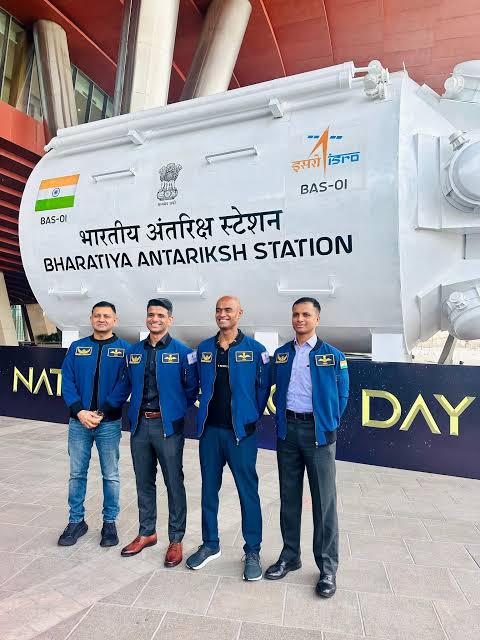
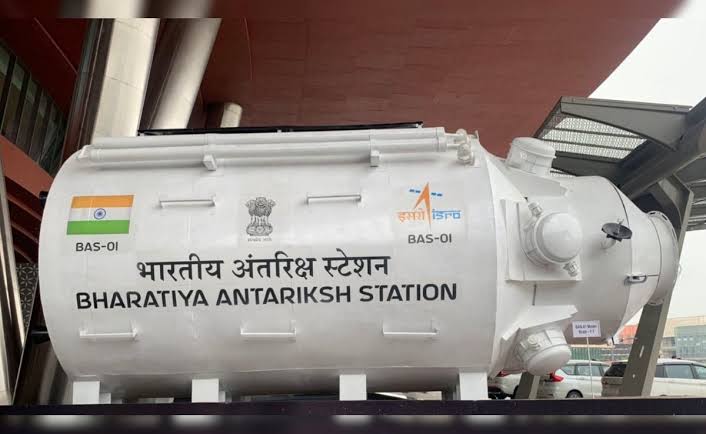
ISRO has finalised the overall configuration of the Bharatiya Antariksh Station, which will comprise five modules. The proposed design has been reviewed by a National Level Review Committee.
In September 2024, the Union Cabinet approved the development and launch of the first module, BAS-01, by 2028. This approval came as part of a revision in the scope of the Gaganyaan human spaceflight programme.
Currently, overall system engineering for BAS-01 and technology development of its various subsystems are progressing at ISRO centres and units across the country.
Platform for Microgravity Research
The Bharatiya Antariksh Station is envisioned as a long-term platform for conducting microgravity research and scientific studies. It will support experiments in life sciences, medicine and other advanced research domains.
By enabling sustained human presence in Low Earth Orbit (LEO), BAS will open new avenues for scientific exploration and technology demonstration.
The station’s advanced life support systems and related technologies are designed to enable long-duration human habitation in space.
Boost to Human Space Exploration
BAS is expected to play a critical role in strengthening India’s human space exploration capabilities beyond Low Earth Orbit. The station will act as a testing and validation platform for technologies required for deeper space missions.
Officials indicated that the project will have potential socio-economic benefits, including advancements in medical research, material science and space-based technology applications.
The initiative aligns with India’s long-term space ambitions under Space Vision 2047, which aims to position the country as a major global space power.
Funding Under Expanded Gaganyaan Programme
The budgetary allocation for precursor missions, development and launch of BAS-01 has been incorporated within the revised scope of the Gaganyaan programme.
The programme received additional funding approval from the Union Cabinet in September 2024, enhancing the total financial outlay to ₹20,193 crore.
This funding will cover critical development phases, technology demonstrations and infrastructure necessary for the space station’s first module.
No International Technical Collaboration Yet
The government clarified that, at present, there are no specific technical collaboration agreements with other space agencies or organisations for the Bharatiya Antariksh Station.
The development is currently being pursued indigenously by ISRO, reflecting India’s emphasis on self-reliance in advanced space technologies.
With the BAS-01 module targeted for 2028, India’s journey toward establishing its own space station marks a significant milestone in the country’s expanding space programme.