
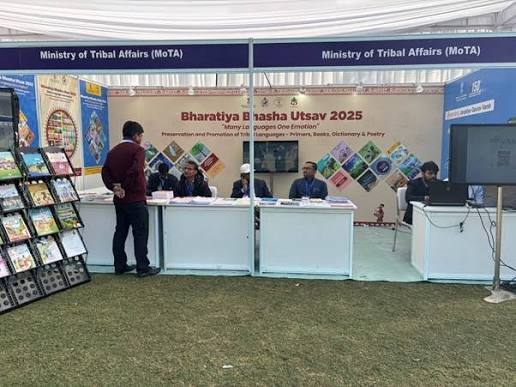

MoTA’s exhibition stall presented an array of tribal language materials aimed at preservation and education. Visitors viewed primers, storybooks, poetry collections, dictionaries and research documents compiled by TRIs from Jharkhand, Odisha and Gujarat. The publications reflect decades of fieldwork and document both lexical resources and oral traditions unique to local tribal communities.
These materials are not merely archival; they are tools for revitalisation. Teachers, researchers and activists at the stall discussed how primers support early language learning in Eklavya Model Residential Schools (EMRS) and local classrooms, while dictionaries and storybooks help standardise scripts and preserve folklore for younger generations.
Adi Vaani Demo: Bridging Technology and Tradition
A major highlight was the live demonstration of Adi Vaani by an IIT Delhi team. Built in collaboration with MoTA, Adi Vaani is an AI-driven platform designed to translate text and speech between Hindi/English and selected tribal languages in real time. It also offers interactive learning modules and archives oral narratives, songs and customary knowledge.
In its first phase, Adi Vaani supports Santali and Kui (Odisha), Bhili (Madhya Pradesh), Mundari (Jharkhand), Gondi (Chhattisgarh) and Garo (Meghalaya). The app’s live demo drew visitors who tested speech-to-text translation and playback of recorded folklore, illustrating how technology can broaden access to previously marginalised languages.
Educational and Cultural Programs Energise the Festival
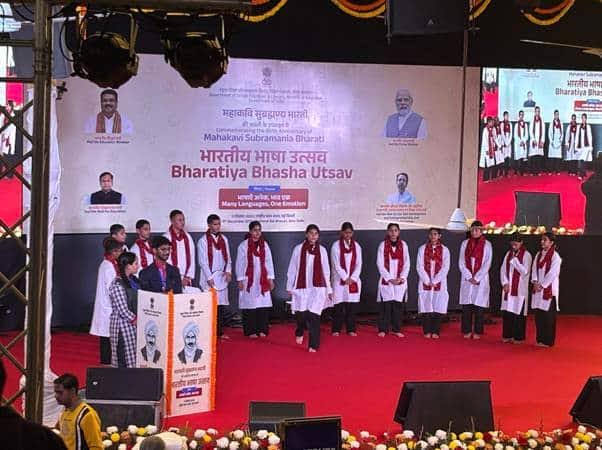
Beyond displays and demos, Bharatiya Bhasha Utsav featured cultural performances by students from across the country. EMRS Kalsi (Uttarakhand), under the NESTS programme, presented a vibrant dance and a socially resonant nukkad natak that captured local traditions and contemporary concerns of tribal youth.
In a unifying moment, students performed “Vande Mataram” in 22 Indian languages — a symbolic gesture underscoring the festival’s message that linguistic diversity strengthens national unity. The performances highlighted the critical role of schools and cultural programmes in passing language and identity from one generation to the next.
Why Tribal Language Preservation Matters
Tribal languages carry unique worldviews, ecological knowledge, ritual practices and oral histories. Preserving them safeguards community identity and builds inclusive education systems. MoTA’s participation at the festival emphasised the twin approach of documentation and modern dissemination combining TRIs’ scholarly work with digital tools like Adi Vaani to reach broader audiences.
The Ministry underscored that language preservation contributes to improved learning outcomes, cultural resilience and social inclusion. By integrating tribal languages into school primers and digital tools, policymakers aim to reduce early-school dropouts and enhance cultural pride among tribal children.
Next Steps: Expansion and Community Feedback
MoTA noted that Adi Vaani’s expansion will be guided by regional priorities and feedback from speech communities. The app’s roadmap includes adding more languages, integrating healthcare and educational modules, and strengthening community-driven content creation to ensure authenticity and local ownership.
TRIs will continue to collaborate with state governments, educators and civil society to adapt the printed materials for classroom use and digital distribution. MoTA also highlighted plans to use the Adi Vaani platform for training teachers and recording elders’ narratives as part of ongoing preservation efforts.
Event Partnerships and Further Reading
Bharatiya Bhasha Utsav 2025 was organised by the Ministry of Education on the birth anniversary of Mahakavi Subramania Bharati. The event brought together government agencies, research institutions and students to celebrate multilingualism.