

The decision marks a symbolic and administrative shift from colonial-era infrastructure to modern governance spaces. Constructed during British rule, the North and South Blocks long served as the epicentre of India’s executive functioning, including housing the Prime Minister’s Office in South Block since Independence.
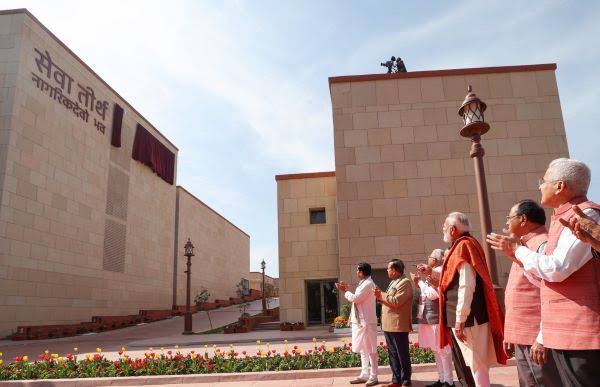
On 13 February 2026, Prime Minister Narendra Modi dedicated the new Prime Minister’s Office, now named ‘Seva Teerth’, to the nation. The Cabinet meeting held in South Block was the last to take place in the historic chamber.
A Chamber That Witnessed History
Over decades, the South Block complex has seen defining moments in India’s journey — from the trauma of Partition to critical wartime decisions and the challenges of the Emergency. It has also been the site of policy deliberations that guided India’s economic reforms and technological evolution.
Cabinets led by successive Prime Ministers, beginning with Jawaharlal Nehru and continuing through 16 leaders up to Prime Minister Narendra Modi, have shaped national policy within these walls.
Era of Reforms and Governance Transformation
In the past decade, South Block became the command centre for major structural reforms. Initiatives such as Direct Benefit Transfer (DBT), Swachh Bharat Abhiyan, Digital India, and the rollout of the Goods and Services Tax (GST) were steered from here.
Key national decisions, including the abrogation of Article 370, legislation against triple talaq, and strategic security responses like surgical and air strikes, were also shaped during Cabinet deliberations in this complex.
The government described the shift as an extension of the philosophy of “Minimum Government, Maximum Governance,” reflecting a move toward efficient, technology-driven and citizen-centric administration.
Why Seva Teerth and Kartavya Bhavans?
the transition is intended to provide a modern, environmentally sustainable, and technologically advanced workspace. The new facilities aim to enhance productivity and reinforce the ethos of public service.
The symbolic renaming underscores a cultural shift from a colonial mindset to a service-oriented governance model. Officials described the move as a step toward realizing the vision of a ‘Developed India’ aligned with the nation’s long-term aspirations.
Yuge Yugeen Bharat National Museum
As part of the decision, North and South Blocks will be integrated into the proposed ‘Yuge Yugeen Bharat’ National Museum. The museum is envisioned as a grand tribute to India’s civilizational heritage spanning thousands of years.
The project aims to preserve the architectural grandeur of the historic buildings while transforming them into a cultural and educational hub. The museum will narrate India’s journey from ancient civilizations to modern nationhood, linking past achievements with future aspirations.
A Symbolic Step Forward
The Cabinet resolution expressed gratitude to Prime Minister Narendra Modi for what it termed visionary leadership in redefining the centre of governance. The transition from North and South Blocks to Seva Teerth represents not just a relocation of offices but a broader narrative shift from colonial legacy to self-confident nationhood.
As India moves toward its long-term developmental milestones, the transformation of these iconic structures into a national museum signals an attempt to preserve history while embracing the future.