
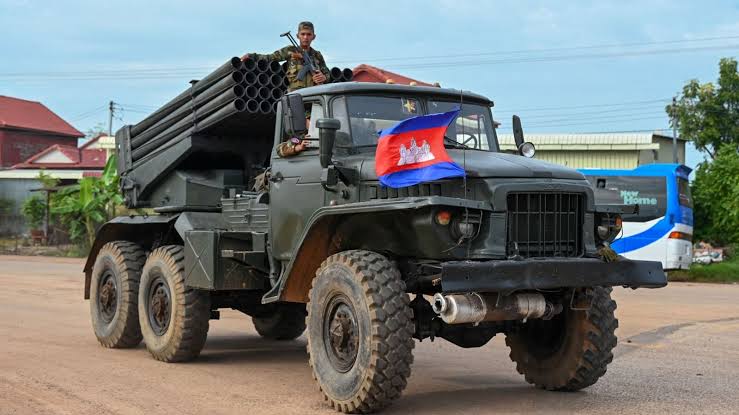
The border between Thailand and Cambodia has turned into a conflict zone, with heavy artillery fire, civilian casualties, and rising international concern. As violence escalates, Cambodia has called for an immediate ceasefire, while Thailand signals openness to peace talks, possibly mediated by Malaysia.
Clashes Spark Urgent Calls for Peace
For the second consecutive day, border clashes between Thailand and Cambodia intensified. According to Cambodia’s UN envoy Chhea Keo, Phnom Penh is demanding an “unconditional ceasefire” and a diplomatic solution through the UN or ASEAN. Thailand responded cautiously, saying no formal proposal had been received yet.
By Friday afternoon, Thai authorities reported the fighting had started to slow down. However, the damage was already significant.


The violence, centered around the disputed border near ancient temples, has killed at least 19 people in Thailand — most of them civilians. Cambodia reported 13 deaths, with dozens more wounded on both sides. The Thai health ministry said over 138,000 residents have been evacuated from high-risk areas.
Malaysia Offers to Mediate Peace Talks
Malaysia, which currently chairs the ASEAN regional bloc, has stepped up with an offer to mediate. Malaysian Prime Minister Anwar Ibrahim said both sides had verbally agreed to a ceasefire and troop withdrawal, but required more time to implement the terms.
“We urge both Thailand and Cambodia to open space for peaceful dialogue,” Anwar said, according to Bernama, Malaysia’s national news agency.
Thailand Warns of Possible Escalation
Acting Thai Prime Minister Phumtham Wechayachai issued a stern warning. “If this continues, it could develop into war,” he said. So far, Thailand has declared martial law in eight border districts.
The Thai army accused Cambodian forces of firing BM-21 rocket systems, heavy artillery, and targeting civilian infrastructure — including a hospital and petrol station. Cambodia has denied initiating attacks, pointing to its lack of an air force and smaller military size.
UN Security Council Weighs In
During a closed-door UN Security Council meeting, both nations were urged to show maximum restraint. Cambodia’s representative asked, “How can a small nation attack a country with an army three times its size?” The envoy reiterated that Cambodia seeks peace, not escalation.
Root of the Conflict: A Border Dispute
The root cause is an old, unresolved dispute over the 800-kilometer shared border. Tensions reignited after a landmine explosion on Wednesday injured five Thai soldiers. The next day, fighting erupted in six zones, including near two ancient Hindu temples that are sacred to both countries.
International Attention Intensifies
The global community is closely watching. The conflict endangers not only regional peace but also Southeast Asia’s booming tourism industry. Thailand and Cambodia are among the region’s most visited destinations, and prolonged conflict could deeply impact the sector.
What’s Next?
The coming days will be critical. With both nations appearing willing — if cautiously — to talk, the role of Malaysia and ASEAN could be pivotal. A peaceful solution would not only save lives but also strengthen ASEAN’s role in conflict resolution.
The world now waits to see whether diplomacy will prevail — or if this flare-up spirals into a broader war.